Recurrences & the Master Theorem
A recursive algorithm's cost is itself defined recursively — mergesort's cost on n elements is twice its
cost on n/2 elements, plus the merge. That self-reference is exact but not directly useful: nobody
reads off T(n) = 2T(n/2) + Θ(n) by eye. Solving a recurrence means turning that
self-referential definition into a closed form with no T on the right-hand side.
Two tools do this. A recursion tree makes the substitution visible: draw every recursive call as a
node, write the non-recursive work done at that node, and sum by level. It always works, but requires
summing a series, which can be fiddly. The master theorem shortcuts the same computation for the
common shape T(n) = aT(n/b) + f(n) by reducing the sum to one comparison, at the cost of only applying
to that shape. When a recurrence does not fit — non-constant coefficients, unequal subproblem sizes, a
subtractive rather than divisive step — the recursion tree, or the more general substitution method,
is what is left.
The comparison the master theorem makes is between two competing costs: n^(log_b a), the total size of
all the leaves of the recursion tree combined, and f(n), the work done per call outside the recursive
calls themselves. Whichever one dominates decides the total; a tie multiplies by a log factor.
Core Concepts
| Term | Meaning |
|---|---|
| a | Number of subproblems per call |
| b | Factor each subproblem shrinks by (subproblem size = n/b) |
| f(n) | Work done outside the recursive calls — dividing, combining |
| n^(log_b a) | The "leaf cost" — total size of all leaves in the recursion tree |
| Recursion tree | Every call as a node, work-per-node written in, summed level by level |
| Substitution method | Guess a closed form, prove it by induction — the general fallback |
Mechanism
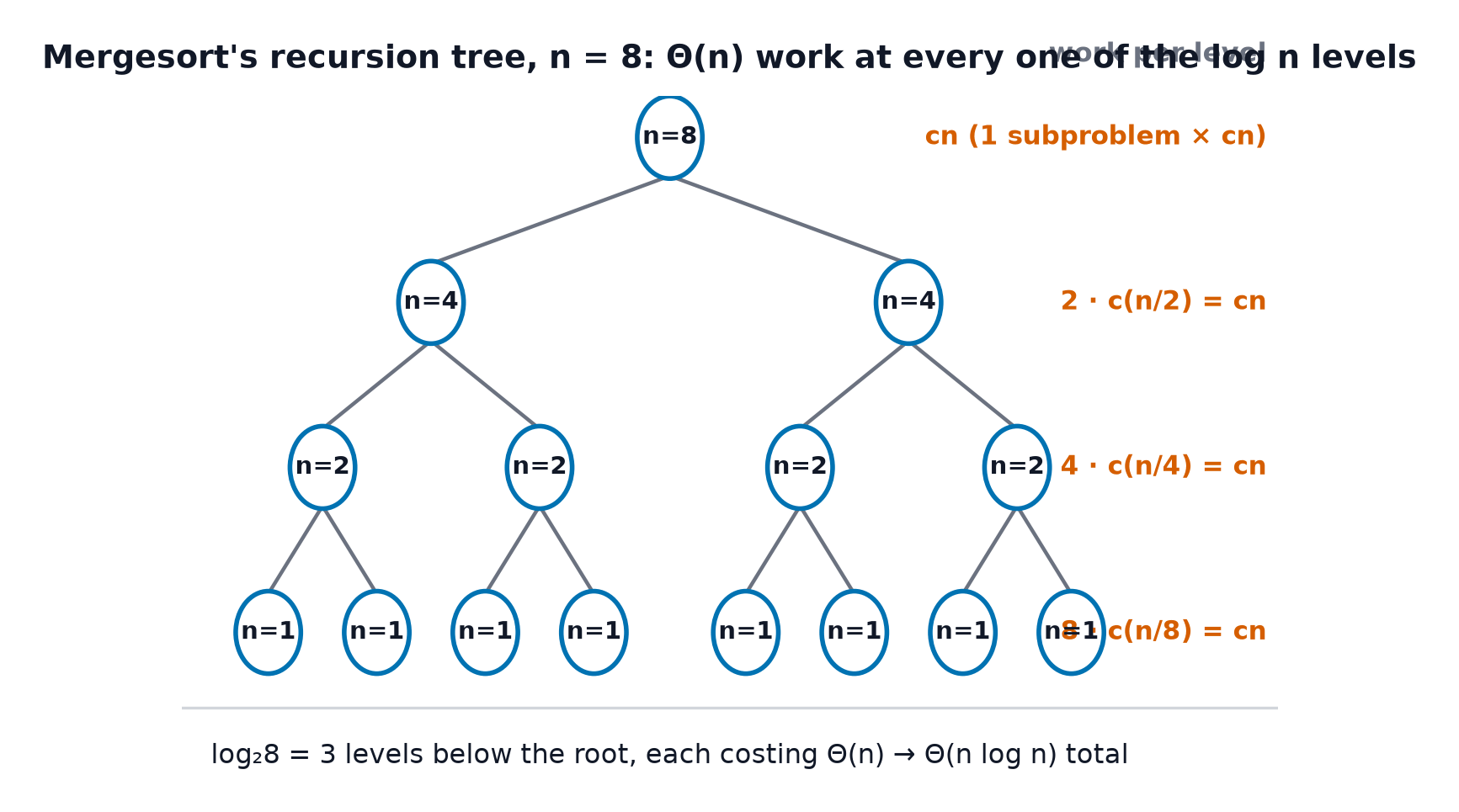
Building the tree by hand: mergesort, T(n) = 2T(n/2) +
level 0:  n=8                              work = c·8   = 8c
level 1:  n=4      n=4                     work = 2·c·4 = 8c
level 2:  n=2  n=2  n=2  n=2                work = 4·c·2 = 8c
level 3:  n=1..n=1 (8 leaves)               work = 8·c·1 = 8c

levels = log2(8) = 3  →  4 levels total (0..3)
total work = 4 levels × 8c = Θ(n log n)
Each level costs the same, — twice as many subproblems, each half the size, and the product
(number of subproblems) × (size of each) stays n at every level. There are log₂n levels below the
root, so the total is n work repeated log₂n times: .
The three master theorem cases, exact conditions
For T(n) = aT(n/b) + f(n) with a ≥ 1 and b > 1 constants, compare f(n) against n^(log_b a):
| Case | Condition | Result |
|---|---|---|
| 1 — leaves dominate | f(n) = O(n^(log_b a − ε)) for some constant ε > 0 | T(n) = Θ(n^(log_b a)) |
| 2 — tie, log factor | f(n) = Θ(n^(log_b a) · logᵏ n) for some constant k ≥ 0 | T(n) = Θ(n^(log_b a) · log^(k+1) n) |
| 3 — top level dominates | f(n) = Ω(n^(log_b a + ε)) for ε > 0, and the regularity condition a·f(n/b) ≤ c·f(n) holds for some c < 1 and all large n | T(n) = Θ(f(n)) |
Case 1 needs a polynomially smaller f(n), not merely asymptotically smaller — f(n) = n^(log_b a) / log n fails case 1 despite being smaller, because the gap is only logarithmic, not polynomial. Case 3
additionally requires the regularity condition, which fails for functions that oscillate; without it the
recursive cost is not guaranteed to be dominated by the top level.
Applying it: mergesort and Karatsuba
Mergesort, T(n) = 2T(n/2) + Θ(n): a = 2, b = 2, so n^(log_b a) = n^(log₂2) = n¹. f(n) = Θ(n)
matches n^(log_b a) · log⁰n exactly — case 2 with k = 0 — giving T(n) = Θ(n log n), confirming
the tree above.
Karatsuba multiplication, T(n) = 3T(n/2) + Θ(n): three half-size recursive multiplications instead
of the naive four, each with work to combine. a = 3, b = 2, so n^(log_b a) = n^(log₂3) ≈ n^1.585. f(n) = $Θ(n)$ = $O(n^{1.585 - ε})$ for, say, ε = 0.5 — case 1 — giving
T(n) = Θ(n^log₂3) ≈ Θ(n^1.585), beating the naive schoolbook algorithm.
Binary search, T(n) = T(n/2) + Θ(1): only one subproblem, so a = 1, b = 2, and
n^(log_b a) = n^(log₂1) = n⁰ = 1. f(n) = Θ(1) = Θ(n⁰ · log⁰n) matches exactly — case 2 with
k = 0 — giving T(n) = Θ(log n), the familiar bound reached here from the same theorem rather than
by direct halving-argument.
The substitution method, worked: confirming mergesort by induction
The master theorem is a shortcut; substitution is the general method it shortcuts. Guess
T(n) ≤ c·n·log₂n for mergesort's T(n) = 2T(n/2) + n (dropping the Θ's constant to a concrete n
for the arithmetic), then prove the guess by induction.
inductive hypothesis: T(n/2) ≤ c·(n/2)·log₂(n/2), assumed true for smaller inputs

T(n) = 2T(n/2) + n
     ≤ 2 · c·(n/2)·log₂(n/2) + n            (substitute the hypothesis)
     = c·n·log₂(n/2) + n
     = c·n·(log₂n − 1) + n                  (log₂(n/2) = log₂n − 1)
     = c·n·log₂n − c·n + n
     = c·n·log₂n − n·(c − 1)
     ≤ c·n·log₂n                            (holds whenever c ≥ 1)

base case: T(1) = 0 ≤ c·1·log₂1 = 0  ✓ (log₂1 = 0, so c ≥ 1 is checked at the next base case, n = 2)
Picking any c ≥ 1 and checking a small base case makes the induction go through, confirming
T(n) = O(n log n) — the same answer the master theorem's case 2 gave in one line. The trade is exactly
what the mechanism section promised: substitution needs a correct guess and an inductive proof;
the master theorem needs only that the recurrence matches its form.
Where the theorem does not apply
T(n) = 2T(n/2) + n/log n: here n^(log_b a) = n, and f(n) = n/log n is asymptotically smaller
than n but not by a polynomial factor — no ε > 0 makes n/log n = O(n^(1−ε)). This falls in the gap
between cases 1 and 2, and the master theorem gives no answer. (It can still be solved — by the
Akra–Bazzi method, a generalisation the master theorem is a special case of — but that is outside the
scope here.) Subtractive recurrences such as T(n) = T(n−1) + Θ(n) (insertion sort's shape) are outside
the theorem entirely, since it is not divisive; those are solved directly by summing the series.
- Python
- C++
import math


def leaf_cost_exponent(a, b):
    """n^(log_b a): the exponent that decides which master-theorem case applies."""
    return math.log(a) / math.log(b)


mergesort_exp = leaf_cost_exponent(2, 2)
karatsuba_exp = leaf_cost_exponent(3, 2)
assert abs(mergesort_exp - 1.0) < 1e-9          # f(n)=Θ(n) ties it — case 2
assert abs(karatsuba_exp - 1.5849625007) < 1e-6  # f(n)=Θ(n) is polynomially smaller — case 1
#include <cassert>
#include <cmath>

double leaf_cost_exponent(double a, double b) {
    return std::log(a) / std::log(b);   // n^(log_b a)
}
Practical Usage
Reach for the master theorem first on any balanced divide-and-conquer routine — it answers in one line what a tree takes several. Reach for the recursion tree, or full substitution with induction, whenever the recurrence has non-constant coefficients (randomised quickselect's expected recurrence), unequal subproblem sizes, or extra additive terms the master theorem's exact form does not admit. CLRS's "Akra–Bazzi" note and Sedgewick & Wayne's tree-based treatment are the two standard fallbacks once the theorem does not apply.
Edge Cases & Pitfalls
- Skipping the polynomial-gap check. "f(n) is asymptotically smaller, so case 1" is wrong unless
the gap is polynomial (
n^(log_b a − ε)) — a logarithmic gap, as inn/log nabove, satisfies neither case 1 nor case 2. - Forgetting the regularity condition in case 3.
f(n)dominating is necessary but not sufficient; withouta·f(n/b) ≤ c·f(n), the top-level cost is not guaranteed to dominate the total. - Using the theorem on a non-matching shape.
T(n) = T(n−1) + T(n−2) + Θ(1)(naive Fibonacci) is additive-subtractive, not divisive — the master theorem gives no answer, and the correct closed form () comes from solving the linear recurrence directly, not from this theorem. - Treating
aorbas non-constant. Randomised quickselect's recurrence has a subproblem size that varies with the pivot, which is why its bound needs an expectation argument, not a direct master-theorem application.
Comparisons
| Method | Handles | Effort | Gives no answer when |
|---|---|---|---|
| Master theorem | T(n) = aT(n/b) + f(n), constant a, b | comparison | Polynomial gap missing, or regularity fails |
| Recursion tree | Any recursive shape, drawn by hand | Sum a series per level | Series has no closed form (rare) |
| Substitution (induction) | Any recursive shape | Guess + prove, most general | Never — but requires a correct guess |
| Akra–Bazzi | Multiple terms, T(n) = Σ aᵢT(n/bᵢ) + f(n) | Evaluate one integral | Almost never, but is heavier machinery |
Recall
References
- Cormen, Leiserson, Rivest & Stein, Introduction to Algorithms, 4th ed., Ch. 4 — "Divide-and-Conquer", the master theorem's three cases with full proof, plus the recursion-tree and substitution methods.
- Sedgewick & Wayne, Algorithms, 4th ed., §2.2 — mergesort, with the recursion-tree argument applied directly to its bound.
- Karatsuba, A. & Ofman, Y. (1962) — the original T(n) = 3T(n/2) + multiplication algorithm this page worked through.
Related Pages
- Amortized Analysis — the other major tool for bounding cost, used when the expense is spread over a sequence of calls rather than one recursive call tree.
- Mergesort — the algorithm behind this page's worked recursion tree.
- Common Complexities — where sits among the growth classes met most often, including the comparison-sort lower bound this recurrence achieves.
- Cheat Sheet — a decision flow for picking loop counting, recursion tree, master theorem, or amortized analysis on a new problem.