Deques & Ring Buffers
A stack grows and shrinks at one end; a queue adds at one end and removes at the other. A deque (double-ended queue) generalises both: push and pop at either end in the same cost, so it is a stack, a queue, or both at once depending on which end a caller chooses. That flexibility is the whole feature — sliding-window algorithms, undo/redo history, and work-stealing schedulers all need to add or remove from both ends, and forcing that through a structure that only supports one end means paying for a workaround.
Two designs get there for entirely different reasons. A block-based deque — Python's
collections.deque, std::deque — stores fixed-size chunks and a directory pointing at them, so
pushing at either end means writing into an existing block or allocating one more, never shifting
existing elements. A ring (circular) buffer is the fixed-capacity special case: one contiguous
array, a head index and a tail index that both wrap around the end back to the start, and no
allocation at all once the buffer exists — the trade is a capacity fixed at construction time in
exchange for zero allocation overhead per operation.
Both are "arrays that pretend the two ends are next to each other" in spirit; they differ in whether that pretence is implemented with a directory of blocks (unbounded, general-purpose) or literal modular arithmetic on one fixed array (bounded, allocation-free).
Core Concepts
| Term | Meaning |
|---|---|
| Deque | Double-ended queue: push/pop at either front or back |
| Block | A fixed-size chunk of contiguous storage; a block-based deque is a doubly linked list of these |
| Directory / block map | The structure that finds the right block for a given logical index |
| Ring buffer | A fixed-capacity circular array: head and tail indices wrap modulo capacity |
| Wraparound | tail (or head) advancing past the last slot back to index 0 |
| Full vs. empty ambiguity | head == tail describes both an empty buffer and a full one, unless resolved explicitly |
Mechanism
collections.deque: a doubly linked list of blocks
CPython's deque is not a resizable array. It is a doubly linked list where each node is a block of
64 pointers, not a single element — the source comment in CPython's Modules/_collectionsmodule.c
states the block size directly: #define BLOCKLEN 64. Pushing at either end writes into the current
end block's next free slot, in , and only allocates a new block once a block is exhausted — so
allocation is amortized across 64 pushes, not paid on every one.
Indexing by position (d[i]) is where this design costs something: there is no single array to offset
into, so reaching logical index i means walking the block list from whichever end is closer,
in the worst case for a middle index — a cost list does not have, and the reason a deque is
not a drop-in replacement for random-access code (Python documentation,
collections.deque, notes
this explicitly: "indexed access is at both ends but slows to in the middle").
deque with BLOCKLEN = 4 (shrunk from 64 for the diagram), after several appendleft/append calls:

  block A (left)      block B (middle)      block C (right)
  [ _, _, x, y]  <->  [a, b, c, d]     <->  [e, f, _, _]
        ^                                        ^
   leftmost filled                        rightmost filled
   slot is x                                 slot is f

appendleft(w): block A has one free slot on the left → write it, O(1), no new block
append(g):     block C has a free slot on the right  → write it, O(1), no new block
d[5]:          walk from whichever end is closer — here from the right, 2 hops into block C
std::deque's block table
C++'s std::deque is specified only by complexity guarantees, not layout, but the standard's
guarantees ( amortized push/pop at both ends, random-access indexing — see
cppreference, std::deque) are what every major
implementation (libstdc++, libc++) satisfies with a map of pointers to fixed-size blocks: an array
of block pointers (the "map"), each pointing at one block of elements. Unlike Python's deque, the map
itself supports indexing — map[i / block_size][i % block_size] — because the map is a
contiguous array of pointers, not a linked list of blocks. That one difference is why std::deque
gives random-access indexing (via operator[]) while collections.deque gives only
end access and middle access — same block idea, different directory structure over the
blocks.
Ring buffers: the head/tail/full-vs-empty problem
A fixed-capacity ring buffer over one array of size cap tracks head (next slot to pop) and tail
(next slot to push), both taken modulo cap. Pushing writes buf[tail]; tail = (tail + 1) % cap.
Popping reads buf[head]; head = (head + 1) % cap. The one subtlety: after enough pushes and pops,
head can equal tail in two completely different situations — the buffer is empty, or it just
wrapped all the way around and is completely full — and the indices alone cannot tell those apart.
The standard fixes are: keep an explicit count (or size) field, sacrifice one slot so "full" is
detected as (tail + 1) % cap == head before it ever reaches equality, or split head/tail into
absolute (non-wrapping) counters and only wrap on access — this page's implementation below uses the
explicit count.
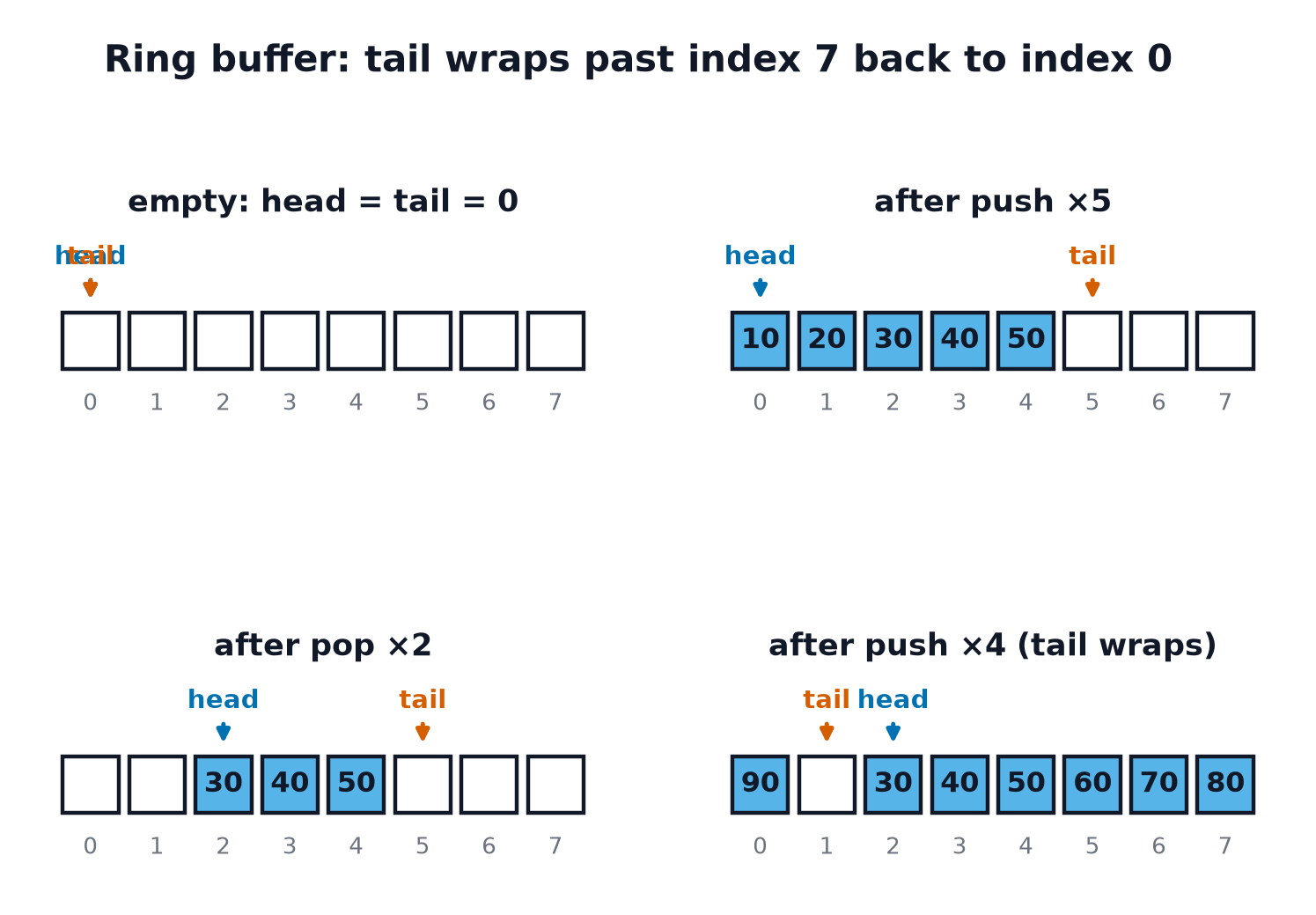
8-slot ring buffer, capacity 8, count tracked explicitly:

start:              head=0 tail=0 count=0        [_ _ _ _ _ _ _ _]
push 10,20,30,40,50: head=0 tail=5 count=5        [10 20 30 40 50 _ _ _]
pop, pop:            head=2 tail=5 count=3        [.. .. 30 40 50 _ _ _]
push 60,70,80,90:    tail: 5->6->7->0->1 (wraps)   [90 .. 30 40 50 60 70 80]
                     head=2 tail=1 count=7
tail finishing at 1 while head sits at 2 is exactly the wraparound: slot 0 holds 90, the seventh
of the last four pushes, even though 0 is numerically before head. Any code that compares head
and tail with < instead of computing occupied slots via count (or modular distance) gets this
case wrong.
- Python
- C++
class RingBuffer:
    """Fixed-capacity ring buffer with an explicit count to resolve full-vs-empty."""

    def __init__(self, capacity):
        self.buf = [None] * capacity
        self.capacity = capacity
        self.head = 0            # next slot to pop
        self.tail = 0            # next slot to push
        self.count = 0

    def push(self, value):
        if self.count == self.capacity:
            raise OverflowError("ring buffer is full")
        self.buf[self.tail] = value
        self.tail = (self.tail + 1) % self.capacity   # wraparound: modulo, not clamp
        self.count += 1

    def pop(self):
        if self.count == 0:
            raise IndexError("ring buffer is empty")
        value = self.buf[self.head]
        self.head = (self.head + 1) % self.capacity
        self.count -= 1
        return value

    def is_full(self):
        return self.count == self.capacity

    def is_empty(self):
        return self.count == 0
#include <optional>
#include <stdexcept>
#include <vector>

template <typename T>
class RingBuffer {
public:
    explicit RingBuffer(std::size_t capacity) : buf_(capacity), capacity_(capacity) {}

    void push(T value) {
        if (count_ == capacity_) throw std::overflow_error("ring buffer is full");
        buf_[tail_] = std::move(value);
        tail_ = (tail_ + 1) % capacity_;              // wraparound: modulo, not clamp
        ++count_;
    }

    T pop() {
        if (count_ == 0) throw std::underflow_error("ring buffer is empty");
        T value = std::move(buf_[head_]);
        head_ = (head_ + 1) % capacity_;
        --count_;
        return value;
    }

    bool full() const { return count_ == capacity_; }
    bool empty() const { return count_ == 0; }

private:
    std::vector<T> buf_;
    std::size_t capacity_, head_ = 0, tail_ = 0, count_ = 0;
};
Practical Usage
from collections import deque

# sliding-window maximum uses a deque of INDICES, kept monotonically decreasing by value
def sliding_window_max(nums, k):
    dq = deque()             # holds indices; front is always the current window's max
    result = []
    for i, x in enumerate(nums):
        while dq and nums[dq[-1]] <= x:      # O(1) amortized: each index pushed/popped once
            dq.pop()
        dq.append(i)
        if dq[0] <= i - k:
            dq.popleft()
        if i >= k - 1:
            result.append(nums[dq[0]])
    return result

assert sliding_window_max([1, 3, -1, -3, 5, 3, 6, 7], 3) == [3, 3, 5, 5, 6, 7]

rb = RingBuffer(8)
for v in (10, 20, 30, 40, 50):
    rb.push(v)
assert rb.pop() == 10 and rb.pop() == 20
for v in (60, 70, 80, 90):
    rb.push(v)
assert rb.count == 7 and rb.tail == 1 and rb.head == 2   # matches the traced wraparound
collections.deque(maxlen=n). A built-in bounded ring buffer: pushing pastmaxlensilently drops from the opposite end, in (Python docs,collections.deque) — the standard way to keep "the last n items seen" without hand-writing the wraparound logic above.deque.popleft()is the front-pop that a plainlist.pop(0)cannot offer (list.pop(0)is : every remaining element shifts down one slot).- Sliding-window problems. Maintaining a monotonic deque of indices (shown above) turns an brute-force sliding-window maximum into amortized — each index enters and leaves the deque at most once.
- Audio/network buffers. A fixed-size ring buffer is the standard structure between a producer (audio callback, network receive) and consumer running at different rates, precisely because it never allocates once created — allocation inside a real-time audio callback is a correctness bug, not just a performance one.
- BFS frontiers, undo/redo stacks, and work-stealing deques. BFS needs FIFO order
(
popleft/append); work-stealing schedulers push and pop from one end locally and steal from the other end — the double-ended access is what makes stealing cheap without locking the whole queue.
Edge Cases & Pitfalls
- Indexing a
dequein a hot loop.d[i]for an arbitraryiis oncollections.deque, not — code migrated fromlistthat indexes by position pays for it silently. Use it for end operations and iteration, not random access. - Comparing
head < tailto test ordering. After a wraparound,tailcan be numerically smaller thanhead(as in the traced example,tail=1 < head=2while the buffer holds 7 elements) — any logic that assumestail >= headfor a non-empty buffer breaks the first time the buffer wraps. - The
head == tailambiguity, unresolved. A ring buffer that drops thecountfield and tries to distinguish full from empty using onlyhead/tailneeds one of the standard fixes (reserve one slot, or trackcount/absolute counters) — skipping this is the classic ring-buffer bug, and it surfaces only once the buffer happens to wrap, which is often well after the code first ships. list.pop(0)mistaken for a queue's dequeue. A plain Pythonlistused as a queue viapop(0)is per call, because every remaining element shifts down one index — the entire reasoncollections.dequeexists for FIFO workloads.- Fixed capacity, unexpectedly exceeded. A ring buffer built for expected load throws or silently overwrites (implementation-dependent) on overflow — decide explicitly which, and document it, rather than discovering the behaviour under production load.
Comparisons
Block-based deque (collections.deque, std::deque) | Ring buffer (fixed capacity) | Dynamic array (list, std::vector) | |
|---|---|---|---|
| Push/pop at both ends (amortized) | back, front | ||
| Random access by index (worst) | Python, C++ | ||
| Capacity | Unbounded, grows by blocks | Fixed at construction | Unbounded, grows by doubling |
| Allocation per push (amortized) | Rare — one block per BLOCKLEN pushes | None, ever, after construction | Rare — one array per doubling |
| Memory overhead | One block-pointer directory plus partially-full end blocks | None beyond the fixed array | Unused capacity past current size |
Reach for a ring buffer specifically when the maximum size is known up front and allocation-free operation matters (real-time, embedded, producer/consumer). Reach for a block-based deque for general-purpose double-ended access with no fixed bound. A dynamic array remains the right default when access is overwhelmingly at the back and by index.
Recall
References
- Python documentation,
collections.deque— the end-operation and middle-index guarantees, and themaxlenbounded-deque behaviour, quoted above. - CPython source,
Modules/_collectionsmodule.c,#define BLOCKLEN 64— the fixed block size adequelinks together; the doubly linked list of blocks structure is documented in the module's top-of-file comments. - cppreference,
std::deque— the complexity guarantees ( amortized insert/erase at both ends, random access) that the map-of-blocks implementation exists to satisfy. - Sedgewick & Wayne, Algorithms, 4th ed., §1.3 "Bags, Queues, and Stacks" — the linked-list and resizing-array implementations of a double-ended queue this page's block-based design generalises.
Related Pages
- Stacks & Queues — the single-ended structures a deque generalises.
- Linked Lists — the doubly linked node structure a block-based deque links together, one block at a time instead of one element at a time.
- Arrays & Dynamic Arrays — the contiguous-storage baseline a ring buffer specialises for a fixed, known capacity.
- Cheat Sheet — the full operation-cost matrix across every structure in this folder.