Probabilistic Data Structures
Every structure so far in this section answers its question exactly, at the cost of storing enough information to do so. A hash set of a billion strings needs memory proportional to a billion strings. Probabilistic structures make a different trade: allow a small, quantifiable chance of a wrong answer, and get memory sublinear in the data — often by one or two orders of magnitude — or a query cost that no exact structure can match.
The trade is never unconditional. Each structure below fixes the kind of error it will tolerate (a false positive here, an approximation error there) and the exact probability or bound is a formula in terms of the memory given to it — not a vague "usually close enough," but a number computed before the structure is even built. Knowing which error each one accepts, and refusing the ones it does not, is the entire skill in choosing one.
A Bloom filter answers set membership and can false-positive but never false-negative. A count-min sketch answers frequency counts and can only overestimate. HyperLogLog answers distinct-count and is off by a small percentage in either direction. A skip list is the odd one out — it answers ordered-map queries exactly, using randomness only to keep itself balanced without the rotation bookkeeping a balanced tree needs.
Core Concepts
| Term | Meaning |
|---|---|
| False positive | "Yes, it's a member" when it is not — the error a Bloom filter accepts |
| False negative | "No, it's not a member" when it is — a Bloom filter never does this |
| Hash function, k of them | A Bloom filter uses k independent hash functions per element |
| Sketch | A fixed-size summary that approximates a statistic (count, cardinality) over a stream |
| Cardinality | The number of distinct elements — what HyperLogLog estimates |
| Skip list level | A tier of "express lane" pointers; higher levels skip more nodes, chosen randomly |
Mechanism
Bloom filter: the false-positive formula, worked on 16 bits
A Bloom filter is m bits, all initially 0, plus k independent hash functions. insert(x) sets bit
h_i(x) mod m to 1 for each of the k hashes. query(x) reports "possibly present" if every one of
those k bits is 1, and "definitely absent" the moment any one of them is 0 — a bit can only ever be
set by an insert, never cleared, so a false negative is structurally impossible; the only way to be
wrong is for other elements' insertions to have coincidentally already set all k bits some element
never touched.
Traced on a 16-bit filter, hash functions, inserting "cat" and "dog", then querying "cow":
m = 16 bits, k = 2, bits indexed 0..15, all start at 0

insert("cat"): h1("cat")=3,  h2("cat")=11   -> set bits 3, 11
  bits: 0000 0001 0000 0010   (bit 3 and bit 11 now 1)

insert("dog"): h1("dog")=7,  h2("dog")=11   -> set bits 7, 11 (11 already set)
  bits: 0000 0001 0001 0010   (bit 7 now also 1)

query("cow"):  h1("cow")=3,  h2("cow")=7
  bit 3 is 1 (set by "cat"), bit 7 is 1 (set by "dog") -> BOTH set
  filter reports "possibly present" — a FALSE POSITIVE: "cow" was never inserted.
  It happened because "cat" and "dog" together, by coincidence, set exactly
  the two bits "cow" would have needed.
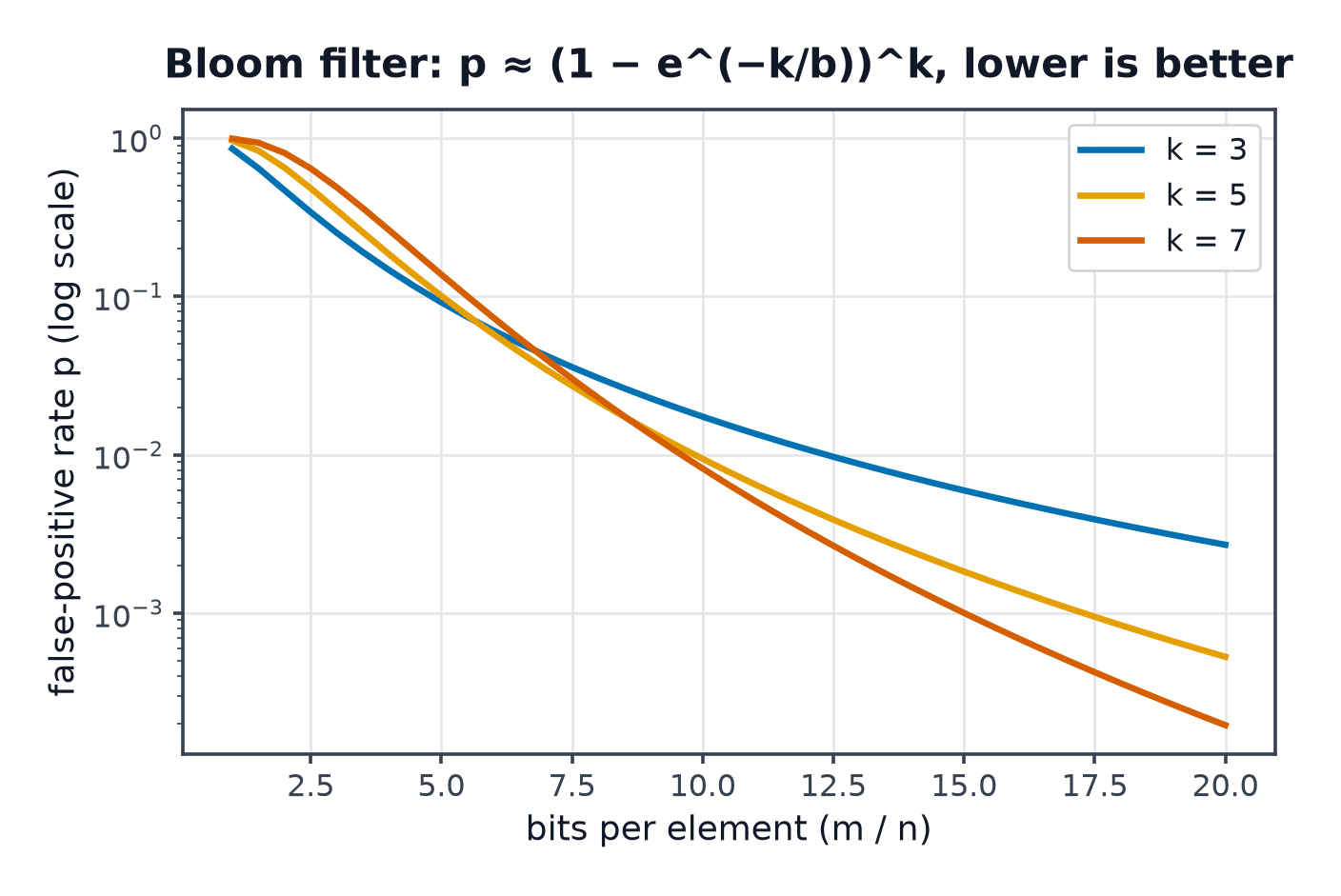
The false-positive probability, for n inserted elements, m bits and k hash functions, assuming
independent uniform hashing:
Rewritten in bits-per-element , this is minimised at — more hash functions help up to a point, then start hurting because each additional hash sets more bits faster than it rules out more false candidates.
Count-min sketch: frequency counts that only overestimate
A count-min sketch is a 2D array of d rows by w columns, each row with its own independent hash
function. add(x) increments sketch[i][h_i(x)] for every row i. estimate(x) returns the
minimum across the d cells x hashes to — taking the minimum is what makes the sketch
overestimate-only: any single row's count for x may be inflated by hash collisions with other
elements, but the true count is a lower bound on every row's cell, so the minimum across independent
rows is the tightest available bound, never below the truth. This is the same shape of trade as a
Bloom filter (multiple independent hashes, one structure shared by everything hashed into it) applied
to counting instead of membership.
HyperLogLog, in outline
Counting distinct elements exactly needs to remember every element seen — no way around it without approximation. HyperLogLog's insight: hash each element to a uniform random bit string, and the position of that string's leftmost 1-bit has a distribution that depends only on how many distinct values have been hashed — seeing a hash with 20 leading zeros before its first 1-bit is unlikely unless roughly distinct values have been tried. Splitting the hash space into thousands of independent buckets and averaging each bucket's maximum leftmost-1-bit position (harmonic-mean averaged, to control variance) turns that single noisy signal into an estimate accurate to roughly 2% using a few kilobytes, regardless of whether the true cardinality is a thousand or a billion (Flajolet et al., "HyperLogLog: the analysis of a near-optimal cardinality estimation algorithm," 2007). This page states the mechanism's shape and its accuracy bound without deriving the bias-correction constant the original paper works out in full.
Skip lists
A skip list is a sorted linked list with extra "express lane" pointers layered on top, chosen randomly: each node gets a level by a coin-flip process (level with probability ), and a node at level has forward pointers at every level up to . Searching starts at the top level, moves forward while the next node's key is still less than the target, and drops down a level whenever moving forward would overshoot — the same doubling structure that gives a balanced binary search tree its height, but assembled by chance instead of by rotations. The expected search cost is ; a run of unlucky coin flips can degrade this, but that is a probability-bounded tail, not a guaranteed worst case the way an unbalanced BST's chain is (Pugh, "Skip Lists: A Probabilistic Alternative to Balanced Trees," 1990).
- Python
- C++
import hashlib


class BloomFilter:
    def __init__(self, size_bits, k):
        self.size = size_bits
        self.k = k
        self.bits = 0                              # one Python int used as a bit array

    def _hashes(self, item):
        for i in range(self.k):
            digest = hashlib.sha256(f"{i}:{item}".encode()).digest()
            yield int.from_bytes(digest, "big") % self.size

    def add(self, item):
        for h in self._hashes(item):
            self.bits |= (1 << h)

    def __contains__(self, item):                  # "possibly present" or "definitely absent"
        return all(self.bits & (1 << h) for h in self._hashes(item))


class CountMinSketch:
    def __init__(self, width, depth):
        self.width, self.depth = width, depth
        self.table = [[0] * width for _ in range(depth)]

    def _hash(self, row, item):
        digest = hashlib.sha256(f"{row}:{item}".encode()).digest()
        return int.from_bytes(digest, "big") % self.width

    def add(self, item, count=1):
        for row in range(self.depth):
            self.table[row][self._hash(row, item)] += count

    def estimate(self, item):
        return min(self.table[row][self._hash(row, item)] for row in range(self.depth))
#include <bitset>
#include <functional>
#include <string>
#include <vector>

template <std::size_t Bits>
class BloomFilter {
public:
    explicit BloomFilter(int k) : k_(k) {}

    void add(const std::string& item) {
        for (int i = 0; i < k_; ++i) bits_.set(hash(i, item));
    }

    bool maybe_contains(const std::string& item) const {   // never a false negative
        for (int i = 0; i < k_; ++i)
            if (!bits_.test(hash(i, item))) return false;
        return true;
    }

private:
    std::size_t hash(int salt, const std::string& item) const {
        return std::hash<std::string>{}(std::to_string(salt) + item) % Bits;
    }
    std::bitset<Bits> bits_;
    int k_;
};
Practical Usage
bf = BloomFilter(size_bits=16, k=2)

# reproduce the traced example with hashes pinned to match the worked trace above
class PinnedBloom(BloomFilter):
    _table = {("cat", 0): 3, ("cat", 1): 11, ("dog", 0): 7, ("dog", 1): 11,
              ("cow", 0): 3, ("cow", 1): 7, ("fox", 0): 0, ("fox", 1): 1}
    def _hashes(self, item):
        for i in range(self.k):
            yield self._table[(item, i)]

pb = PinnedBloom(size_bits=16, k=2)
pb.add("cat")
pb.add("dog")
assert "cat" in pb and "dog" in pb          # true positives
assert "cow" in pb                          # the false positive traced above
assert "fox" not in pb                      # bits 3/7/11 don't cover fox's hashes here

cms = CountMinSketch(width=64, depth=4)
for word in ["a", "b", "a", "c", "a", "b"]:
    cms.add(word)
assert cms.estimate("a") >= 3               # true count is 3; sketch never underestimates
assert cms.estimate("z") >= 0               # never negative, may overestimate an unseen key
- Bloom filters gate expensive lookups. Databases (Cassandra, HBase, Postgres extensions) and CDN edge caches check a Bloom filter before an expensive disk read or origin fetch — a "definitely absent" answer skips the read entirely, and the rare false positive costs one wasted read, not a wrong answer.
- Count-min sketches back "heavy hitters" queries. Network traffic analysis and streaming analytics use them to answer "top-k most frequent items" over a stream too large to store exactly.
- HyperLogLog powers
COUNT(DISTINCT ...)at scale. Redis'sPFADD/PFCOUNT, and BigQuery'sAPPROX_COUNT_DISTINCT, are HyperLogLog under the hood — exact distinct-count over billions of rows is not memory-feasible, and callers who ask for it are usually fine with 2% error. - Skip lists back real ordered-map implementations. Redis's sorted set (
ZSET) is a skip list precisely because concurrent insert is simpler to implement correctly with random levels than with rotation-based rebalancing — no cited claim of a skip list being asymptotically superior to a balanced tree, only that its probabilistic balancing is easier to get right under concurrent access.
Edge Cases & Pitfalls
- Treating a Bloom filter's "yes" as certain. "Possibly present" is not "present" — code that skips a real membership check after a Bloom filter says yes silently accepts the false-positive rate as a correctness bound, which it usually is not meant to be.
- Not sizing
mandkfor the actualn. A Bloom filter sized for 1,000 elements and then filled with 100,000 saturates — nearly every bit sets to 1, and the false-positive rate approaches 1 regardless ofk. Size from the target false-positive rate and expected before filling it. - No deletion, ever, from a plain Bloom filter. Clearing a bit because one element that set it was removed can un-set a bit another still-present element also depends on — a Bloom filter supports insert and query only. Deletion needs a counting Bloom filter (small counters instead of bits), which trades more memory for that one extra operation.
- Reporting a HyperLogLog or count-min estimate as exact. Both carry a stated error bound; treating their output as ground truth in a context that needs exactness (billing, auditing) is a category error, not a tuning problem.
- Assuming a skip list's is a hard worst case. It is an expectation over the random level assignment. Pathologically unlucky coin flips (astronomically unlikely, but not impossible) degrade a search toward — the same caveat that applies to randomized quicksort's pivot choice.
Comparisons
| Bloom filter | Count-min sketch | HyperLogLog | Skip list | |
|---|---|---|---|---|
| Answers | Set membership | Item frequency | Distinct count | Ordered map (exact) |
| Error direction | False positive only | Overestimate only | Either direction, ~2% | None — exact |
| Memory vs. exact structure | Orders of magnitude smaller | Orders of magnitude smaller | Kilobytes for billions of items | Comparable to a balanced tree |
| Deletion | Not supported (plain form) | Not supported (plain form) | Not supported | expected |
| Typical use | Skip an expensive lookup | Streaming top-k / heavy hitters | COUNT(DISTINCT ...) at scale | Concurrent ordered sets (Redis ZSET) |
Recall
References
- B. H. Bloom, "Space/Time Trade-offs in Hash Coding with Allowable Errors," Communications of the ACM 13(7), 1970 — the original Bloom filter and the false-positive-rate derivation used above.
- Cormen, Leiserson, Rivest & Stein, Introduction to Algorithms, 4th ed., §11.5 "Exercises" briefly poses Bloom filters as an exercise on hashing; the full development here follows Bloom's original paper and Broder & Mitzenmacher's survey below, not CLRS's main text.
- A. Broder & M. Mitzenmacher, "Network Applications of Bloom Filters: A Survey," Internet Mathematics 1(4), 2004 — count-min-adjacent variants and the standard optimum.
- P. Flajolet, É. Fusy, O. Gandouet & F. Meunier, "HyperLogLog: the analysis of a near-optimal cardinality estimation algorithm," AOFA, 2007 — the leftmost-1-bit estimator and its bias correction, outlined but not derived above.
- W. Pugh, "Skip Lists: A Probabilistic Alternative to Balanced Trees," Communications of the ACM 33(6), 1990 — the randomized-level construction and its expected bound.
Related Pages
- Hash Tables — the exact structure a Bloom filter trades correctness for memory against, and the source of the independent-hash-function assumption used in the false-positive formula.
- Balanced Trees — the rotation-based alternative to a skip list's randomized balancing, with the same expected/guaranteed operations.
- Union-Find — another structure that gives up a general capability (splitting sets) for speed on the one operation it keeps.
- Cheat Sheet — the full operation-cost matrix across every structure in this folder.