Tries (Prefix Trees)
A hash set answers "is this exact string in the set?" and nothing else. It cannot answer "what strings
start with ca?" without scanning every entry, because hashing deliberately destroys any relationship
between a string and its prefixes — that is the whole point of a good hash function. A trie is the
structure built for the opposite trade: it throws away the whole-string lookup and gets, in
return, every prefix operation for free.
The idea is to stop storing strings and start storing paths. Every node is one character position;
following edges from the root spells out a string one character at a time. Two words that share a
prefix share the path down to where they diverge — cat and car are the same three nodes and then
split at the fourth. Nothing is duplicated for the shared part, and that sharing is also what makes
prefix queries cheap: walking to the node for ca visits every word that starts with ca in one
traversal, because they all pass through it on the way down.
A node's only real job is to answer one question — "given the next character, which child do I go to?" — but how it answers it is where the design space lives. That single choice, covered below, determines whether a trie feels memory-hungry or featherlight.
Core Concepts
| Term | Meaning |
|---|---|
| Node | One character position on some path from the root; not itself a full key |
| Root | The empty-string node — every key's path starts here |
| Child map | The node's answer to "which child for character c?" — array, hash map, or sorted list |
| End-of-word marker | A flag on the node reached after the last character of an inserted key |
| Prefix | Any path from the root; a key is a prefix that is also marked end-of-word |
| Radix / compressed trie | A trie where chains of single-child nodes are collapsed into one edge labelled with a substring |
A node with no children and no end marker simply does not exist — a trie only ever materialises the nodes some inserted key actually needs.
Mechanism
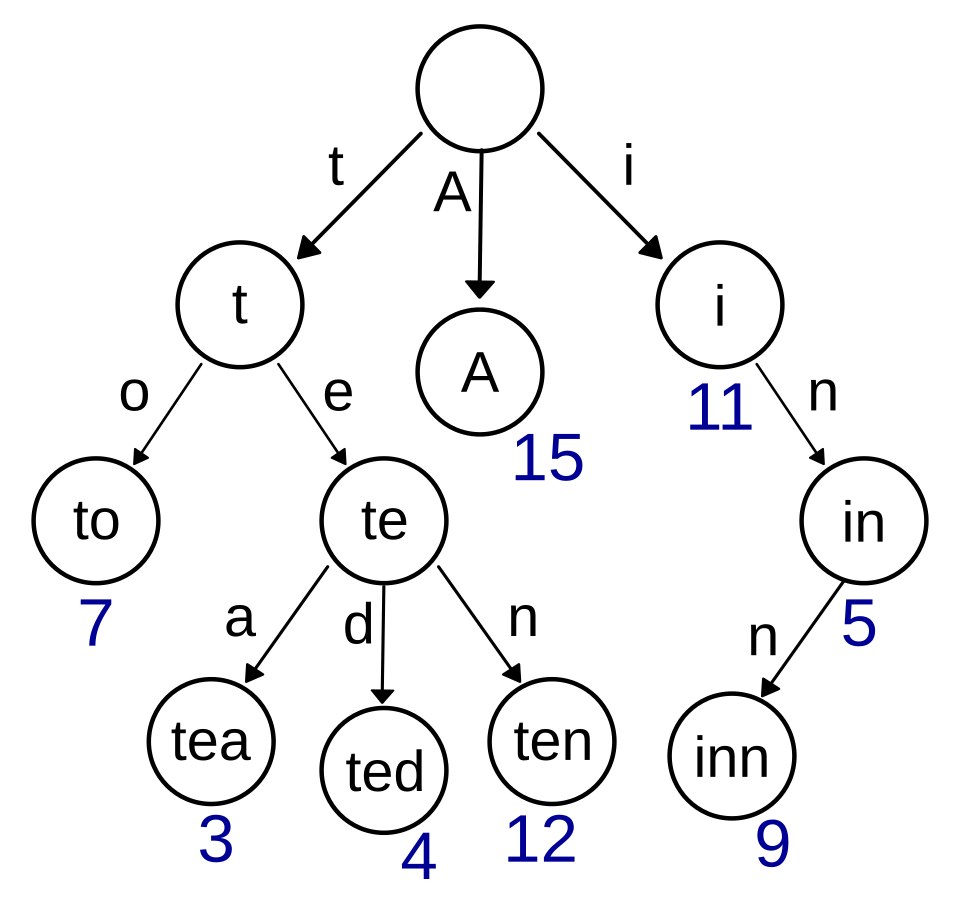
Traced over insert("cat"), insert("car"), insert("card"), then starts_with("ca"):
insert "cat":              insert "car":               insert "card":
root                       root                        root
 └─c                        └─c                          └─c
    └─a                        └─a                          └─a
       └─t*                       ├─t*                         ├─t*
                                   └─r*                         └─r*
                                                                    └─d*
new nodes: c, a, t(*)       new nodes: r(*)             new nodes: d(*)
                             (c, a are reused —          (c, a, r are reused —
                              already on the path)        already on the path)

* marks is_end = True

starts_with("ca"): walk root → c → a — 2 steps, found the node, stop.
No character of "cat", "car" or "card" beyond index 2 is touched.
Every word reachable below this node (cat, car, card) is a completion of "ca".
Only three character-steps of work locate the prefix node no matter how many words hang below it — the cost of a prefix query is the length of the prefix, never the number or length of the matches.
- Python
- C++
class TrieNode:
    __slots__ = ("children", "is_end")

    def __init__(self):
        self.children = {}      # hash map: pays only for children that exist
        self.is_end = False


class Trie:
    def __init__(self):
        self.root = TrieNode()

    def insert(self, word):
        node = self.root
        for ch in word:                          # O(L), L = len(word)
            node = node.children.setdefault(ch, TrieNode())
        node.is_end = True

    def _walk(self, prefix):
        node = self.root
        for ch in prefix:
            if ch not in node.children:
                return None
            node = node.children[ch]
        return node

    def search(self, word):                      # exact-key membership
        node = self._walk(word)
        return node is not None and node.is_end

    def starts_with(self, prefix):                # prefix existence
        return self._walk(prefix) is not None
#include <array>
#include <memory>
#include <string>

struct TrieNode {
    std::array<std::unique_ptr<TrieNode>, 26> children{};  // fixed 26 slots, lowercase a-z
    bool is_end = false;
};

class Trie {
public:
    void insert(const std::string& word) {
        TrieNode* node = &root_;
        for (char c : word) {                     // O(L), L = word.size()
            int i = c - 'a';
            if (!node->children[i]) node->children[i] = std::make_unique<TrieNode>();
            node = node->children[i].get();
        }
        node->is_end = true;
    }

    const TrieNode* walk(const std::string& prefix) const {
        const TrieNode* node = &root_;
        for (char c : prefix) {
            int i = c - 'a';
            if (!node->children[i]) return nullptr;
            node = node->children[i].get();
        }
        return node;
    }

    bool search(const std::string& word) const {
        auto* n = walk(word);
        return n && n->is_end;
    }

    bool starts_with(const std::string& prefix) const { return walk(prefix) != nullptr; }

private:
    TrieNode root_;
};
Node layouts: three ways to answer "which child for c?"
The child-lookup structure is the only real design decision in a trie; everything else follows from it.
| Layout | Memory per node | Child lookup | Child insert | Best when |
|---|---|---|---|---|
| Array of 26 (or of the alphabet size) | Fixed bytes = 208 bytes on a 64-bit build, whether the node has 1 child or 26 | Small, fixed alphabet; nodes are usually well-branched (dictionary words) | ||
| Hash map | Proportional to children actually present; a Python dict grows in amortized per insert (Python docs, dict) | average | amortized | Large or unknown alphabet (Unicode), sparse branching |
| Sorted list of children | Compact — one entry per child, no wasted slots | via binary search, k = number of children at that node | worst, to keep the list sorted | Memory-constrained, few children per node, built once and rarely mutated |
The array layout trades memory for guaranteed : a trie of short English words has thousands of nodes with only 1–2 children each, and every one of them still pays for 26 pointer slots. The hash-map layout is what the Python implementation above uses, and it is the right default whenever the alphabet is large (Unicode text) or the branching factor is unpredictable.
Cost versus a hash set of whole words
A set of complete strings gives average-case membership — computing the hash still touches
every character — so exact-match cost is the same order as a trie's. The difference is everything
else:
- Prefix queries. "Every key starting with
pre" costs to locate the node in a trie, then to enumerate matches. In a hash set it costs — scan every one of the entries and check each prefix — because hashing threw away exactly the locality a trie keeps (Sedgewick & Wayne, 4th ed., §5.2). - Memory. A trie is smaller than a hash set when keys share a lot of structure — a dictionary of English words, a filesystem's paths — because shared prefixes are stored once. It is larger when keys share little (random tokens, hashes), because per-node overhead is paid on every character regardless of sharing.
- Ordered iteration. Walking a trie in a fixed child order (say, alphabetical) yields keys in sorted order for free. A hash set's iteration order carries no such guarantee.
Autocomplete
Locate the prefix node in , then depth-first from there, collecting every node with
is_end set:
# doc:no-run
def autocomplete(trie, prefix, limit=10):
    node = trie._walk(prefix)
    if node is None:
        return []
    results = []

    def dfs(node, path):
        if len(results) >= limit:
            return
        if node.is_end:
            results.append(prefix + path)
        for ch, child in node.children.items():
            dfs(child, path + ch)

    dfs(node, "")
    return results
Cost is to find the node plus for the subtree actually visited, where is
bounded by limit once enough matches are found — never the size of the whole trie.
Radix / compressed tries
A trie built over sparse keys — file paths, IP prefixes, UUIDs — spends most of its nodes on chains
with exactly one child: /usr/local/bin is fifteen single-child nodes before the path ever branches.
A radix trie (also called a Patricia trie) collapses each such chain into a single edge labelled
with the whole substring, so a chain of single-child nodes becomes one edge and one node. Lookup
now compares substrings instead of single characters, but the node count drops to roughly the number
of branch points rather than the number of characters stored — the original construction is due to
D. R. Morrison, "PATRICIA — Practical Algorithm To Retrieve Information Coded in Alphanumeric",
JACM 15(4), 1968. Compressed tries are named, not derived here, because the mechanism — the
representation is described above, but the incremental-edge-splitting insert algorithm that keeps a
radix trie compressed as new keys arrive is its own structure; see the reference for the full
construction. IP routers use exactly this structure (longest-prefix match over CIDR blocks), and it is
why the term "radix tree" appears throughout networking code.
Practical Usage
Neither Python nor C++ ships a trie type — like union-find, it is a structure you write, because the right node layout depends on the alphabet and access pattern. Where it is worth building:
- Autocomplete and typeahead. Search-bar suggestions, IDE symbol completion: the prefix-then-DFS pattern above, usually with an early cutoff at a handful of results.
- Spell-checking and dictionary lookup.
searchfor exact membership, plusstarts_withto prune a search early — no point continuing down a branch that cannot complete to any real word. - IP routing tables. Longest-prefix match over CIDR blocks is a lookup on a compressed (radix) trie keyed on address bits rather than characters.
- T9-style predictive text and word games. Any problem that asks "which words are consistent with this partial input" is a prefix query.
trie = Trie()
for word in ("cat", "car", "card"):
    trie.insert(word)

assert trie.search("cat") and trie.search("car") and trie.search("card")
assert not trie.search("ca")             # "ca" is a prefix, never inserted as its own key
assert trie.starts_with("ca")            # but the prefix path does exist
assert not trie.starts_with("do")        # no path at all for an unrelated prefix
assert trie._walk("ca") is trie.root.children["c"].children["a"]   # the shared c -> a path
collections.defaultdict (Python docs,
collections.defaultdict)
is a common shortcut for the node's child map — defaultdict(TrieNode) avoids the explicit
setdefault call above, at the cost of silently creating a node on every failed lookup, which is
wrong for search and starts_with (they must not mutate the trie). That is exactly why the
implementation above uses plain dict with setdefault only in insert.
Edge Cases & Pitfalls
- Confusing "prefix exists" with "word exists."
starts_with("ca")is true after insertingcat, butsearch("ca")is false unless"ca"was itself inserted as a key. Theis_endflag is what distinguishes a key from a mere waypoint on the way to one. defaultdict-as-children on a read path. Using adefaultdictforchildrenmakessearchandstarts_withmutate the trie on a miss — every failed lookup permanently adds empty nodes. Use plaindictand check membership explicitly, or adefaultdictonly insideinsert.- Deleting a key without pruning. Clearing
is_endon the last node of a deleted key leaves every now-useless ancestor node in place if nothing else uses them. A correct delete walks back up (recursively, or with a stack of visited nodes) and removes each node that has no children and is not itself an end marker. - Fixed alphabet arrays over Unicode text. An array-of-26 node silently corrupts on any input
outside
a-z(out-of-bounds index, or worse, silent wraparound in unchecked code). Anything beyond a small fixed alphabet needs the hash-map layout. - Case and normalization.
"Cat"and"cat"are different paths unless the caller normalizes case before inserting — a trie enforces no equivalence the input didn't already have.
Comparisons
| Trie | Hash set of strings | Sorted array of strings | |
|---|---|---|---|
| Exact membership | average | average | worst — binary search, L per comparison |
| Prefix query ("starts with") | $O( | prefix | )O(m)$ for m matches |
| Sorted iteration | Free — walk children in order | Not supported | Already sorted |
| Memory | Shared prefixes stored once; per-node overhead otherwise | One hash-table slot per string | One slot per string, no overhead per character |
| Insert | amortized | — must keep the array sorted |
A trie wins the moment prefix or "starts with" queries matter at all; a hash set is smaller and no slower for pure exact-match workloads with little shared structure between keys.
Recall
References
- Sedgewick & Wayne, Algorithms, 4th ed., §5.2 "Tries" — R-way tries, ternary search tries, and the memory-per-node trade-offs across layouts, with the prefix-query cost argument used above.
- Cormen, Leiserson, Rivest & Stein, Introduction to Algorithms, 4th ed. — tries are not a dedicated chapter in CLRS; the closest formal treatment is the string-matching chapter's discussion of suffix structures (Ch. 32), which builds on the same path-per-character idea.
- D. R. Morrison, "PATRICIA — Practical Algorithm To Retrieve Information Coded in Alphanumeric," Journal of the ACM 15(4), 1968 — the original compressed (radix) trie.
- Python documentation,
dictandcollections.defaultdict— the amortized- hash map used for the child-map layout above.
Related Pages
- Hash Tables — the structure a trie is usually compared against, and the source of the child-map layout's amortized cost.
- Segment Trees and Fenwick Trees — another tree shaped entirely by the query it answers, rather than by the data's natural order.
- Strings & Text: KMP and the Z-Algorithm — pattern matching within one text, versus a trie's multi-key prefix search.
- Trees & Binary Search Trees — the general tree vocabulary (node, root, child) a trie specialises for one purpose.