Union-Find (Disjoint Set Union)
Some problems never ask what is in a group. They ask only whether two things have ended up in the same one: are these two computers on the same network segment, do these two pixels belong to the same blob, would adding this edge close a cycle. Union-find is the structure for exactly that question, and it is fast because it refuses to answer any other.
The representation is a forest. Every element points at a parent; an element that points at itself
is a root, and the root is the name of its set. find(x) walks the parent pointers to the root.
Two elements are in the same set precisely when that walk ends in the same place. union(a, b) finds
both roots and makes one point at the other — one pointer write, and two sets are one.
The tree's shape carries no meaning at all. It is not a hierarchy, nothing was "contained in"
anything, and the child-parent relation records only the accident of which union happened first. That
is what licenses the second optimisation: since the shape means nothing, you are free to flatten it
whenever you like. Every find may re-point every node it passes straight at the root, and the
structure is unchanged as far as any caller can tell — only faster. A structure whose shape is
meaningless is a structure you can aggressively destroy in your own favour.
Core Concepts
| Term | Meaning |
|---|---|
| Parent array | parent[x] is x's parent; parent[x] == x means x is a root |
| Representative (root) | The single element that names a set. Arbitrary, and it changes as sets merge |
find(x) | Walk to the root of x's tree — the set-identity query |
union(a, b) | Attach one root under the other. Roots, never a and b themselves |
| Union by rank | Attach the shorter tree under the taller. rank is an upper bound on height, not the exact height |
| Union by size | Attach the smaller tree under the larger. Same asymptotics; size is also useful data |
| Path compression | During find, re-point every node on the walk directly at the root |
| α(n) | The inverse Ackermann function — below 5 for any n that fits in the observable universe |
The two optimisations attack different halves of the same problem. Union by rank stops tall trees from being built; path compression flattens the ones that were. Either alone leaves a per-operation cost of — balanced linking in the worst case, because a tree of rank k can still have height k (Sedgewick & Wayne, 4th ed., §1.5, Proposition H proves the lg n depth bound for union by size; union by rank gives the same bound); path compression alone amortized, because linking a large tree under a small root keeps rebuilding depth faster than compression flattens it (Tarjan & van Leeuwen, 1984). Together they give the amortized α(n) bound proved in CLRS 4th ed. §19.4.
Mechanism
Two views of the same three unions. The left pair is what the caller believes it has — a partition
into disjoint sets. The right pair is what is actually in memory: a forest, and the compression that
follows a find.


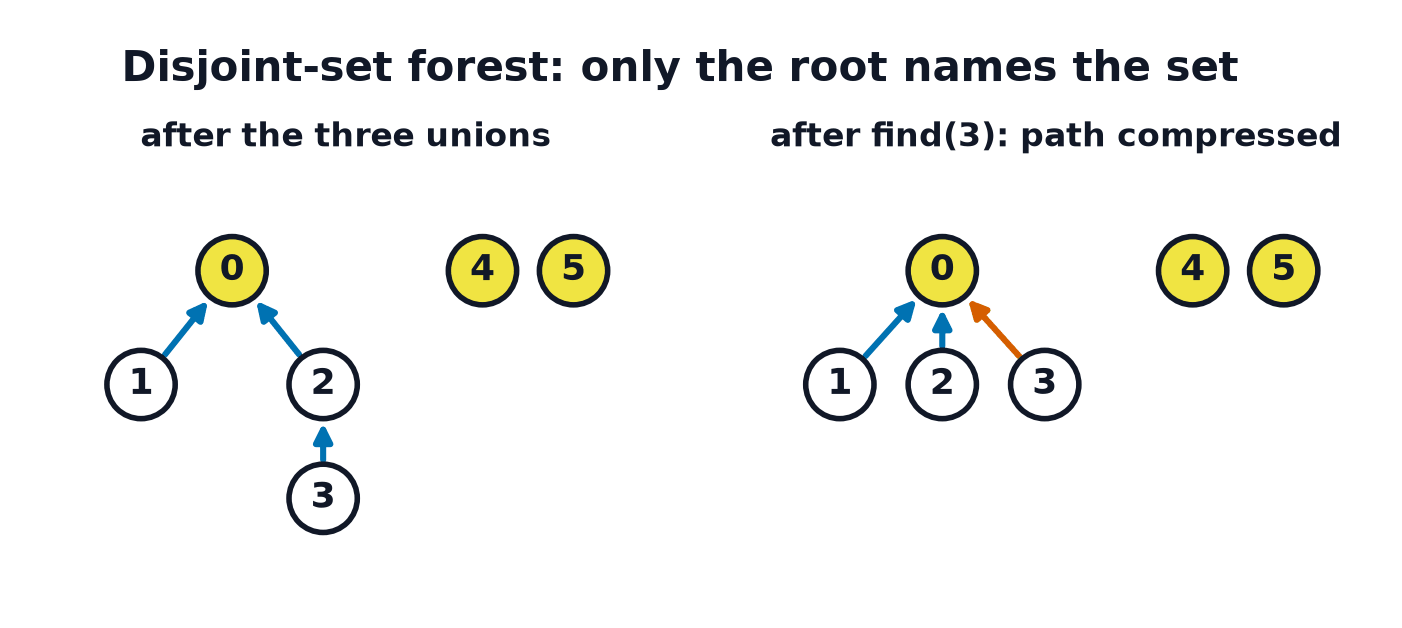
Traced over 0..5, with the operations union(0,1) union(2,3) union(1,3) find(0) find(3):
union over 0..5, operations: union(0,1) union(2,3) union(1,3) find(0) find(3)

  op            parent array            forest
  start         [0, 1, 2, 3, 4, 5]      six singletons
  union(0,1)    [0, 0, 2, 3, 4, 5]      1's root now 0
  union(2,3)    [0, 0, 2, 2, 4, 5]      3's root now 2
  union(1,3)    [0, 0, 0, 2, 4, 5]      find(1)=0, find(3)=2 → 2's root now 0
  find(0)       [0, 0, 0, 2, 4, 5]      already a root, no change
  find(3)       [0, 0, 0, 0, 4, 5]      path compression: 3 re-parented straight to 0
Note that union(1,3) writes parent[2], not parent[3]. Nothing in the array records that the
caller ever named 1 and 3 — only that their sets merged.
- Python
- C++
class DSU:
    """Disjoint set union with union by rank and full path compression."""

    def __init__(self, n):
        self.parent = list(range(n))   # every element is its own root
        self.rank = [0] * n            # upper bound on tree height, not exact
        self.components = n            # O(1) worst case per union

    def find(self, x):
        root = x
        while self.parent[root] != root:   # first pass: locate the root
            root = self.parent[root]
        while self.parent[x] != root:      # second pass: re-point the whole path
            self.parent[x], x = root, self.parent[x]
        return root

    def union(self, a, b):
        ra, rb = self.find(a), self.find(b)
        if ra == rb:
            return False                   # already together — the cycle test
        if self.rank[ra] < self.rank[rb]:  # attach the shorter tree under the taller
            ra, rb = rb, ra
        self.parent[rb] = ra               # a root is written, never `a` or `b`
        if self.rank[ra] == self.rank[rb]:
            self.rank[ra] += 1             # height grows only on a tie
        self.components -= 1
        return True

    def connected(self, a, b):
        return self.find(a) == self.find(b)
#include <algorithm>
#include <numeric>
#include <vector>

struct DSU {                                    // `union` is a keyword: name it `unite`
    std::vector<int> parent, rank_;
    int components;

    explicit DSU(int n) : parent(n), rank_(n, 0), components(n) {
        std::iota(parent.begin(), parent.end(), 0);
    }

    int find(int x) {                           // path halving: one pass, same bound
        while (parent[x] != x) {
            parent[x] = parent[parent[x]];      // point at the grandparent, then step
            x = parent[x];
        }
        return x;
    }

    bool unite(int a, int b) {
        int ra = find(a), rb = find(b);
        if (ra == rb) return false;             // already together — the cycle test
        if (rank_[ra] < rank_[rb]) std::swap(ra, rb);
        parent[rb] = ra;                        // a root is written, never `a` or `b`
        if (rank_[ra] == rank_[rb]) ++rank_[ra];
        --components;
        return true;
    }

    bool connected(int a, int b) { return find(a) == find(b); }
};
Note that find is not read-only: it rewrites the parent array. That matters if you ever share a DSU
across threads, and it is why a const find is not offered above.
Practical Usage
Neither language ships one. There is no disjoint-set type in the Python standard library and none in
the C++ standard library, so this is a structure you write — which is part of why it is worth knowing
by heart. (Boost provides boost::disjoint_sets, and SciPy provides scipy.cluster.hierarchy.DisjointSet;
both are third-party dependencies.)
Where it earns its place:
- Kruskal's minimum spanning tree. Sort the edges by weight and take each one whose endpoints are not already connected. The DSU is the cycle test, and it is what makes the algorithm worst case rather than a worst-case — see CLRS 4th ed. §21.2 and Sedgewick & Wayne §4.3.
- Connected components. Union every edge, then
componentsis the answer in worst case. Compare with a traversal, which needs a full worst-case pass per batch. - Cycle detection in an undirected graph.
union(u, v)returningFalsemeans the edge closes a cycle. This does not work for directed graphs — direction is exactly the information the structure discards. - Dynamic connectivity in a grid. Flood-fill problems where cells switch on over time: index each
cell as
row * width + col, union it with each already-on neighbour. Percolation (Sedgewick & Wayne §1.5) is the canonical example. - Equivalence classes generally. Merging duplicate account records, unifying type variables in a type checker, grouping equal-valued keys.
- Python
- C++
def kruskal(n, edges):
    """edges: (weight, u, v). Returns the total weight of a minimum spanning tree."""
    dsu, total = DSU(n), 0
    for weight, u, v in sorted(edges):       # O(E log E) worst case — the sort dominates
        if dsu.union(u, v):                  # False means it would close a cycle
            total += weight
    return total


# A B C D E F as 0..5
GRAPH = [(4, 0, 1), (2, 0, 2), (1, 1, 2), (5, 1, 3), (8, 2, 3),
         (10, 2, 4), (2, 3, 4), (6, 3, 5), (3, 4, 5)]

d = DSU(6)
d.union(0, 1); d.union(2, 3); d.union(1, 3)
assert d.parent == [0, 0, 0, 2, 4, 5]    # exactly the traced array, 3 not yet compressed
assert d.find(1) == d.find(3)            # merged through their roots
assert d.parent[3] == 0                  # that find() re-pointed 3 straight at the root
assert d.find(4) != d.find(0)            # 4 was never touched
assert d.components == 3                 # {0,1,2,3}, {4}, {5}
assert kruskal(6, GRAPH) == 13           # B–C, A–C, D–E, E–F, B–D
struct Edge { int weight, u, v; };

long long kruskal(int n, std::vector<Edge> edges) {
    std::sort(edges.begin(), edges.end(),
              [](const Edge& a, const Edge& b) { return a.weight < b.weight; });
    DSU dsu(n);
    long long total = 0;
    for (const Edge& e : edges)
        if (dsu.unite(e.u, e.v)) total += e.weight;   // false → would close a cycle
    return total;
}
Edge Cases & Pitfalls
- Uniting the elements instead of the roots.
parent[b] = arather thanparent[find(b)] = find(a)compiles, runs, and is wrong. The symptom is nasty: everything looks fine for a while, then sets silently stop merging, because you have re-parented a node that already had a parent and orphaned an entire subtree from the merge. Anyunionthat does not callfindtwice first is a bug. - Recursive
findblowing the stack. The one-line recursive version is elegant, but before any compression happens a degenerate chain is n deep. CPython's limit on interpreter stack depth is settable viasys.setrecursionlimit; the docs do not fix a default, and on CPython 3.14sys.getrecursionlimit()returns 1000. A DSU over a few thousand elements can therefore raiseRecursionErroron a bad input distribution. Both implementations above are iterative for this reason. - Deletion is not supported. Sets merge and never split. Removing an element, or undoing a union, requires a different structure (a union-find with rollback, which forgoes path compression so that each union writes exactly one array cell that can be replayed backwards). If the problem splits groups, this is the wrong structure — consider processing the operations in reverse so that splits become merges.
rankis not height after compression. Compression shortens trees without decrementing any rank, sorankdrifts above the true height. That is harmless — it is used only as a tie-breaker, and the CLRS §19.4 analysis assumes exactly this.- Non-integer elements. The parent array is indexed by integer. Map your keys to
0..n-1first (a dict, orenumerate); a dict-of-parents works too but pays hashing on every step of every walk.
Comparisons
| Union-find | BFS/DFS flood fill | Hash map of set IDs | |
|---|---|---|---|
| Model | Incremental — edges arrive over time | Offline — the whole graph must be known | Incremental |
| Merge two groups | amortized | n/a | worst — relabel the smaller set |
| "Same group?" query | amortized | worst, per traversal | average |
| Enumerate a group's members | worst — a full scan | worst | worst |
| Split a group | Not supported | Recompute, worst | worst |
| Memory | One or two int arrays | Visited array plus a frontier | One entry per element |
Union-find wins when connectivity queries are interleaved with edge insertions. A traversal wins when the graph is fixed and you also need to walk it — distances, paths, or the members of a component. The hash-map-of-IDs approach is only competitive with the "small-to-large" merging trick, and even then it is worst case overall, against union-find's near-linear.
Recall
References
- Sedgewick & Wayne, Algorithms, 4th ed., §1.5 "Case Study: Union-Find" — the definitive introduction, developing quick-find → quick-union → weighted quick-union with doubling-test measurements for each, plus the percolation application.
- Cormen, Leiserson, Rivest & Stein, Introduction to Algorithms, 4th ed., Ch. 19 "Data Structures for Disjoint Sets" — the forest representation in §19.3 and the amortized proof in §19.4.
- R. E. Tarjan, "Efficiency of a Good But Not Linear Set Union Algorithm", JACM 22(2), 1975 — where the inverse-Ackermann bound comes from.
- R. E. Tarjan & J. van Leeuwen, "Worst-case Analysis of Set Union Algorithms", JACM 31(2), 1984 — the case-by-case analysis showing what each optimisation is worth on its own.
Related Pages
- Trees — the parent-pointer representation, used here without any of the ordering.
- Graphs — where the edges being unioned come from.
- Graph Traversal — the offline alternative for connectivity.
- Amortized Analysis — where the α(n) bound comes from.
- Minimum Spanning Trees — Kruskal's is union-find with a sort in front of it.