Minimum Spanning Trees
Given a connected, undirected, weighted graph, a spanning tree picks exactly V - 1 edges that keep
every vertex reachable with no cycle. Many spanning trees usually exist; a minimum spanning tree
(MST) is one whose edge weights sum to the least possible total. This is the network-design question
in its purest form — wire together a set of sites for the least total cable, pipe, or track — and it
is one of the rare optimization problems where the greedy answer is provably the exact answer, not an
approximation.
Two greedy strategies solve it, and they differ in which direction they grow the tree from. Kruskal's algorithm looks at the whole edge list at once, sorted cheapest first, and accepts an edge unless it would close a cycle — a global, edge-centric sweep. Prim's algorithm grows a single tree outward from one vertex, at each step crossing its current boundary at the cheapest available edge — a local, vertex-centric expansion. Both are correct for the same underlying reason, not by coincidence, and that reason is worth stating once rather than re-deriving twice.
That reason is the cut property: partition the vertices into any two nonempty groups, and the minimum-weight edge crossing that partition belongs to some MST. Kruskal's sorted sweep and Prim's frontier expansion are both just repeatedly finding a cut and taking its cheapest crossing edge — they merely choose which cut to look at in different orders.
Core Concepts
| Term | Meaning |
|---|---|
| Cut | Any partition of the vertices into two nonempty sets. An edge "crosses" the cut if its endpoints are on opposite sides |
| Cut property | The minimum-weight edge crossing any cut is in some MST — the theorem both algorithms lean on (CLRS 4th ed., Thm 21.1) |
| Safe edge | An edge that provably belongs to some MST given what has been built so far — what the cut property certifies |
| Frontier | Prim's boundary: edges from the tree built so far to vertices not yet in it |
| Light edge | The minimum-weight edge crossing a particular cut — the one the cut property says is safe |
Mechanism
Kruskal's algorithm: sort, then union-find
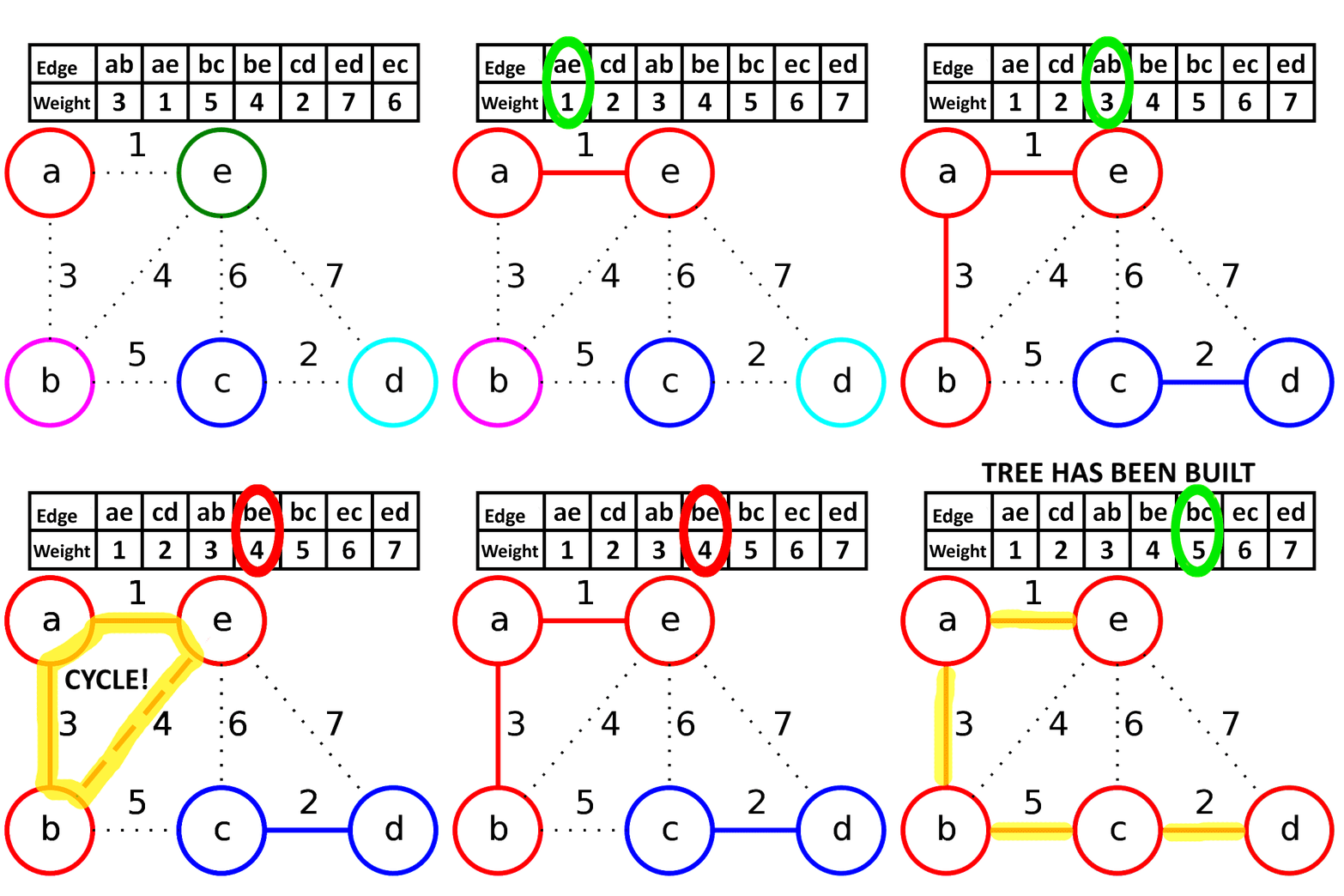
Sort every edge once, then walk the sorted list, using union-find exactly as in cycle detection to reject any edge whose endpoints are already connected:
shared graph, edges sorted by weight ascending (ties broken alphabetically):
  B-C 1, A-C 2, D-E 2, E-F 3, A-B 4, B-D 5, D-F 6, C-D 8, C-E 10

  edge    accept?   reason
  B-C 1   accept    B, C in separate components -> {B,C}
  A-C 2   accept    A alone, C in {B,C}          -> {A,B,C}
  D-E 2   accept    D, E in separate components  -> {D,E}
  E-F 3   accept    F alone, E in {D,E}          -> {D,E,F}
  A-B 4   reject    A and B already both in {A,B,C}: closes a cycle
  B-D 5   accept    {A,B,C} and {D,E,F} merge     -> {A,B,C,D,E,F}
                     5 edges accepted = V-1: MST complete, remaining edges unneeded
Total weight 1 + 2 + 2 + 3 + 5 = 13.
- Python
- C++
def kruskal_mst(n, edges):
    """edges: [(u, v, w), ...] over vertices 0..n-1. Returns (mst_edges, total_weight)."""
    parent = list(range(n))

    def find(x):
        while parent[x] != x:
            parent[x] = parent[parent[x]]      # path halving
            x = parent[x]
        return x

    mst, total = [], 0
    for u, v, w in sorted(edges, key=lambda e: e[2]):
        ru, rv = find(u), find(v)
        if ru != rv:
            parent[ru] = rv
            mst.append((u, v, w))
            total += w
    return mst, total
#include <algorithm>
#include <numeric>
#include <queue>
#include <tuple>
#include <vector>

using Edge = std::tuple<int, int, int>;   // u, v, weight

std::pair<std::vector<Edge>, int> kruskal_mst(int n, std::vector<Edge> edges) {
    std::vector<int> parent(n);
    std::iota(parent.begin(), parent.end(), 0);
    auto find = [&](int x) {
        while (parent[x] != x) { parent[x] = parent[parent[x]]; x = parent[x]; }
        return x;
    };

    std::sort(edges.begin(), edges.end(),
              [](const Edge& a, const Edge& b) { return std::get<2>(a) < std::get<2>(b); });

    std::vector<Edge> mst;
    int total = 0;
    for (const auto& [u, v, w] : edges) {
        int ru = find(u), rv = find(v);
        if (ru != rv) {
            parent[ru] = rv;
            mst.push_back({u, v, w});
            total += w;
        }
    }
    return {mst, total};
}
Prim's algorithm: a heap over the frontier
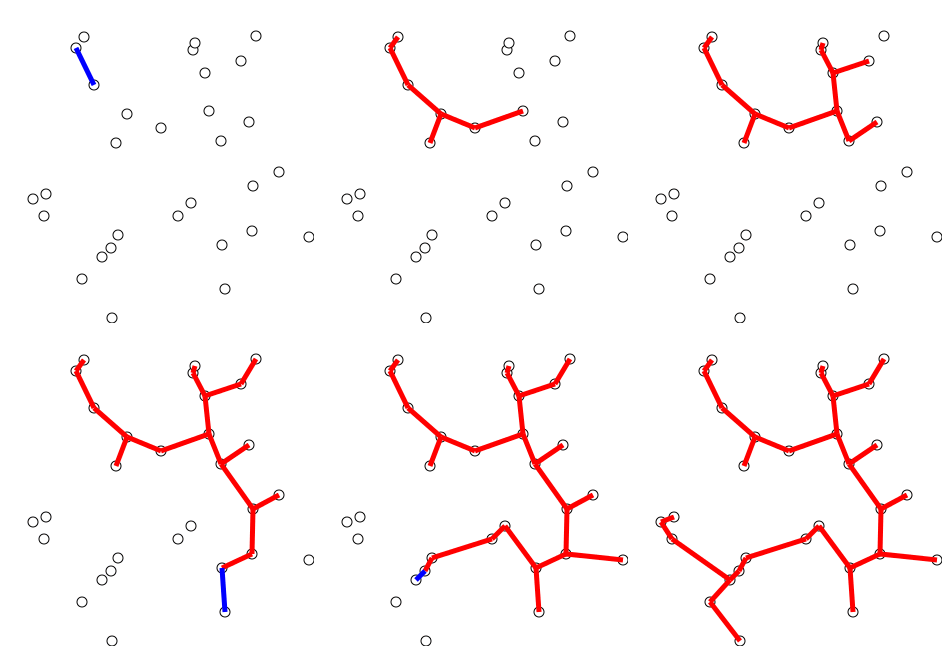
Starting from A, the frontier is every edge from a vertex already in the tree to one that is not,
held in a min-heap so the cheapest is always on top:
start = A. tree = {A}. frontier (min-heap by weight) seeded from A's edges: A-C 2, A-B 4

  pop      in tree already?   action                                          tree
  A-C 2    no                 accept, push C's edges (C-B 1, C-D 8, C-E 10)   {A,C}
  C-B 1    no                 accept, push B's edges (B-D 5)                  {A,C,B}
  A-B 4    yes -- B is already in the tree; this stale entry is just skipped
  B-D 5    no                 accept, push D's edges (D-E 2, D-F 6)           {A,C,B,D}
  D-E 2    no                 accept, push E's edges (E-F 3)                  {A,C,B,D,E}
  E-F 3    no                 accept                                          {A,C,B,D,E,F}
Five edges accepted (n − 1 for 6 vertices), so the loop stops here — C-D 8, C-E 10, and D-F 6 are
sitting in the heap but never popped. Total weight 2 + 1 + 5 + 2 + 3 = 13 — the same weight Kruskal
found, and in fact the same five edges, since this graph's MST happens to be unique.
- Python
- C++
import heapq

def prim_mst(n, adj, start=0):
    """adj: {u: [(v, w), ...]}. Returns (mst_edges, total_weight)."""
    visited = [False] * n
    visited[start] = True
    frontier = [(w, start, v) for v, w in adj[start]]
    heapq.heapify(frontier)

    mst, total = [], 0
    while frontier and len(mst) < n - 1:
        w, u, v = heapq.heappop(frontier)
        if visited[v]:
            continue                            # a stale, already-superseded frontier entry
        visited[v] = True
        mst.append((u, v, w))
        total += w
        for nv, nw in adj[v]:
            if not visited[nv]:
                heapq.heappush(frontier, (nw, v, nv))
    return mst, total
using AdjList = std::vector<std::vector<std::pair<int, int>>>;   // adj[u] = {(v, w), ...}

std::pair<std::vector<Edge>, int> prim_mst(int n, const AdjList& adj, int start = 0) {
    std::vector<bool> visited(n, false);
    visited[start] = true;
    using Item = std::tuple<int, int, int>;                       // weight, from, to
    std::priority_queue<Item, std::vector<Item>, std::greater<>> frontier;
    for (auto [v, w] : adj[start]) frontier.push({w, start, v});

    std::vector<Edge> mst;
    int total = 0;
    while (!frontier.empty() && static_cast<int>(mst.size()) < n - 1) {
        auto [w, u, v] = frontier.top();
        frontier.pop();
        if (visited[v]) continue;               // stale entry
        visited[v] = true;
        mst.push_back({u, v, w});
        total += w;
        for (auto [nv, nw] : adj[v])
            if (!visited[nv]) frontier.push({nw, v, nv});
    }
    return {mst, total};
}
Neither algorithm removes stale frontier entries when a vertex is reached more cheaply later — it is
cheaper to leave them and skip them on pop (if visited[v]: continue) than to search the heap for an
entry to delete, since binary heaps have no efficient decrease-key.
Practical Usage
scipy.sparse.csgraph.minimum_spanning_treeimplements Kruskal's algorithm over a sparse adjacency matrix and returns the MST as another sparse matrix — see the SciPy documentation for the exact input format (an upper-triangular or symmetric weight matrix).- C++ Boost Graph Library's
boost::kruskal_minimum_spanning_treeandboost::prim_minimum_spanning_treeare the standard choices when the graph is already aboost::adjacency_list; the standard library itself has no MST algorithm. - Network design is the textbook application: minimum cable length connecting offices, minimum pipe length connecting reservoirs — anywhere "connect everything, minimize total cost" is literal, not a metaphor.
- Clustering. Removing the
k - 1most expensive edges from an MST splits the graph into exactlykclusters, each internally connected by cheap edges — single-linkage clustering is MST computation followed by this cut.
# vertices 0..5 = A..F; edges as (u, v, weight) both ways implied
edges = [(0,1,4), (0,2,2), (1,2,1), (1,3,5), (2,3,8), (2,4,10), (3,4,2), (3,5,6), (4,5,3)]
mst, total = kruskal_mst(6, edges)
assert total == 13
assert sorted(mst) == [(0, 2, 2), (1, 2, 1), (1, 3, 5), (3, 4, 2), (4, 5, 3)]

adj = {i: [] for i in range(6)}
for u, v, w in edges:
    adj[u].append((v, w))
    adj[v].append((u, w))
prim_mst_edges, prim_total = prim_mst(6, adj, start=0)
assert prim_total == 13                             # same weight as Kruskal, as the cut property guarantees
Edge Cases & Pitfalls
- Disconnected graphs have no spanning tree. Kruskal terminates having accepted fewer than
V - 1edges; Prim's frontier empties before every vertex is reached. Check the edge count (or visited count) before trusting the result — neither algorithm raises on its own. - Negative weights are fine. Unlike shortest-path algorithms, MST correctness never assumes non-negative weights; the cut property holds regardless of sign.
- Equal weights mean multiple correct MSTs. Both algorithms are then correct but may disagree with each other, or with a different tie-breaking rule, on which MST — only the total weight is guaranteed to match. This graph has no weight ties among the accepted edges, so its MST is unique.
- Prim needs a starting vertex; Kruskal does not. Prim's result is the same total weight from any start (only the traversal order differs), but a bug that reseeds the frontier incorrectly on restart can silently produce a spanning forest instead of a tree.
- Directed graphs need a different algorithm (minimum arborescence / Chu-Liu-Edmonds) — Kruskal and Prim both assume that crossing a cut in either direction costs the same.
Comparisons
| Best for | Time (worst) | Structure needed | Notes | |
|---|---|---|---|---|
| Kruskal | Sparse graphs, edges already listed | Flat edge list + union-find | Dominated by the one sort | |
| Prim (binary heap) | Dense graphs, adjacency already built | Adjacency list + heap | Never sorts the whole edge set | |
| Prim (array, no heap) | Very dense graphs | Adjacency matrix | Beats the heap version when E is close to V² |
Kruskal wins when the graph arrives as a flat edge list and is sparse — the sort dominates, and E log E is small. Prim wins when the graph is already an adjacency list and dense, since it never needs the full sorted edge order, only the current frontier's minimum; the array-based (heapless) variant of Prim is actually faster still on the densest graphs, because E log V's log factor stops paying for itself once E approaches V² (Sedgewick & Wayne 4th ed., §4.3, gives the crossover analysis in detail).
Recall
References
- Cormen, Leiserson, Rivest & Stein, Introduction to Algorithms, 4th ed., Ch. 21 — the cut property (Thm 21.1), Kruskal's and Prim's algorithms, and their correctness proofs from the same theorem.
- Sedgewick & Wayne, Algorithms, 4th ed., §4.3 "Minimum Spanning Trees" — both algorithms measured against each other, plus the array-vs-heap crossover for Prim on dense graphs.
- J. B. Kruskal, "On the Shortest Spanning Subtree of a Graph...", Proc. AMS 7(1), 1956 — the original paper.
- R. C. Prim, "Shortest Connection Networks and Some Generalizations", Bell System Technical Journal 36(6), 1957 — the original paper, framed as a telephone-network cost problem.
- SciPy
csgraph.minimum_spanning_treedocumentation — the stdlib-adjacent implementation most Python code actually calls.
Related Pages
- Union-Find — the cycle test Kruskal runs on every candidate edge.
- Heaps & Priority Queues — the frontier structure Prim pops from.
- Cycle Detection — the same union-find check, applied here to reject an edge instead of report a cycle.
- Shortest Paths — Prim and Dijkstra share a frontier-and-heap shape but optimize different quantities: total tree weight versus per-vertex distance from a source.