Shortest Paths
"Shortest" means fewest edges on an unweighted graph and lowest total weight on a weighted one, and the two need different algorithms — which one is decided by two questions: are the edges weighted, and can any weight be negative?
Choosing
| Situation | Algorithm | Complexity |
|---|---|---|
| Unweighted graph | BFS | |
| Non-negative weights, one source | Dijkstra's | |
| Negative weights allowed, one source | Bellman–Ford | |
| All pairs, dense graph | Floyd–Warshall | |
| Non-negative weights, one target known | A* with an admissible heuristic | Depends on heuristic |
Mechanism
Dijkstra's algorithm
Repeatedly finalise the nearest unfinalised vertex, then relax its outgoing edges. A priority queue supplies "nearest" in , which is where the log factor comes from.
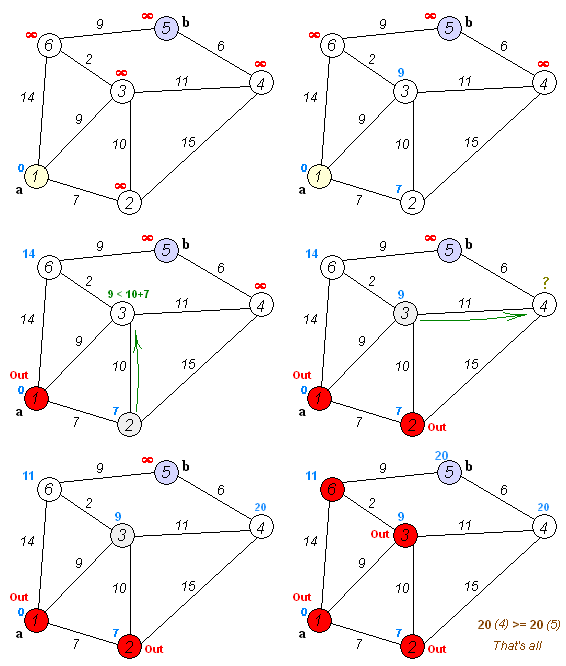
- Python
- C++
import heapq

def dijkstra(graph, start):
    """graph: {node: [(neighbour, weight), ...]} with all weights >= 0."""
    dist = {start: 0}
    prev = {start: None}
    pq = [(0, start)]                       # (distance, node)
    done = set()

    while pq:
        d, node = heapq.heappop(pq)
        if node in done:                    # a stale entry — skip it
            continue
        done.add(node)                      # dist[node] is now final

        for nb, weight in graph[node]:
            candidate = d + weight
            if candidate < dist.get(nb, float("inf")):
                dist[nb] = candidate
                prev[nb] = node
                heapq.heappush(pq, (candidate, nb))   # lazy deletion
    return dist, prev
#include <algorithm>
#include <limits>
#include <queue>
#include <stdexcept>
#include <tuple>
#include <unordered_map>
#include <unordered_set>
#include <vector>

// graph: node -> [(neighbour, weight), ...] with all weights >= 0.
using Graph = std::unordered_map<int, std::vector<std::pair<int, int>>>;

struct Paths {
    std::unordered_map<int, int> dist;
    std::unordered_map<int, int> prev;
};

Paths dijkstra(const Graph& graph, int start) {
    Paths out{{{start, 0}}, {}};
    using Entry = std::pair<int, int>;                      // (distance, node)
    std::priority_queue<Entry, std::vector<Entry>, std::greater<>> pq;
    pq.push({0, start});
    std::unordered_set<int> done;

    while (!pq.empty()) {
        auto [d, node] = pq.top();
        pq.pop();
        if (done.count(node)) continue;                     // a stale entry — skip it
        done.insert(node);                                  // dist[node] is now final

        for (auto [nb, weight] : graph.at(node)) {
            int candidate = d + weight;
            auto it = out.dist.find(nb);
            if (it == out.dist.end() || candidate < it->second) {
                out.dist[nb] = candidate;
                out.prev[nb] = node;
                pq.push({candidate, nb});                   // lazy deletion
            }
        }
    }
    return out;
}
The done check implements lazy deletion: heapq cannot decrease an existing entry's key, so
the code pushes a new one and ignores the outdated copy when it surfaces. This is the standard
workaround, it keeps the complexity correct, and it is simpler than maintaining an indexed heap.
Worked trace: Dijkstra's from A
Run on the shared weighted graph. Each row is one real pop (stale entries — an earlier, more expensive copy of an already-finalised vertex — are noted but change nothing):
pop      done so far      dist[A,B,C,D,E,F]              frontier after (stale entries dropped)
A (0)    {A}              0, 4, 2, inf, inf, inf         [(2,C),(4,B)]
C (2)    {A,C}            0, 3, 2, 10, 12, inf           [(3,B),(10,D),(12,E)]     -- (4,B) now stale
B (3)    {A,C,B}          0, 3, 2, 8, 12, inf            [(8,D),(12,E)]           -- (4,B),(10,D) stale
D (8)    {A,C,B,D}        0, 3, 2, 8, 10, 14             [(10,E),(14,F)]          -- (10,D),(12,E) stale
E (10)   {A,C,B,D,E}      0, 3, 2, 8, 10, 13             [(13,F)]                 -- (12,E),(14,F) stale
F (13)   {A,C,B,D,E,F}    0, 3, 2, 8, 10, 13             []                       -- (14,F) popped, also stale
Final distances from A: B=3 via A->C->B (cheaper than the direct edge's 4), C=2, D=8 via
A->C->B->D, E=10, F=13, in increasing-distance pop order A, C, B, D, E, F — no path still in
the queue can ever beat one already popped, since every edge weight is non-negative.
A negative edge breaks the "never gets shorter" assumption: A→B=5, A→C=6, C→B=−4 finalises B at 5, then discovers A→C→B costs 2 — but B is already done and never updated. No error, no warning; the distance is simply wrong. If any weight can be negative, use Bellman–Ford.
Bellman–Ford
Relax every edge, V−1 times. Slower, but it makes no assumption about sign, and it can detect negative cycles:
- Python
- C++
def bellman_ford(vertices, edges, start):
    """edges: [(u, v, weight), ...]; weights may be negative."""
    dist = {v: float("inf") for v in vertices}
    dist[start] = 0

    for _ in range(len(vertices) - 1):       # any shortest path has ≤ V−1 edges
        changed = False
        for u, v, w in edges:
            if dist[u] + w < dist[v]:
                dist[v] = dist[u] + w
                changed = True
        if not changed:                      # early exit once stable
            break

    for u, v, w in edges:                    # a further improvement means a negative cycle
        if dist[u] + w < dist[v]:
            raise ValueError("negative cycle reachable from start")
    return dist
struct Edge { int u, v, w; };                               // weights may be negative

std::unordered_map<int, long long> bellman_ford(
        const std::vector<int>& vertices, const std::vector<Edge>& edges, int start) {
    constexpr long long INF = std::numeric_limits<long long>::max() / 4;
    std::unordered_map<int, long long> dist;
    for (int v : vertices) dist[v] = INF;
    dist[start] = 0;

    for (std::size_t i = 1; i < vertices.size(); ++i) {     // any shortest path has ≤ V−1 edges
        bool changed = false;
        for (const auto& [u, v, w] : edges) {
            if (dist[u] + w < dist[v]) {
                dist[v] = dist[u] + w;
                changed = true;
            }
        }
        if (!changed) break;                                // early exit once stable
    }

    for (const auto& [u, v, w] : edges)                     // a further improvement means a negative cycle
        if (dist[u] + w < dist[v])
            throw std::runtime_error("negative cycle reachable from start");
    return dist;
}
The V−1 bound is the whole proof: a shortest path visits each vertex at most once, so it has at most V−1 edges, and each pass extends every path by at least one edge. Negative cycles make "shortest path" meaningless — you can loop forever, getting cheaper each time — and detecting them is a feature: it is how currency-arbitrage detection works, with weights set to −log(exchange rate).
Floyd–Warshall: every pair at once
Running Dijkstra's or Bellman–Ford from every vertex answers "all pairs" too, but Floyd–Warshall
often wins on dense graphs by asking, for each pair (i, j): does routing through k shorten the
known path? Trying every k as an intermediate, in order, is the whole algorithm:
- Python
- C++
def floyd_warshall(n, edges):
    """edges: [(u, v, weight), ...]; weights may be negative, but not a negative cycle."""
    INF = float("inf")
    dist = [[0 if i == j else INF for j in range(n)] for i in range(n)]
    for u, v, w in edges:
        dist[u][v] = min(dist[u][v], w)

    for k in range(n):                          # k is the newly-allowed intermediate vertex
        for i in range(n):
            for j in range(n):
                through_k = dist[i][k] + dist[k][j]
                if through_k < dist[i][j]:
                    dist[i][j] = through_k
    return dist

# vertices 0..5 = A..F; the shared weighted graph, both directions
graph = {0:[(1,4),(2,2)], 1:[(0,4),(2,1),(3,5)], 2:[(0,2),(1,1),(3,8),(4,10)],
         3:[(1,5),(2,8),(4,2),(5,6)], 4:[(2,10),(3,2),(5,3)], 5:[(3,6),(4,3)]}
expected = [0, 3, 2, 8, 10, 13]                          # the traced distances from A
dist, _ = dijkstra(graph, 0)
assert [dist[v] for v in range(6)] == expected

edges = [(u, v, w) for u in graph for v, w in graph[u]]  # flatten, already both directions
assert [bellman_ford(range(6), edges, 0)[v] for v in range(6)] == expected
assert floyd_warshall(6, edges)[0] == expected           # row 0 (from A) agrees with both above
using Matrix = std::vector<std::vector<long long>>;

Matrix floyd_warshall(int n, const std::vector<std::tuple<int, int, int>>& edges) {
    constexpr long long INF = std::numeric_limits<long long>::max() / 4;
    Matrix dist(n, std::vector<long long>(n, INF));
    for (int i = 0; i < n; ++i) dist[i][i] = 0;
    for (const auto& [u, v, w] : edges) dist[u][v] = std::min(dist[u][v], (long long)w);

    for (int k = 0; k < n; ++k)                  // k is the newly-allowed intermediate vertex
        for (int i = 0; i < n; ++i)
            for (int j = 0; j < n; ++j) {
                long long through_k = dist[i][k] + dist[k][j];
                if (through_k < dist[i][j]) dist[i][j] = through_k;
            }
    return dist;
}
The k loop must be outermost, per the DP recurrence dp[k][i][j] = min(dp[k-1][i][j], dp[k-1][i][k] + dp[k-1][k][j]) — swapping k for i still compiles and terminates, but silently
computes the wrong answer for some pairs. A negative cycle shows up afterwards as dist[i][i] < 0.
A*: Dijkstra's with a hint
For a path to one target, A* orders the queue by dist[node] + heuristic(node, goal) instead of
dist[node] alone. An admissible heuristic (never overestimates) still returns the true shortest
path while exploring far fewer vertices; zero turns A* back into Dijkstra's exactly — see
A* & Heuristic Search for the implementation.
Practical Usage
| Domain | Vertices | Weights |
|---|---|---|
| Navigation | Intersections | Travel time — the reason A* dominates here |
| Network routing | Routers | Link cost — OSPF is Dijkstra's, RIP is Bellman–Ford |
| Game AI pathfinding | Grid cells or waypoints | Movement cost |
Edge Cases & Pitfalls
- Unreachable vertices stay at infinity — decide whether that is an error or an expected result.
- Reconstructing the path needs the
prevmap, followed backwards from the goal and reversed — returning distances alone is a common oversight. - Ties in the priority queue compare the second tuple element — insert a counter if nodes are not orderable, the same hazard as on the heaps page.
- Dijkstra's on a dense graph is with a plain array, beating the heap's once E approaches .
- An inadmissible A* heuristic returns fast paths that are not necessarily shortest — fine for games, a bug for navigation.
Comparisons
| BFS | Dijkstra's | Bellman–Ford | Floyd–Warshall | |
|---|---|---|---|---|
| Weights, sources, best for | None, one, unweighted | Non-negative, one, usual case | Any, one, cycle check | Any, all pairs, small dense |
| Complexity (worst) | ||||
| Detects negative cycles | — | No | Yes | Yes |
Recall
References
- Dijkstra, E.W. (1959), "A note on two problems in connexion with graphs", Numerische Mathematik — the original two-page paper.
- Cormen, Leiserson, Rivest & Stein, Introduction to Algorithms, 4th ed., Ch. 22–23 — single-source and all-pairs shortest paths, including Floyd-Warshall's DP formulation and correctness proof.
- Hart, Nilsson & Raphael (1968), "A Formal Basis for the Heuristic Determination of Minimum Cost Paths" — the A* paper.
- VisuAlgo — Shortest Paths — run Dijkstra's and Bellman–Ford on the same graph, including one with negative edges.
Related Pages
- Graph Algorithms — Overview — the shared weighted graph this page's trace runs on.
- Traversal: BFS & DFS — BFS as the unweighted special case.
- Heaps & Priority Queues — the structure Dijkstra's complexity depends on.
- Network Layer & Routing — these algorithms in production.