Traversal: BFS & DFS
Breadth-first and depth-first search both visit every vertex reachable from a start point, in , using the same loop. They differ in one line — whether the frontier is a queue or a stack — and that single difference determines the order, the memory profile, and which problems each can solve.
Core Concepts
| Breadth-first (BFS) | Depth-first (DFS) | |
|---|---|---|
| Frontier | Queue (FIFO) | Stack (LIFO), or recursion |
| Explores | All vertices at distance k before k+1 | One branch fully, then backtracks |
| Memory, finds shortest paths | , yes (unweighted) | , no |
| Natural for | Distance, levels, nearest match | Cycles, ordering, connectivity, backtracking |
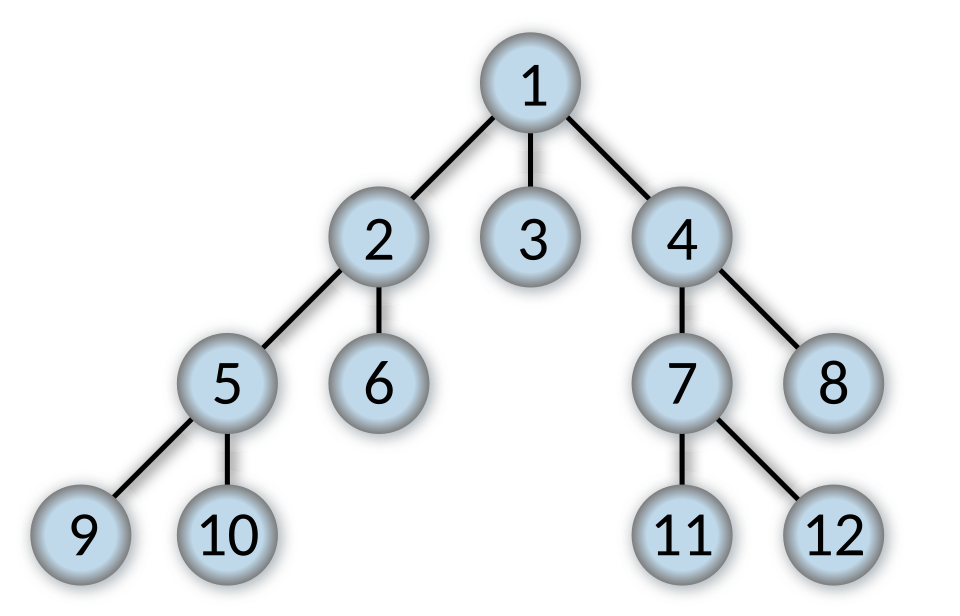
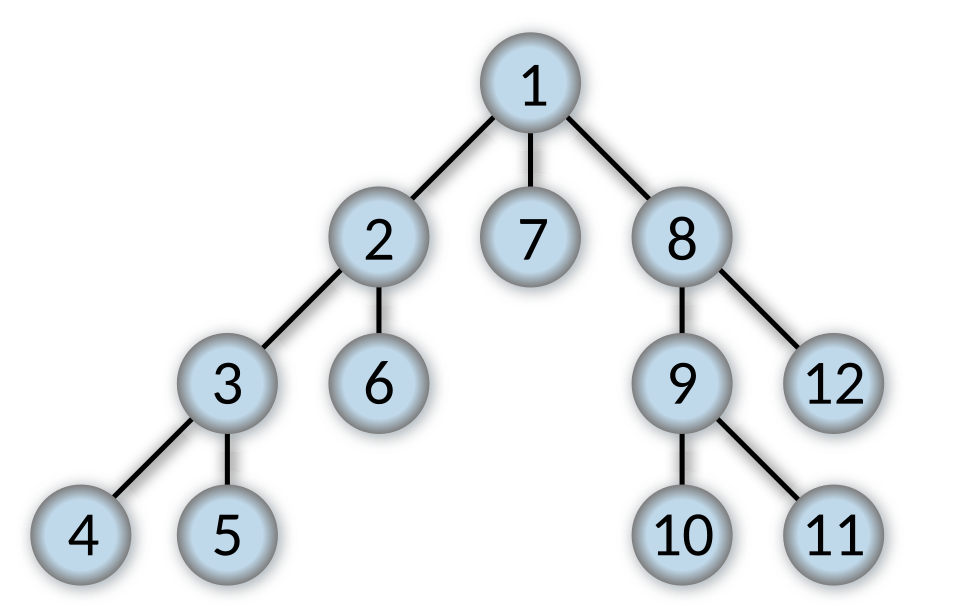
Mechanism
Worked trace: BFS queue vs. DFS stack, side by side
Both searches run on the shared undirected graph from A,
with each vertex's neighbours visited in the order the edge list introduces them (B, C for A;
A, C, D for B; and so on). BFS enqueues a neighbour the moment it is first seen; DFS pushes it
and may push it again before ever popping it, relying on the post-pop check to discard the stale
copy:
BFS from A (queue, FIFO, mark on enqueue):
  pop -    queue=[A]                    visited={A}
  pop A -> queue=[B,C]                  visited={A,B,C}        enqueue B,C
  pop B -> queue=[C,D]                  visited={A,B,C,D}      enqueue D  (A,C already visited)
  pop C -> queue=[D,E]                  visited={A,B,C,D,E}    enqueue E  (A,B,D already visited)
  pop D -> queue=[E,F]                  visited={A,B,C,D,E,F}  enqueue F  (B,C,E already visited)
  pop E -> queue=[F]                    (C,D,F already visited, nothing new)
  pop F -> queue=[]                     (D,E already visited, nothing new)
  BFS visit order: A B C D E F

DFS from A (stack, LIFO, mark on pop — stale entries are skipped):
  pop -    stack=[A]
  pop A -> stack=[C,B]                  visit A, push C,B
  pop B -> stack=[C,D,C]                visit B, push D,C           (A already visited)
  pop C -> stack=[C,D,E,D]              visit C, push E,D           (A,B already visited)
  pop D -> stack=[C,D,E,F,E]            visit D, push F,E           (B,C already visited)
  pop E -> stack=[C,D,E,F,F]            visit E, push F             (C,D already visited)
  pop F -> stack=[C,D,E,F]              visit F                     (D,E already visited, nothing new)
  pop F -> stack=[C,D,E]                stale — F already visited, skip
  pop E -> stack=[C,D]                  stale — E already visited, skip
  pop D -> stack=[C]                    stale — D already visited, skip
  pop C -> stack=[]                     stale — C already visited, skip
  DFS visit order: A B C D E F
Both finish at the same six vertices in the same order here — a property of this input, not a general fact — but the intermediate state is where they diverge: BFS's queue only ever holds unvisited vertices, while DFS's stack accumulates stale duplicates, each discarded for free on pop rather than prevented from entering in the first place.
- Python
- C++
from collections import deque

def bfs(graph, start):
    visited = {start}
    queue = deque([start])
    while queue:
        node = queue.popleft()          # FIFO — the oldest frontier vertex
        yield node
        for nb in graph[node]:
            if nb not in visited:
                visited.add(nb)         # mark on ENQUEUE, not on dequeue
                queue.append(nb)

def dfs(graph, start):
    visited = set()
    stack = [start]
    while stack:
        node = stack.pop()              # LIFO — the newest frontier vertex
        if node in visited:
            continue
        visited.add(node)
        yield node
        for nb in reversed(graph[node]):
            if nb not in visited:
                stack.append(nb)

def dfs_recursive(graph, node, visited=None):
    visited = visited if visited is not None else set()
    visited.add(node)
    yield node
    for nb in graph[node]:
        if nb not in visited:
            yield from dfs_recursive(graph, nb, visited)
#include <algorithm>
#include <deque>
#include <optional>
#include <unordered_map>
#include <unordered_set>
#include <vector>

using Graph = std::unordered_map<int, std::vector<int>>;

std::vector<int> bfs(const Graph& graph, int start) {
    std::unordered_set<int> visited{start};
    std::deque<int> queue{start};
    std::vector<int> order;
    while (!queue.empty()) {
        int node = queue.front();           // FIFO — the oldest frontier vertex
        queue.pop_front();
        order.push_back(node);
        for (int nb : graph.at(node))
            if (visited.insert(nb).second)  // mark on ENQUEUE, not on dequeue
                queue.push_back(nb);
    }
    return order;
}

std::vector<int> dfs(const Graph& graph, int start) {
    std::unordered_set<int> visited;
    std::vector<int> stack{start}, order;
    while (!stack.empty()) {
        int node = stack.back();            // LIFO — the newest frontier vertex
        stack.pop_back();
        if (!visited.insert(node).second) continue;
        order.push_back(node);
        const auto& nbs = graph.at(node);
        for (auto it = nbs.rbegin(); it != nbs.rend(); ++it)
            if (!visited.count(*it)) stack.push_back(*it);
    }
    return order;
}

void dfs_recursive(const Graph& graph, int node,
                   std::unordered_set<int>& visited, std::vector<int>& order) {
    visited.insert(node);
    order.push_back(node);
    for (int nb : graph.at(node))
        if (!visited.count(nb)) dfs_recursive(graph, nb, visited, order);
}
In BFS, marking on dequeue lets a vertex enter the queue several times before it is first processed — once per neighbour that reaches it. On a dense graph the queue can grow to , and the shortest-path distances computed from it may be wrong.
DFS is the opposite: because a vertex can legitimately be pushed several times before being popped,
the iterative version must check visited again after popping, as above. The two algorithms have
genuinely different bookkeeping, and copying one's structure to the other is a common bug.
BFS computes shortest paths; DFS does not
BFS reaches each vertex, for the first time, by a path with the fewest possible edges. Recording each vertex's predecessor as it is first reached gives the path itself:
- Python
- C++
def shortest_path(graph, start, goal):
    prev = {start: None}
    queue = deque([start])
    while queue:
        node = queue.popleft()
        if node == goal:
            path = []
            while node is not None:
                path.append(node)
                node = prev[node]
            return path[::-1]
        for nb in graph[node]:
            if nb not in prev:
                prev[nb] = node
                queue.append(nb)
    return None                         # goal unreachable
std::optional<std::vector<int>> shortest_path(const Graph& graph, int start, int goal) {
    std::unordered_map<int, int> prev{{start, start}};   // start is its own predecessor
    std::deque<int> queue{start};
    while (!queue.empty()) {
        int node = queue.front();
        queue.pop_front();
        if (node == goal) {
            std::vector<int> path;
            for (int v = goal; ; v = prev[v]) {
                path.push_back(v);
                if (v == start) break;
            }
            std::reverse(path.begin(), path.end());
            return path;
        }
        for (int nb : graph.at(node))
            if (!prev.count(nb)) {
                prev[nb] = node;
                queue.push_back(nb);
            }
    }
    return std::nullopt;                                 // goal unreachable
}
DFS can reach the goal by an arbitrarily long detour — it answers "is there a path", never "what is the shortest path".
Practical Usage
| Problem | Use | Why |
|---|---|---|
| Fewest moves in a puzzle, degrees of separation | BFS | Shortest path in edges |
| Web crawling by link depth | BFS | Naturally bounded by level |
| Cycle detection | DFS | A back edge to a vertex still on the stack is a cycle |
| Topological sort | DFS | Post-order reversed gives the ordering |
| Connected components | Either | Loop over vertices, traverse from each unvisited one |
| Maze solving, N-queens, sudoku, flood fill | DFS | Backtracking is depth-first by nature |
| Bipartiteness check | BFS | Two-colour by level |
- Python
- C++
# Connected components — the pattern for any "do it for the whole graph" question
def components(graph):
    seen, groups = set(), []
    for v in graph:                     # every vertex, not just one start point
        if v not in seen:
            group = list(bfs(graph, v))
            seen.update(group)
            groups.append(group)
    return groups

# the shared undirected graph, checked against the traced order above
g = {"A": ["B", "C"], "B": ["A", "C", "D"], "C": ["A", "B", "D", "E"],
     "D": ["B", "C", "E", "F"], "E": ["C", "D", "F"], "F": ["D", "E"]}
assert list(bfs(g, "A")) == ["A", "B", "C", "D", "E", "F"]
assert list(dfs(g, "A")) == ["A", "B", "C", "D", "E", "F"]
assert shortest_path(g, "A", "F") == ["A", "B", "D", "F"]   # 3 edges, fewest possible
assert components(g) == [["A", "B", "C", "D", "E", "F"]]    # one connected component
// Connected components — the pattern for any "do it for the whole graph" question
std::vector<std::vector<int>> components(const Graph& graph) {
    std::unordered_set<int> seen;
    std::vector<std::vector<int>> groups;
    for (const auto& [v, outs] : graph) {       // every vertex, not just one start point
        if (seen.count(v)) continue;
        auto group = bfs(graph, v);
        seen.insert(group.begin(), group.end());
        groups.push_back(std::move(group));
    }
    return groups;
}
Edge Cases & Pitfalls
- Forgetting
visitedentirely loops forever on any cyclic graph — the difference between graph traversal and tree traversal, since trees cannot loop but graphs can. - Directed-graph cycle detection needs three states, not two — a vertex still open on the call stack versus one already finished. Cycle Detection covers the resulting three-colour DFS, plus the separate parent-edge trap undirected graphs need instead.
- Recursive DFS overflows the stack on deep graphs (Python's default limit is ~1000 frames); use the iterative form for untrusted or large input.
- DFS visit order depends on neighbour order — iterative DFS with
stack.pop()visits the last neighbour first, which is why the code above reverses the list to match the recursive version. - Disconnected graphs need the outer loop shown in
components; a single traversal reaches one component only. - BFS memory is the graph's width, which on a broad graph can exceed DFS's depth substantially — the opposite of the usual assumption.
Recall
References
- Cormen, Leiserson, Rivest & Stein, Introduction to Algorithms, 4th ed., §22.2–22.3 — BFS and DFS with the white/grey/black colouring and the classification of edges.
- Sedgewick & Wayne, Algorithms, 4th ed., §4.1 — undirected graphs, with both traversals implemented and applied.
- VisuAlgo — Graph Traversal — run both on the same graph and watch the frontier evolve.
Related Pages
- Shortest Paths — what BFS becomes once edges have weights.
- Topological Sort — DFS post-order put to work.
- Cycle Detection — the three-colour DFS this page's traps point to.
- Stacks & Queues — the one-line difference between the two.