Combinatorics & Counting
"How many ways" questions tempt a direct answer: generate every arrangement, every selection, every outcome, and count them. That is always correct and often the wrong tool, because the count of outcomes frequently grows exponentially even when the number itself has a short formula. Choosing 5 cards from a 52-card deck has C(52, 5) = 2,598,960 possible hands; generating and counting them one by one wastes work a single formula answers instantly. Combinatorics is the set of tools for getting the count without paying for the enumeration — a formula when one exists in closed form, a recurrence built as a DP table when it does not, and an inclusion-exclusion argument when the straightforward count double-counts something.
The same shift shows up in three specific tools this page covers. Permutations and combinations are closed-form counts for ordering and selecting. Pascal's triangle turns "compute C(n, k)" into a table built by addition alone, with no factorials and no risk of an intermediate overflowing before it is divided back down. Inclusion-exclusion corrects a count that over-counts elements belonging to more than one of several sets, by systematically adding and subtracting the overlaps. And the pigeonhole principle is not a counting algorithm at all — it is a counting argument, used to prove existence statements ("two of these must collide") without needing to say which two.
Core Concepts
| Term | Meaning |
|---|---|
| Permutation | An ordered arrangement of k items from n; count is P(n, k) = n! / (n - k)! |
| Combination | An unordered selection of k items from n; count is C(n, k) = n! / (k! * (n - k)!) |
| Pascal's triangle recurrence | C(n, k) = C(n-1, k-1) + C(n-1, k) — choosing item n or not, with base cases C(n, 0) = C(n, n) = 1 |
| Inclusion-exclusion | |A ∪ B| = |A| + |B| - |A ∩ B|, generalizing to any number of sets by alternating added and subtracted overlaps |
| Pigeonhole principle | Placing more than n items into n containers forces at least one container to hold more than one item |
Mechanism
Trace input — C(5, 2), computed both by the closed-form formula and by five rows of Pascal's
triangle, to confirm they agree.
By formula: C(5, 2) = 5! / (2! * 3!) = 120 / (2 * 6) = 120 / 12 = 10.
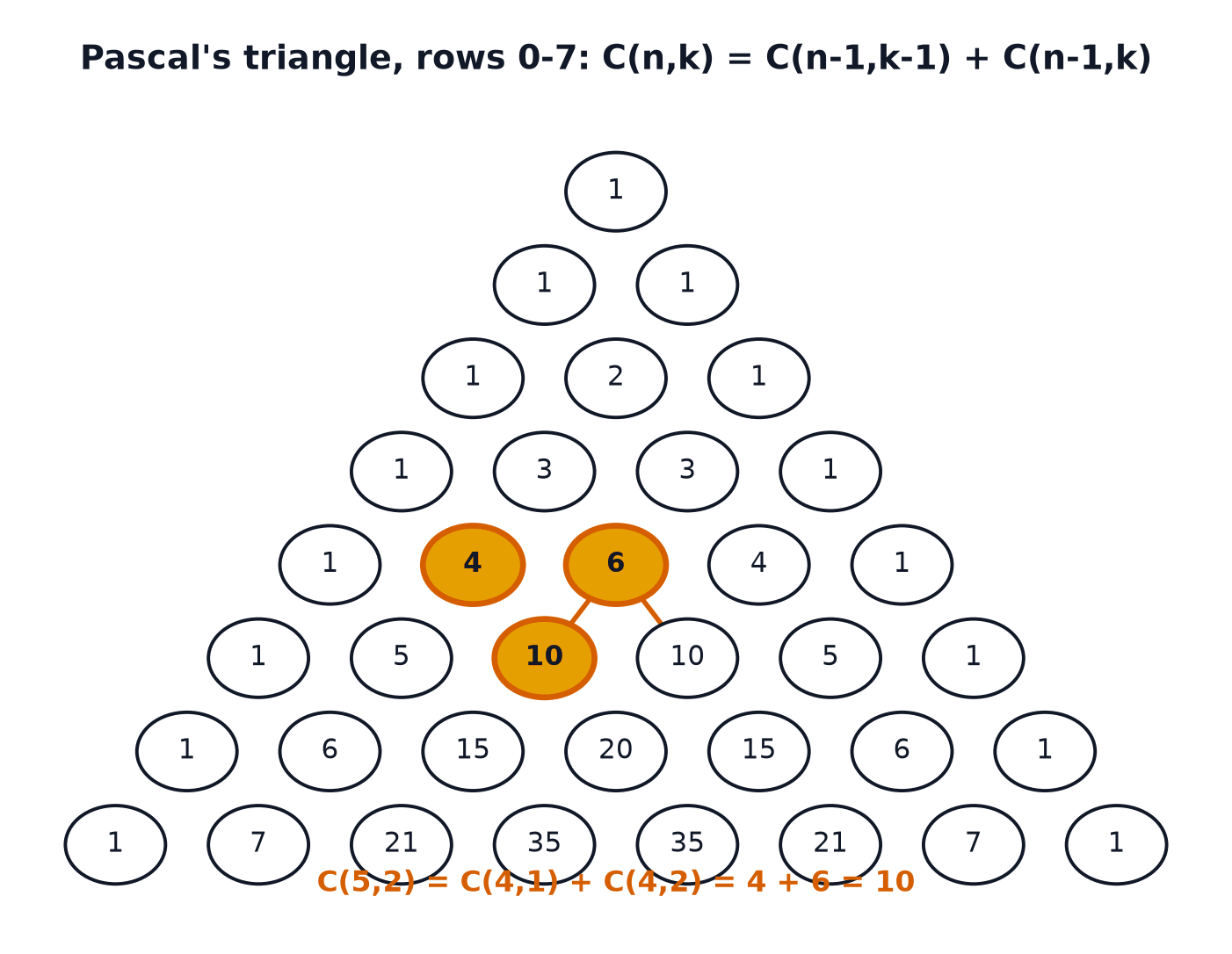
By the recurrence, building row by row from C(0,0) = 1:
row 0:             1
row 1:            1 1
row 2:           1 2 1
row 3:          1 3 3 1
row 4:         1 4 6 4 1
row 5:        1 5 10 10 5 1
                    ^
              C(5, 2) = 10  -- the 3rd entry (index 2) of row 5

Building C(5, 2) from the recurrence directly:
  C(4, 1) = C(3, 0) + C(3, 1) = 1 + 3 = 4
  C(4, 2) = C(3, 1) + C(3, 2) = 3 + 3 = 6
  C(5, 2) = C(4, 1) + C(4, 2) = 4 + 6 = 10      -- agrees with the formula
Both routes give 10, and the agreement is not a coincidence: Pascal's recurrence is the formula's
own identity C(n,k) = C(n-1,k-1) + C(n-1,k), provable directly by splitting a choice of k from
n items into "the n-th item is included" (choose k-1 more from the remaining n-1) and "the
n-th item is excluded" (choose k from the remaining n-1) — two disjoint cases that together
cover every selection exactly once.
- Python
- C++
from math import comb, factorial, perm


def permutations_count(n, k):
    """P(n, k) = n! / (n - k)! -- ordered selections. O(k) with the loop form below."""
    result = 1
    for i in range(k):
        result *= (n - i)
    return result


def combinations_count(n, k):
    """C(n, k) = n! / (k! (n - k)!) -- unordered selections."""
    return permutations_count(n, k) // factorial(k)


def pascals_triangle(rows):
    """Builds C(n, k) for 0 <= n < rows via the DP recurrence -- no factorials, no overflow risk."""
    triangle = [[1]]
    for n in range(1, rows):
        prev = triangle[-1]
        row = [1] + [prev[k - 1] + prev[k] for k in range(1, n)] + [1]
        triangle.append(row)
    return triangle
#include <cassert>
#include <cstdint>
#include <vector>

long long permutations_count(int n, int k) {
    long long result = 1;
    for (int i = 0; i < k; ++i) result *= (n - i);
    return result;
}

long long factorial_ll(int k) {
    long long result = 1;
    for (int i = 2; i <= k; ++i) result *= i;
    return result;
}

long long combinations_count(int n, int k) {
    return permutations_count(n, k) / factorial_ll(k);
}

std::vector<std::vector<long long>> pascals_triangle(int rows) {
    std::vector<std::vector<long long>> triangle;
    triangle.push_back({1});
    for (int n = 1; n < rows; ++n) {
        std::vector<long long> row(n + 1, 1);
        for (int k = 1; k < n; ++k) row[k] = triangle.back()[k - 1] + triangle.back()[k];
        triangle.push_back(row);
    }
    return triangle;
}
Practical Usage
- Python's
math.combandmath.perm(both added in 3.8) compute exactlycombinations_count/permutations_countabove, in C, and should be preferred in real code;pascals_triangleearns its keep specifically when everyC(n, k)up to some bound is needed at once, since building the whole table is cheaper thanrows^2separatemath.combcalls once intermediate factorials would otherwise be recomputed repeatedly. - Modular binomial coefficients. When
nis large and results must be taken modulo a primep, factorials overflow long beforen!fits any fixed-width integer — the standard fix precomputes factorials and their modular inverses modpusing fast exponentiation, turning eachC(n, k) mod pquery into after an precompute. - Inclusion-exclusion in practice. Counting integers up to
Ndivisible by 2 or 3 isN/2 + N/3 - N/6(the last term removes double-counting multiples of 6) — the same pattern scales to any fixed number of divisibility conditions. - Pigeonhole as a proof tool. Among any 13 people, two share a birth month (12 months, 13 people) — a one-line existence proof that requires no search to find which two.
- Python
- C++
# formula, recurrence, and stdlib agreement on the traced C(5, 2)
triangle = pascals_triangle(8)
assert triangle[5][2] == 10
assert combinations_count(5, 2) == 10
assert comb(5, 2) == 10                              # cross-checked against the stdlib
assert perm(5, 2) == permutations_count(5, 2) == 20   # P(5, 2) = 5*4 = 20

# inclusion-exclusion: multiples of 2 or 3 up to 30
n = 30
count = n // 2 + n // 3 - n // 6
assert count == len([x for x in range(1, n + 1) if x % 2 == 0 or x % 3 == 0])
int main() {
    auto triangle = pascals_triangle(8);
    assert(triangle[5][2] == 10);
    assert(combinations_count(5, 2) == 10);
    assert(permutations_count(5, 2) == 20);

    int n = 30;
    int count = n / 2 + n / 3 - n / 6;
    int brute = 0;
    for (int x = 1; x <= n; ++x) if (x % 2 == 0 || x % 3 == 0) ++brute;
    assert(count == brute);
}
Edge Cases & Pitfalls
- Computing
n!directly for largen.factorial(k)insidecombinations_countoverflows a fixed-width integer long beforengets large, even when the finalC(n, k)is modest — dividing the permutation count byk!(as done above) keeps the intermediatepermutations_count(n, k)smaller thann!itself, but for genuinely largenthe DP recurrence or a modular formulation is the only safe option in a fixed-width language. - Forgetting inclusion-exclusion's overlap term. Counting "divisible by 2" plus "divisible by 3" without subtracting "divisible by 6" double-counts every multiple of 6 — a classic silent overcount, not a crash.
- Misapplying pigeonhole with the wrong container count. The principle requires strictly more items than containers; "n items, n containers" proves nothing about a collision on its own.
- Confusing permutations and combinations. Using
P(n, k)where order does not matter (or vice versa) is a factor-of-k!error that produces a plausible-looking wrong number rather than an obvious crash.
Comparisons
| Cost | When it applies | |
|---|---|---|
Closed-form C(n, k) / P(n, k) | worst | One or a few queries, n small enough that intermediates do not overflow |
| Pascal's triangle DP, full table | worst | Every C(n, k) up to a bound needed at once |
Modular C(n, k) via precomputed factorial inverses | precompute, per query | Large n, results needed modulo a prime |
| Brute-force enumeration | worst | Never, once a formula or recurrence exists — useful only to sanity-check one by hand |
The choice is almost always "closed form for a single query, DP table for many queries over a bounded range" — the same precompute-once trade this folder's sieve page makes for primality.
Recall
References
- Cormen, Leiserson, Rivest & Stein, Introduction to Algorithms, 4th ed., Appendix C "Counting and Probability" — permutations, combinations, and the binomial coefficient's properties.
math.comb,math.perm— CPython's own documentation for the closed-form counts, including the 3.8 version note.
Related Pages
- Math & Number Theory — the folder's map of where this arithmetic surfaces elsewhere.
- GCD & Modular Arithmetic — fast exponentiation, used to compute
modular factorial inverses for large-
nbinomial coefficients. - Recurrences & the Master Theorem — the general tool for analyzing a recurrence like Pascal's, beyond just evaluating it.
- Randomized Algorithms & Sampling — the next page, where counting arguments justify why a random choice behaves as expected on average.