GCD & Modular Arithmetic
The greatest common divisor looks like a problem for factoring both numbers and comparing their
prime factorizations — and that works, but it costs as much as factoring, which for large numbers is
expensive. Euclid's algorithm answers the same question without ever finding a single factor, using
one observation instead: gcd(a, b) = gcd(b, a mod b). Repeatedly replacing the pair (a, b) with
(b, a mod b) shrinks the numbers every step and always reaches (g, 0), at which point g is the
answer. No factoring, no primality testing, just repeated remainders — and it is fast for a reason
this page derives rather than asserts.
Fast exponentiation solves a different-looking problem the same way: computing a^b mod m by
squaring is not a modular-arithmetic trick bolted onto ordinary exponentiation, it is what
exponentiation becomes once every intermediate result is kept small by reducing modulo m at every
step, rather than only once at the very end. That single habit — reduce early, reduce often — is the
one idea underlying every use of modular arithmetic this section's other pages lean on, from a
rolling hash's window update to a cryptographic key exchange's repeated squaring.
Core Concepts
| Term | Meaning |
|---|---|
| GCD | gcd(a, b): the largest integer dividing both a and b with no remainder |
| Extended Euclid | Alongside gcd(a, b), finds integers x, y such that a*x + b*y = gcd(a, b) (Bezout's identity) |
| Modular inverse | a⁻¹ mod m: the value x with a*x ≡ 1 (mod m); exists exactly when gcd(a, m) = 1 |
| Fast exponentiation | Computing a^b mod m in multiplications by repeated squaring, instead of sequential ones |
| Modular multiply identity | (a * b) mod m = ((a mod m) * (b mod m)) mod m — the identity that lets every intermediate stay bounded |
Mechanism
Trace input — gcd(252, 198) by Euclid's algorithm, and 3^13 mod 7 by fast exponentiation.
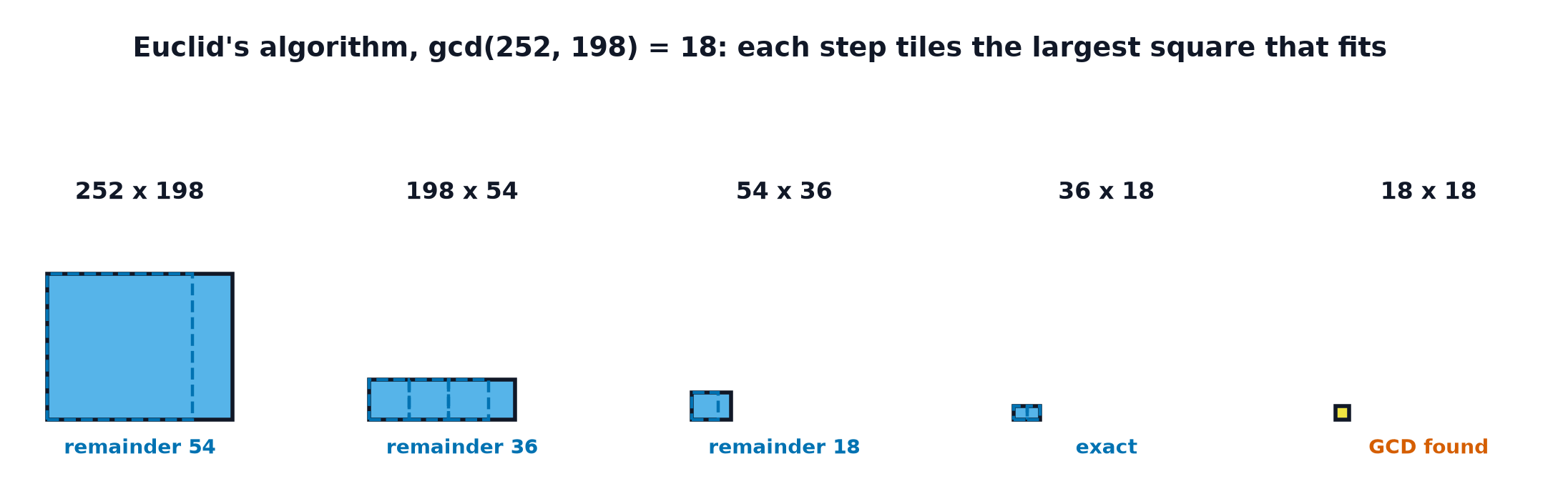
gcd(252, 198):
  252 = 1*198 + 54      gcd(252, 198) = gcd(198, 54)
  198 = 3*54  + 36      gcd(198, 54)  = gcd(54, 36)
   54 = 1*36  + 18      gcd(54, 36)   = gcd(36, 18)
   36 = 2*18  +  0      gcd(36, 18)   = gcd(18, 0) = 18

gcd(252, 198) = 18
Every step replaces the pair with strictly smaller numbers, and the sequence of remainders it produces is at its slowest exactly when consecutive Fibonacci numbers are fed in — Lame's theorem (cited in CLRS 4th ed. §31.2 and Knuth's TAOCP Vol. 2) shows the number of division steps is , with the Fibonacci pair as the adversarial input that makes every quotient equal to 1 and forces the maximum number of steps for a given size.
3^13 mod 7 by squaring -- the algorithm below reads the exponent's bits low to high (bit 0
first), squaring the base at every step and folding it into the result only where the bit is 1.
13 in binary is 1101, so bit 0 = 1, bit 1 = 0, bit 2 = 1, bit 3 = 1:

  result = 1, base = 3
  bit 0 (=1): result = 1*3       mod 7 = 3         base = 3^2  mod 7 = 2
  bit 1 (=0): result unchanged = 3                 base = 2^2  mod 7 = 4
  bit 2 (=1): result = 3*4       mod 7 = 5         base = 4^2  mod 7 = 2
  bit 3 (=1): result = 5*2       mod 7 = 3         base = 2^2  mod 7 = 4 (unused, loop ends)

3^13 mod 7 = 3      (check: 3 has order 6 mod 7 -- 3^6 = 729 = 104*7 + 1 -- and 13 mod 6 = 1,
                     so 3^13 = 3^(6*2+1) = (3^6)^2 * 3^1 = 1^2 * 3 = 3 mod 7)
- Python
- C++
def gcd(a, b):
    """O(log min(a, b)) worst case -- the Fibonacci pair realizes it (CLRS 4/e s31.2)."""
    while b:
        a, b = b, a % b
    return a


def extended_gcd(a, b):
    """Returns (g, x, y) with a*x + b*y = g = gcd(a, b). Same O(log min(a, b)) bound."""
    old_r, r = a, b
    old_x, x = 1, 0
    old_y, y = 0, 1
    while r:
        q = old_r // r
        old_r, r = r, old_r - q * r
        old_x, x = x, old_x - q * x
        old_y, y = y, old_y - q * y
    return old_r, old_x, old_y


def mod_inverse(a, m):
    """a^-1 mod m, via extended Euclid. Exists iff gcd(a, m) == 1."""
    g, x, _ = extended_gcd(a, m)
    if g != 1:
        raise ValueError(f"no modular inverse: gcd({a}, {m}) = {g} != 1")
    return x % m


def mod_pow(base, exp, mod):
    """a^b mod m in O(log b) multiplications: reduce after every squaring, never wait."""
    result = 1 % mod
    base %= mod
    while exp > 0:
        if exp & 1:
            result = (result * base) % mod
        base = (base * base) % mod
        exp >>= 1
    return result
#include <cassert>
#include <cstdint>
#include <stdexcept>
#include <tuple>

long long gcd_fn(long long a, long long b) {
    while (b) { long long t = a % b; a = b; b = t; }
    return a;
}

std::tuple<long long, long long, long long> extended_gcd(long long a, long long b) {
    long long old_r = a, r = b, old_x = 1, x = 0, old_y = 0, y = 1;
    while (r) {
        long long q = old_r / r;
        long long tmp_r = old_r - q * r; old_r = r; r = tmp_r;
        long long tmp_x = old_x - q * x; old_x = x; x = tmp_x;
        long long tmp_y = old_y - q * y; old_y = y; y = tmp_y;
    }
    return {old_r, old_x, old_y};
}

long long mod_inverse(long long a, long long m) {
    auto [g, x, y] = extended_gcd(a, m);
    if (g != 1) throw std::domain_error("no modular inverse");
    return ((x % m) + m) % m;                 // C++'s % can return negative -- see Edge Cases
}

// Note: uses __int128 internally to avoid overflow on the intermediate product --
// see "overflow in the modular multiply" below.
long long mod_pow(long long base, long long exp, long long mod) {
    long long result = 1 % mod;
    base %= mod;
    while (exp > 0) {
        if (exp & 1) result = static_cast<long long>((__int128)result * base % mod);
        base = static_cast<long long>((__int128)base * base % mod);
        exp >>= 1;
    }
    return result;
}
Practical Usage
- Python's
math.gcdis implemented in C and should be preferred over a hand-written loop in production code; the loop above exists to show the mechanism, not to be re-implemented. pow(base, exp, mod)— Python's three-argument built-inpowperforms fast modular exponentiation natively (see the built-in functions docs); it is the standard library's version ofmod_powabove and should be used directly rather than hand-rolled, except when the goal is to show the squaring mechanism itself.- Cryptography. RSA key generation needs a modular inverse (extended Euclid) to compute the private exponent from the public one, and RSA encryption/decryption is fast exponentiation modulo a large composite — both are exactly the two functions on this page, at much larger bit widths.
- Naive Matching & Rabin-Karp's rolling
hash precomputes
pow(BASE, m - 1, MOD)once with fast exponentiation, then updates its window hash with one modular multiply per slide — the identity this page opened with, applied directly.
- Python
- C++
# gcd, extended Euclid, modular inverse, and fast exponentiation, checked on the traced inputs
assert gcd(252, 198) == 18
g, x, y = extended_gcd(252, 198)
assert g == 18 and 252 * x + 198 * y == 18          # Bezout's identity holds exactly
assert mod_inverse(3, 11) == 4                       # 3*4 = 12 = 1 (mod 11)
assert (3 * mod_inverse(3, 11)) % 11 == 1
assert mod_pow(3, 13, 7) == 3                        # matches the traced squaring above
assert mod_pow(3, 13, 7) == pow(3, 13, 7)            # cross-checked against the stdlib
int main() {
    assert(gcd_fn(252, 198) == 18);
    auto [g, x, y] = extended_gcd(252, 198);
    assert(g == 18 && 252 * x + 198 * y == 18);
    assert(mod_inverse(3, 11) == 4);
    assert(mod_pow(3, 13, 7) == 3);
}
Edge Cases & Pitfalls
- Overflow in the modular multiply.
(a * b) % moverflows a 64-bitlong longthe momentaandbare both close to 2^63 -- the product itself, not the final residue, is what overflows. C++ code that will run withmnear the limit of a 64-bit type needs a widening multiply (__int128, shown above) or a "Russian peasant" modular multiply that never forms the full product. See Integers & Two's Complement for what silently wrapping around actually looks like. Python has no such trap: itsintis arbitrary precision, so(a * b) % mis always exact regardless of magnitude. - Negative results from C++'s
%. C++'s%can return a negative value when its left operand is negative —(-7) % 3 == -1in C++, not2.mod_inverseabove addsmand takes% magain specifically to normalize this. Python's%always returns a result with the sign of the divisor, so this trap is language-specific to C++ and similar languages, not universal. - Assuming a modular inverse always exists.
mod_inverse(a, m)is only defined whengcd(a, m) = 1; calling it with, say,a = 4, m = 8has no solution (gcd(4, 8) = 4 != 1) and the function above correctly raises rather than returning a wrong number. - Sequential multiplication instead of squaring. Computing
a^b mod mwith a loop that multiplies byaexactlybtimes is , not -- correct, but for cryptographic-sized exponents (hundreds of bits) the difference is the difference between instant and never finishing.
Comparisons
| Cost | What it computes | |
|---|---|---|
| Euclid's algorithm | worst | gcd(a, b) |
| Extended Euclid | worst | gcd(a, b) plus Bezout coefficients x, y |
| Modular inverse via extended Euclid | worst | a⁻¹ mod m, when it exists |
| Modular inverse via Fermat's little theorem | worst | a⁻¹ mod m, but only when m is prime (a^(m-2) mod m) |
| Fast exponentiation (squaring) | worst | a^b mod m |
| Sequential exponentiation | worst | a^b mod m |
Fermat's-little-theorem inverses avoid extended Euclid entirely when the modulus is prime — one call
to mod_pow instead — but silently give a wrong answer if m is composite, since the theorem's
precondition simply does not hold; extended Euclid works for any modulus and detects the
no-inverse case explicitly instead of failing silently.
Recall
References
- Cormen, Leiserson, Rivest & Stein, Introduction to Algorithms, 4th ed., §31.2 "Greatest common divisor" — Euclid's algorithm, its running time, and the Fibonacci worst case.
- Sedgewick & Wayne, Algorithms, 4th ed., §1.1 "Basic Programming Model" — GCD as a canonical worked example of a while-loop algorithm's correctness argument.
math.gcdand the three-argumentpow(base, exp, mod)— CPython's own documentation for both operations this page derives by hand.
Related Pages
- Math & Number Theory — the folder's map of where this arithmetic surfaces elsewhere.
- Primes & Sieves — the previous page's sieve, and where fast exponentiation reappears inside probabilistic primality tests.
- Integers & Two's Complement — the overflow behavior this page's modular-multiply warning depends on.
- Naive Matching & Rabin-Karp — the rolling hash that applies this page's modular multiply once per slide.