Primes & Sieves
Testing whether a single number n is prime is a small, self-contained problem: try dividing it by
every integer from 2 upward and stop as soon as one divides evenly, or as soon as trying further
cannot possibly find one. That second stopping rule is the entire trick, and it is easy to under-use:
a number n that has a factor d greater than sqrt(n) must also have a partner factor n / d that
is smaller than sqrt(n), because d * (n / d) = n and both factors cannot be on the large side at
once. So if no divisor up to sqrt(n) has been found, none exists at all — checking further is
provably wasted work. This turns an scan into an one, for free, just by knowing where
to stop.
That single-number test stops being the right tool the moment the question changes from "is this one
number prime" to "which of these many numbers are prime" — a factorization routine called in a loop,
a number-theoretic filter run over a whole range. Trial-dividing each of n numbers up to sqrt(n)
costs in total, and almost all of that work is repeated: the same small primes get
tested against nearly every candidate. A sieve inverts the direction of the computation — instead
of asking "is this number divisible by anything smaller", it starts from each small prime and crosses
out every multiple of it in one pass, so that whatever is left unmarked at the end must be prime by
construction, not by having survived a test.
Core Concepts
| Term | Meaning |
|---|---|
| Trial division | Testing n's primality by dividing it by every candidate up to sqrt(n) |
| Sieve of Eratosthenes | Cross out every multiple of each prime, starting from the prime itself, up to a bound N |
| Linear sieve | A sieve variant in which every composite is crossed out exactly once, by its smallest prime factor, giving total work |
| Smallest prime factor (SPF) table | spf[i] = the smallest prime dividing i, built alongside a sieve; repeatedly dividing by spf[i] factorizes i in |
Mechanism
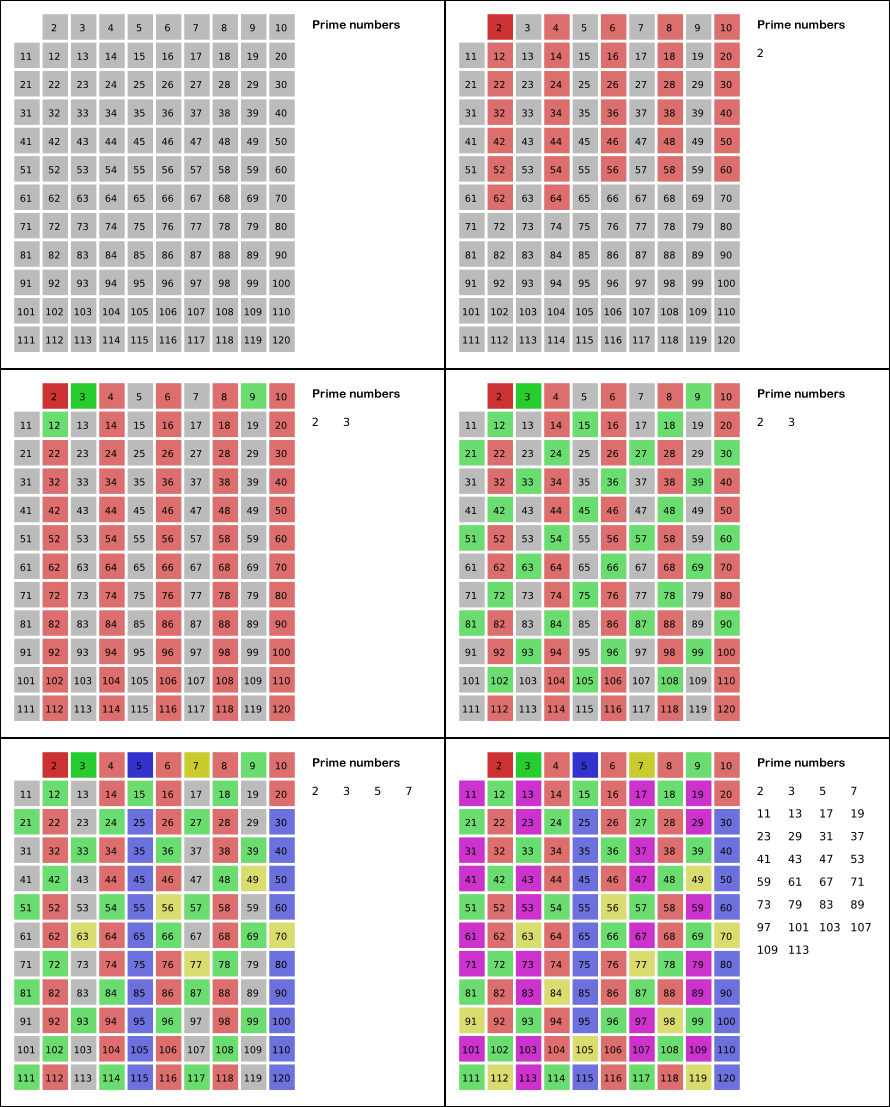
Trace input — sieving 2..30 (sqrt(30) is about 5.47, so the outer loop stops after 5, since any
composite <= 30 must have a factor <= 5):
start: 2 3 4 5 6 7 8 9 10 11 12 13 14 15 16 17 18 19 20 21 22 23 24 25 26 27 28 29 30
        all unmarked

cross out multiples of 2 (starting at 4, step 2):
  marked: 4 6 8 10 12 14 16 18 20 22 24 26 28 30
  remaining unmarked: 2 3 5 7 9 11 13 15 17 19 21 23 25 27 29

cross out multiples of 3 (starting at 9, step 3; 12,18,24,30 already marked):
  newly marked: 9 15 21 27
  remaining unmarked: 2 3 5 7 11 13 17 19 23 25 29

cross out multiples of 5 (starting at 25, step 5; 15,20,30 already marked):
  newly marked: 25
  remaining unmarked: 2 3 5 7 11 13 17 19 23 29

next prime would be 7, and 7 > sqrt(30) -- stop. Everything still unmarked is prime:
  2 3 5 7 11 13 17 19 23 29    (10 primes below 30)
Nothing above 5 ever needed its own pass: every composite <= 30 has a prime factor <= 5, so the
three passes above already crossed out all of them. Sedgewick & Wayne, Algorithms 4th ed., §1.4,
and CLRS 4th ed. Ch. 31 both give the classic bound on the total work: each prime p <= N contributes
about N / p crossings, and summing N / p over all primes p <= N is `N * sum(1/p) = N * ln(ln N)
, i.e. **O(N log log N)** — a function that grows barely faster thanNfor any practicalN`.
- Python
- C++
def sieve(n):
    """Primality up to n (inclusive), O(n log log n) worst case (Sedgewick & Wayne 4/e, s1.4)."""
    is_prime = [True] * (n + 1)
    is_prime[0:2] = [False, False]           # 0 and 1 are not prime by definition
    p = 2
    while p * p <= n:
        if is_prime[p]:
            for multiple in range(p * p, n + 1, p):   # smaller multiples already crossed by a smaller prime
                is_prime[multiple] = False
        p += 1
    return is_prime


def is_prime_trial_division(n):
    """O(sqrt n) worst case: no factor beyond sqrt(n) can exist without a partner below it."""
    if n < 2:
        return False
    d = 2
    while d * d <= n:
        if n % d == 0:
            return False
        d += 1
    return True
#include <cassert>
#include <cstdint>
#include <vector>

std::vector<bool> sieve(int n) {
    std::vector<bool> is_prime(n + 1, true);
    if (n >= 0) is_prime[0] = false;
    if (n >= 1) is_prime[1] = false;
    for (long long p = 2; p * p <= n; ++p) {
        if (is_prime[p]) {
            for (long long m = p * p; m <= n; m += p) is_prime[m] = false;
        }
    }
    return is_prime;
}

bool is_prime_trial_division(long long n) {
    if (n < 2) return false;
    for (long long d = 2; d * d <= n; ++d)
        if (n % d == 0) return false;
    return true;
}
The linear sieve and the smallest-prime-factor table
The Sieve of Eratosthenes still crosses some composites more than once — 12 is crossed by both 2 and
3. The linear sieve fixes this by processing candidates in increasing order and, for each one,
crossing it out using only its smallest prime factor, stopping the inner loop the instant a prime
already found divides the current prime being multiplied — the exact condition that guarantees every
composite is marked exactly once, for total work instead of . The same pass
naturally builds a smallest-prime-factor (SPF) table: spf[i] for every composite i is already
known by the time the linear sieve finishes, and factorizing any i <= N afterwards is just
repeatedly dividing by spf[i] — at most log2(i) divisions, since each division at least halves
what remains, giving factorization instead of trial division per query.
- Python
- C++
def linear_sieve(n):
    """Every composite crossed out exactly once, by its smallest prime factor -- O(n) worst case."""
    spf = [0] * (n + 1)               # spf[i] = smallest prime factor of i
    primes = []
    for i in range(2, n + 1):
        if spf[i] == 0:                # i has no smaller factor recorded yet -> i is prime
            spf[i] = i
            primes.append(i)
        for p in primes:
            if p > spf[i] or p * i > n:
                break                   # p would not be i*p's smallest factor, or out of range
            spf[p * i] = p
    return spf, primes


def factorize(n, spf):
    """O(log n) worst case: each step divides out one prime factor, at least halving n."""
    factors = []
    while n > 1:
        factors.append(spf[n])
        n //= spf[n]
    return factors
std::pair<std::vector<int>, std::vector<int>> linear_sieve(int n) {
    std::vector<int> spf(n + 1, 0);
    std::vector<int> primes;
    for (int i = 2; i <= n; ++i) {
        if (spf[i] == 0) { spf[i] = i; primes.push_back(i); }
        for (int p : primes) {
            if (p > spf[i] || 1LL * p * i > n) break;
            spf[p * i] = p;
        }
    }
    return {spf, primes};
}

std::vector<int> factorize(int n, const std::vector<int>& spf) {
    std::vector<int> factors;
    while (n > 1) { factors.push_back(spf[n]); n /= spf[n]; }
    return factors;
}
Practical Usage
- Python's
sympy.isprimeuses trial division for smallnand switches to Miller-Rabin plus a BPSW check for largen— neither trial division nor a sieve is the right tool oncenexceeds a sieve's practical memory. - Precompute once, query many times. Any problem that repeatedly asks "is
kprime" for manyk <= Nshould sieve[2, N]once, in , rather than trial-dividing each query in — the same precompute-once trade Prefix Sums & Difference Arrays makes for range sums. - Segmented sieving sieves a range
[lo, hi]using only primes up tosqrt(hi)(found by a small sieve first), keeping memory at instead of — the standard technique oncehiis too large to hold a full sieve array.
- Python
- C++
# both sieves and factorization, checked against the traced n=30 result
is_prime_30 = sieve(30)
assert [i for i in range(31) if is_prime_30[i]] == [2, 3, 5, 7, 11, 13, 17, 19, 23, 29]
assert all(is_prime_trial_division(i) == is_prime_30[i] for i in range(31))

spf, primes_30 = linear_sieve(30)
assert primes_30 == [2, 3, 5, 7, 11, 13, 17, 19, 23, 29]
assert factorize(24, spf) == [2, 2, 2, 3]             # 24 = 2^3 * 3
int main() {
    auto is_prime_30 = sieve(30);
    std::vector<int> primes_found;
    for (int i = 0; i <= 30; ++i) if (is_prime_30[i]) primes_found.push_back(i);
    assert((primes_found == std::vector<int>{2, 3, 5, 7, 11, 13, 17, 19, 23, 29}));

    auto [spf, primes_30] = linear_sieve(30);
    assert((primes_30 == std::vector<int>{2, 3, 5, 7, 11, 13, 17, 19, 23, 29}));
    assert((factorize(24, spf) == std::vector<int>{2, 2, 2, 3}));
}
Edge Cases & Pitfalls
- Starting the inner crossing loop at
2*pinstead ofp*p. Every multiple ofpsmaller thanp*palready has a smaller prime factor and was crossed out earlier; starting at2*pdoes not break correctness but wastes work that grows the effective constant factor noticeably at scale. - Trial-dividing by every integer instead of stopping the loop bound at sqrt(n). Looping to
ninstead of tosqrt(n)is a correctness-preserving but instead of mistake — the kind of bug that only shows up as "why is this slow" under profiling, never as a wrong answer. - Forgetting 0 and 1 are not prime. A sieve initialized to "all true" that never clears indices 0 and 1 reports both as prime, which corrupts any factor count or product built on top of it.
- Reusing a single-query trial-division check inside a loop over
Ncandidates. This is exactly the mistake a sieve exists to avoid — see the Mechanism section above.
Comparisons
| Per-query cost | Total for N queries | Extra space | |
|---|---|---|---|
| Trial division, one number | worst | worst | |
| Sieve of Eratosthenes, precomputed | lookup after build | worst | |
| Linear sieve, precomputed | lookup after build | worst | |
| Factorization via SPF table | worst | worst (N factorizations) | |
| Factorization via trial division | worst | worst |
A sieve only pays off when the range [2, N] is queried repeatedly; for a single one-off primality
check on a large n, trial division (or, past a few million, Miller-Rabin) needs no memory at
all.
Recall
References
- Cormen, Leiserson, Rivest & Stein, Introduction to Algorithms, 4th ed., Ch. 31 "Number-Theoretic Algorithms" — primality testing and the sieve's asymptotic analysis.
- Sedgewick & Wayne, Algorithms, 4th ed., §1.4 "Analysis of Algorithms" — the sieve used as a worked example of the harmonic-sum analysis behind .
sympy.ntheory.primetest.isprime— the CPython-ecosystem library's own documentation of when it switches from trial division to probabilistic primality testing.
Related Pages
- Math & Number Theory — the folder's map of where this arithmetic surfaces elsewhere.
- GCD & Modular Arithmetic — the next arithmetic building block, including modular exponentiation used by the probabilistic primality tests mentioned above.
- Prefix Sums & Difference Arrays — the same precompute-once-query-many trade applied to range sums instead of primality.
- Big-O Notation — what "worst case" and the log log N growth rate actually mean.