Intervals & Sweep Line
A calendar full of meetings, a set of (start, end) ranges to merge, a question like "how many
meetings overlap at once" — all of these are asking something about ranges on a line, and the naive
approach checks every pair of ranges against every other, an comparison for what turns out to be
a question a single sorted pass can answer.
The trick is to stop thinking in intervals and start thinking in events. Every interval (s, e)
is really two point events: "something started at s" and "something ended at e." Sort all 2n
events by position instead of sorting the n intervals, sweep left to right keeping a running count
(+1 at a start, −1 at an end), and every question about "what is true between here and there"
becomes a question about that running total — no per-pair comparison needed at all.
Merging is the same idea specialised to the case where only adjacency matters: sort intervals by start, then walk once, extending the last kept interval whenever the next one begins before it ends. Interval scheduling — pick the largest possible set of non-overlapping intervals — needs a different sort key entirely: by end time, because the interval that finishes earliest always leaves the most room for whatever comes after it, and no exchange argument beats that greedy choice (Cormen, Leiserson, Rivest & Stein, 4th ed., §15.1).
Core Concepts
| Term | Meaning |
|---|---|
| Interval | A pair (start, end), usually treated as covering [start, end] |
| Merge by start | Sort by start, then fold each interval into the last kept one if it begins early enough |
| Event sweep | Sort every endpoint (not every interval) with a +1/−1 tag, and read a running total |
| Active count | The running total after a given event — how many intervals currently cover that point |
| Meeting rooms | The minimum resources needed at once = the peak of the active-count curve |
| Interval scheduling | Choosing the largest compatible subset, greedily, by soonest finish time |
Mechanism
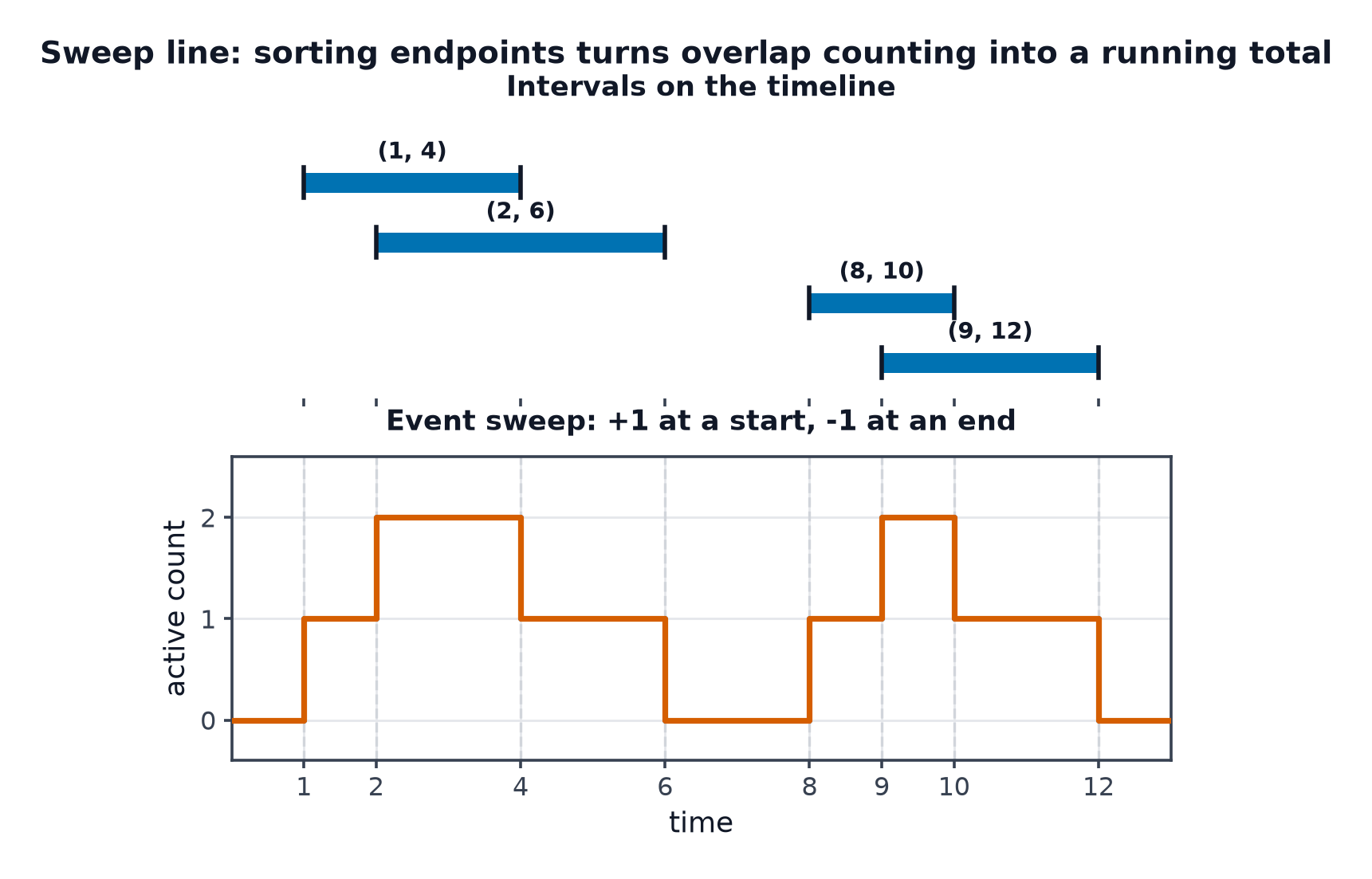
intervals = [(1, 4), (2, 6), (8, 10), (9, 12)]

sorted events (time, delta):
  ( 1, +1)  ( 2, +1)  ( 4, -1)  ( 6, -1)  ( 8, +1)  ( 9, +1)  (10, -1)  (12, -1)

active count after each event:
   1    2    1    0    1    2    1    0
   ^--- (1,4) & (2,6) overlap ---^    ^--- (8,10) & (9,12) overlap ---^

peak active count = 2  ->  2 rooms needed, never more than two intervals at once
- Python
- C++
def merge_intervals(intervals):
    """Merge overlapping intervals after sorting by start. O(n log n) worst case, the sort dominates."""
    ordered = sorted(intervals)
    merged = [ordered[0]]
    for start, end in ordered[1:]:
        last_start, last_end = merged[-1]
        if start <= last_end:                       # touching counts as overlapping here
            merged[-1] = (last_start, max(last_end, end))
        else:
            merged.append((start, end))
    return merged


INTERVALS = [(1, 4), (2, 6), (8, 10), (9, 12)]
assert merge_intervals(INTERVALS) == [(1, 6), (8, 12)]
#include <algorithm>
#include <cassert>
#include <utility>
#include <vector>

using Interval = std::pair<int, int>;

std::vector<Interval> merge_intervals(std::vector<Interval> intervals) {
    std::sort(intervals.begin(), intervals.end());
    std::vector<Interval> merged{intervals.front()};
    for (std::size_t i = 1; i < intervals.size(); ++i) {
        auto [start, end] = intervals[i];
        auto& [lastStart, lastEnd] = merged.back();
        if (start <= lastEnd) {
            lastEnd = std::max(lastEnd, end);
        } else {
            merged.push_back({start, end});
        }
    }
    return merged;
}
Counting overlaps by sorting endpoints, not intervals
Merging only needs adjacent intervals compared. Counting how many intervals are active at once needs every endpoint in one global order — this is the general event-sweep technique, and it works for any "how much is covered right now" question, not just meeting rooms.
def sweep_active_counts(intervals):
    """Running count of active intervals after each event, left to right. O(n log n): the sort dominates."""
    events = sorted([(s, +1) for s, _ in intervals] + [(e, -1) for _, e in intervals])
    counts, running = [], 0
    for _, delta in events:
        running += delta
        counts.append(running)
    return events, counts


events, counts = sweep_active_counts(INTERVALS)
assert events == [(1, 1), (2, 1), (4, -1), (6, -1), (8, 1), (9, 1), (10, -1), (12, -1)]
assert counts == [1, 2, 1, 0, 1, 2, 1, 0]
Meeting rooms: the peak of the active-count curve
The minimum number of rooms needed at once is exactly max(counts) above — but computing it via a
min-heap of in-use end times avoids materialising every event explicitly and generalises to "reuse the
room that frees up soonest."
import heapq


def min_meeting_rooms(intervals):
    """Minimum concurrent rooms needed. O(n log n): sort by start, track the earliest-ending room."""
    ordered = sorted(intervals)
    heap = []                                    # end times of rooms currently in use
    for start, end in ordered:
        if heap and heap[0] <= start:
            heapq.heapreplace(heap, end)         # reuse the room that frees up earliest
        else:
            heapq.heappush(heap, end)
    return len(heap)


assert min_meeting_rooms(INTERVALS) == 2
Practical Usage
- Python's
sorted(intervals)sorts tuples lexicographically for free — by start, then by end on a tie — which is exactly the merge-by-start order;sorted(intervals, key=lambda iv: iv[1])gives the finish-time order that interval scheduling needs. Seesorted. heapqturns "which room frees up first" intoheap[0], the smallest element, in — seeheapq; C++'sstd::priority_queueneedsstd::greater<int>as its comparator to get a min-heap instead of the default max-heap, per[priqueue.cons].- Real call sites: calendar/meeting-room scheduling, CPU or resource-interval merging in a task scheduler, and skyline-style "how many buildings overlap this x-coordinate" problems, which are the 2-D generalisation of the same sweep.
Edge Cases & Pitfalls
- Touching intervals.
(1, 4)and(4, 6)share only the point 4 — whether that counts as overlapping depends entirely on the convention chosen (start <= last_endabove treats it as overlapping;start < last_endwould not). Pick one and apply it consistently to both the merge condition and the event-sweep tie-break. - Tie-breaking at equal event coordinates. When a start and an end share the same time, processing the end first (so it decrements before the start increments) treats touching intervals as non-overlapping; processing the start first treats them as overlapping. The sweep code above never needs this because none of the sample coordinates coincide — a real dataset usually will.
- Sorting intervals instead of endpoints for a count. Sorting only by start and stepping through intervals one at a time cannot tell when an earlier interval's end falls inside a later one's span without extra bookkeeping — the event sweep sidesteps this by making every endpoint, not every interval, a first-class item to sort.
- Assuming sort-by-start also solves scheduling. The interval-scheduling greedy needs sort-by-end; sorting by start and greedily taking everything compatible can strand a long early interval that blocks several short later ones, giving a strictly smaller selected set.
Comparisons
| Pairwise overlap check | Merge by start | Event sweep | Min-heap (meeting rooms) | |
|---|---|---|---|---|
| Build / sort (worst) | — | |||
| Answer overlap count (worst) | — | after sorting | total | |
| Extra space (worst) | ||||
| Answers | Yes/no per pair | The merged set | Active count at every instant | Peak concurrency only |
Merging and the event sweep both cost , dominated by the sort; the difference is what they hand back — a reduced interval set versus a full timeline of how many intervals are active at every point.
Recall
References
- Cormen, Leiserson, Rivest & Stein, Introduction to Algorithms, 4th ed., §15.1 "An activity-selection problem" — the exchange argument proving sort-by-finish-time is optimal for interval scheduling.
- Sedgewick & Wayne, Algorithms, 4th ed., §2.5 "Applications" — sorting as the first step of a larger algorithm, the role it plays for both merging and the event sweep here.
sortedandheapq— CPython docs for the two building blocks used above.[priqueue.cons]— the C++ standard'spriority_queueconstructors, including the comparator that turns the default max-heap into a min-heap.
Related Pages
- Greedy Algorithms — the general framework the sort-by-end exchange argument belongs to.
- Two Pointers & Sliding Window — another linear scan over sorted data, for contiguous ranges rather than a global event order.
- Heaps — the min-heap that tracks the earliest-ending room.
- Problem-Solving Patterns — where this pattern sits among the others.