Recursion, Memoization & Tabulation
Dynamic Programming names the idea — overlapping subproblems plus optimal substructure — but says little about the mechanical journey from a first working solution to a fast one. That journey has four fixed stops, always in the same order, and each stop is a small, almost mechanical edit to the previous one. Skipping a stop is how most DP attempts either stall on a recurrence nobody has verified, or ship a table nobody can explain.
This page walks all four stops on one problem, so the edits are visible rather than asserted: plain recursion, the same recursion with a cache bolted on, the same recurrence read as a fill order over a table, and finally the table collapsed to the one row it actually needs. Nothing about the logic changes across the four forms — only how the answers to subproblems are stored and in what order they are computed. Treat the first form as the specification and every later form as a re-implementation that must agree with it on every input, which is exactly how you should test them.
Core Concepts
| Term | Meaning |
|---|---|
| State | What one subproblem needs to know — here, "which items are still available" and "how much capacity is left" |
| Recurrence | How a state's answer follows from smaller states — take the current item or skip it |
| Memoization | Top-down: recurse normally, but cache each state's answer the first time it is computed |
| Tabulation | Bottom-up: fill every state's slot in an order that guarantees its dependencies are already filled |
| Rolling array | A tabulation whose recurrence only ever looks at the previous row, so only one row needs to exist in memory |
Mechanism
The running example is 0/1 knapsack: items (w=1, v=1), (w=3, v=4), (w=4, v=5), (w=5, v=7),
capacity 7 — each item taken at most once, maximise total value without exceeding capacity. Index items
1..4 in that order. Every form below computes the same function: best(i, c) = the best value
achievable using only the first i items within capacity c, with the recurrence
best(i, c) = best(i-1, c)                                  if item i does not fit (w_i > c)
best(i, c) = max(best(i-1, c), best(i-1, c - w_i) + v_i)    otherwise
best(0, c) = 0 for every c
Form 1 — plain recursion
best(i, c) calls itself twice per item, and the two branches share subproblems: best(2, 4) is asked
for both by the "skip item 3" branch and, separately, by parts of the "take item 3" branch lower in the
tree. Nothing remembers that best(2, 4) was already answered, so it is recomputed from scratch every
time it recurs — the definition of overlapping subproblems, and the reason this form is exponential:
T(n) = 2·T(n-1) + O(1), so calls in the worst case, independent of the capacity.
Form 2 — memoized recursion
Identical logic, plus a cache keyed on (i, c). The first call for a given (i, c) does the work and
stores the answer; every later call for the same pair returns the stored value in . Since there are
only n · capacity distinct (i, c) pairs and each is computed once, the cost drops to
time and space for the cache — plus recursion-stack depth,
which the next two forms remove entirely.
Form 3 — bottom-up tabulation
The memoized version computes states in whatever order the recursion happens to visit them. Tabulation
instead reads the recurrence as a dependency graph — row i needs only row i-1 — and fills a 2-D
table dp[i][c] explicitly in increasing i, increasing c, so every dependency is already filled
when it is read. Same time, same space for the table, but zero
recursion stack — this is a plain nested loop.
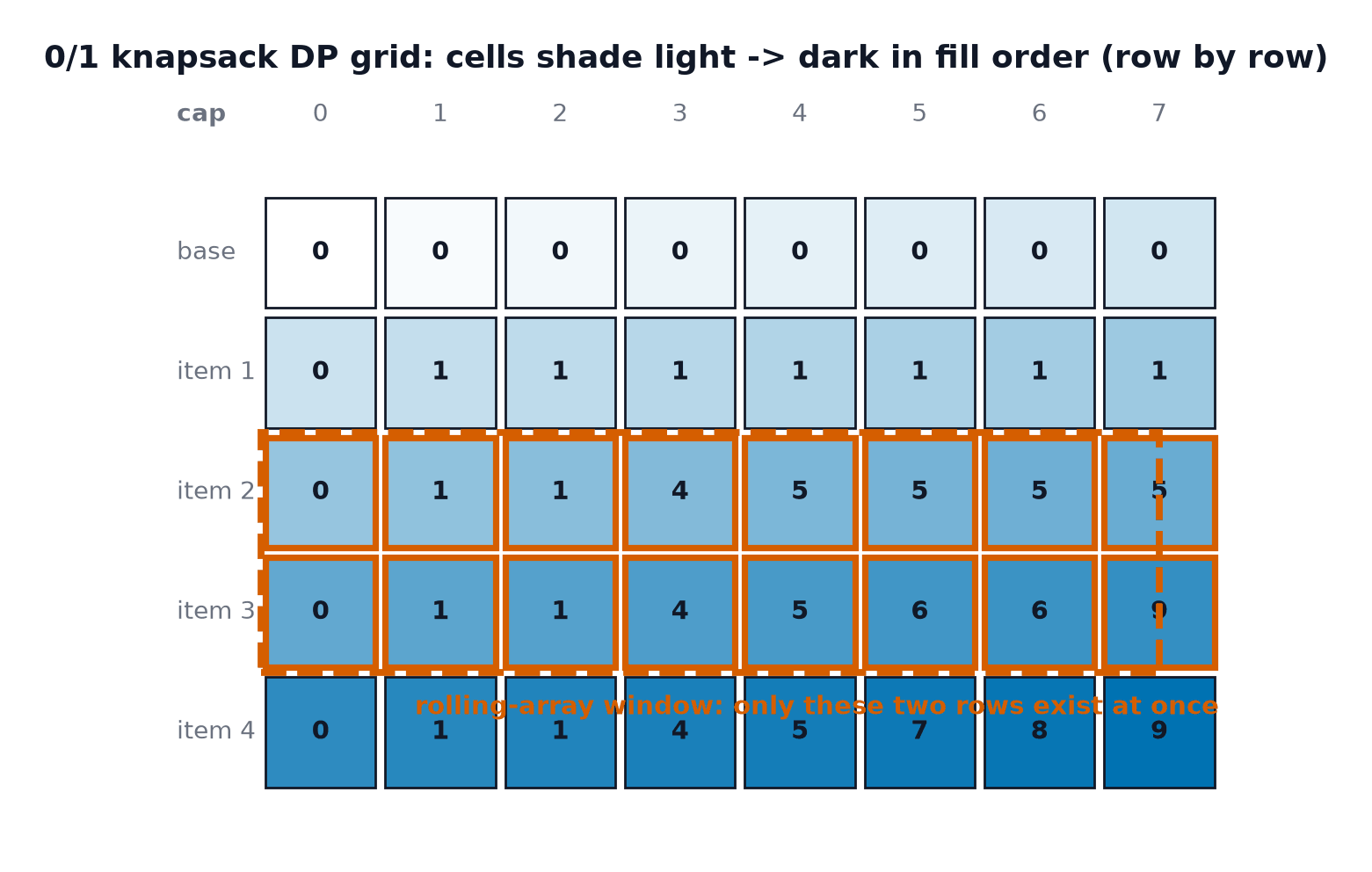
Traced cell by cell for the first two items (row 0 is the base case, all zero by definition):
capacity c:        0    1    2    3    4    5    6    7

row 0 (0 items):    0    0    0    0    0    0    0    0

row 1 (item 1, w=1,v=1)
  c=0: w=1 > 0, can't fit          -> dp[1][0] = dp[0][0]           = 0
  c=1: fits, max(skip, take)       -> dp[1][1] = max(0, dp[0][0]+1) = 1
  c=2..7: same as c=1 (w=1 always fits, dp[0][*] is always 0)
row 1:               0    1    1    1    1    1    1    1

row 2 (item 2, w=3,v=4)
  c=0,1,2: w=3 doesn't fit         -> dp[2][c] = dp[1][c]           = 0, 1, 1
  c=3: fits    -> dp[2][3] = max(dp[1][3], dp[1][0]+4) = max(1, 4) = 4
  c=4: fits    -> dp[2][4] = max(dp[1][4], dp[1][1]+4) = max(1, 5) = 5
  c=5: fits    -> dp[2][5] = max(dp[1][5], dp[1][2]+4) = max(1, 5) = 5
  c=6: fits    -> dp[2][6] = max(dp[1][6], dp[1][3]+4) = max(1, 5) = 5
  c=7: fits    -> dp[2][7] = max(dp[1][7], dp[1][4]+4) = max(1, 5) = 5
row 2:               0    1    1    4    5    5    5    5

(row 3, item 3 w=4,v=5): 0  1  1  4  5  6  6  9
(row 4, item 4 w=5,v=7): 0  1  1  4  5  7  8  9

answer: dp[4][7] = 9

tracing the answer back — at each row, "did taking this item improve the cell?":
  dp[4][7]=9 came from dp[3][7]=9 (equal to skipping)         -> item 4 NOT taken
  dp[3][7]=9 came from dp[2][3]+5=9 (better than dp[2][7]=5)  -> item 3 TAKEN,  move to column 7-4=3
  dp[2][3]=4 came from dp[1][0]+4=4 (better than dp[1][3]=1)  -> item 2 TAKEN,  move to column 3-3=0
  dp[1][0]=0 (item 1 does not fit in capacity 0)              -> item 1 not taken
  chosen items: {2, 3} -> weight 3+4=7, value 4+5=9  ✓ exactly fills the capacity
Form 4 — rolling array
Every cell of row i reads only row i-1, never row i-2 or earlier, and never another cell of its
own row in the forward direction. Collapsing to one 1-D array dp[c] and updating it in place
reproduces the same table, provided the capacity loop runs downward for each item — the same
direction rule as in Dynamic Programming.
Downward means dp[c - w] on the right of an assignment still holds last item's value when it is
read, because the cell at the lower index has not been touched yet this pass. Space drops from
to ; time is unchanged at .
- Python
- C++
from functools import lru_cache

ITEMS = [(1, 1), (3, 4), (4, 5), (5, 7)]   # (weight, value)
CAPACITY = 7


# Form 1: plain recursion — O(2^n) calls, no memory of repeated states
def knapsack_naive(i, c):
    if i == 0:
        return 0
    w, v = ITEMS[i - 1]
    best = knapsack_naive(i - 1, c)                       # skip item i
    if w <= c:
        best = max(best, knapsack_naive(i - 1, c - w) + v)  # or take it
    return best


# Form 2: memoized recursion — same logic, O(n * capacity) calls
@lru_cache(maxsize=None)
def knapsack_memo(i, c):
    if i == 0:
        return 0
    w, v = ITEMS[i - 1]
    best = knapsack_memo(i - 1, c)
    if w <= c:
        best = max(best, knapsack_memo(i - 1, c - w) + v)
    return best


# Form 3: bottom-up table — same recurrence, filled by explicit loops
def knapsack_table(items, capacity):
    n = len(items)
    dp = [[0] * (capacity + 1) for _ in range(n + 1)]
    for i in range(1, n + 1):
        w, v = items[i - 1]
        for c in range(capacity + 1):
            dp[i][c] = dp[i - 1][c]
            if w <= c:
                dp[i][c] = max(dp[i][c], dp[i - 1][c - w] + v)
    return dp


# Form 4: rolling array — one row, capacity iterated DOWNWARD
def knapsack_rolling(items, capacity):
    dp = [0] * (capacity + 1)
    for w, v in items:
        for c in range(capacity, w - 1, -1):    # downward: dp[c - w] is still last item's value
            dp[c] = max(dp[c], dp[c - w] + v)
    return dp[capacity]


# all four forms must agree — the traced answer is 9 (items with weight 3 and weight 4)
assert knapsack_naive(len(ITEMS), CAPACITY) == 9
assert knapsack_memo(len(ITEMS), CAPACITY) == 9
assert knapsack_table(ITEMS, CAPACITY)[len(ITEMS)][CAPACITY] == 9
assert knapsack_rolling(ITEMS, CAPACITY) == 9
#include <algorithm>
#include <cassert>
#include <unordered_map>
#include <vector>

using Item = std::pair<int, int>;   // (weight, value)
const std::vector<Item> ITEMS = {{1, 1}, {3, 4}, {4, 5}, {5, 7}};
constexpr int CAPACITY = 7;

// Form 1: plain recursion — O(2^n) calls
int knapsack_naive(int i, int c) {
    if (i == 0) return 0;
    auto [w, v] = ITEMS[i - 1];
    int best = knapsack_naive(i - 1, c);
    if (w <= c) best = std::max(best, knapsack_naive(i - 1, c - w) + v);
    return best;
}

// Form 2: memoized recursion — same logic, O(n * capacity) distinct calls
int knapsack_memo(int i, int c, std::unordered_map<long long, int>& cache) {
    if (i == 0) return 0;
    long long key = static_cast<long long>(i) * 100000 + c;
    if (auto it = cache.find(key); it != cache.end()) return it->second;
    auto [w, v] = ITEMS[i - 1];
    int best = knapsack_memo(i - 1, c, cache);
    if (w <= c) best = std::max(best, knapsack_memo(i - 1, c - w, cache) + v);
    return cache[key] = best;
}

// Form 3: bottom-up table
std::vector<std::vector<int>> knapsack_table(const std::vector<Item>& items, int capacity) {
    int n = static_cast<int>(items.size());
    std::vector<std::vector<int>> dp(n + 1, std::vector<int>(capacity + 1, 0));
    for (int i = 1; i <= n; ++i) {
        auto [w, v] = items[i - 1];
        for (int c = 0; c <= capacity; ++c) {
            dp[i][c] = dp[i - 1][c];
            if (w <= c) dp[i][c] = std::max(dp[i][c], dp[i - 1][c - w] + v);
        }
    }
    return dp;
}

// Form 4: rolling array — capacity iterated DOWNWARD
int knapsack_rolling(const std::vector<Item>& items, int capacity) {
    std::vector<int> dp(capacity + 1, 0);
    for (auto [w, v] : items) {
        for (int c = capacity; c >= w; --c)
            dp[c] = std::max(dp[c], dp[c - w] + v);
    }
    return dp[capacity];
}
Practical Usage
Write form 1 first, always. It is the specification: the shortest possible statement of the recurrence, with nothing to get wrong except the recurrence itself. Confirm it on a small case by hand — the trace above — before optimising anything.
Add memoization (form 2) next, not a table. In Python, @lru_cache turns a correct recursion into
an efficient one in one line, with no change to the control flow, and Python's own docs describe it as
caching up to maxsize "most recent calls" using the arguments as a key — functools.lru_cache
docs. This is almost always
the right place to stop for a one-off script or a competitive-programming submission: the complexity is
already optimal, and the code is closest to the mathematical recurrence, which is what gets debugged
when the answer is wrong.
Move to tabulation (form 3) only when memoization is not good enough — a recursion-depth limit
(CPython's default is 1000, raised with sys.setrecursionlimit, but that trades one failure mode for a
real C-stack overflow), a language or embedded environment without automatic memoization, or a
requirement to reason about worst-case stack usage. Tabulation is strictly more mechanical to write
once the state and recurrence are settled, and strictly easier to hand-optimize for space, because the
dependency structure between rows is explicit in the loop instead of implicit in the call graph.
Collapse to a rolling array (form 4) last, and only under memory pressure, because it is the form most likely to hide a bug: getting the iteration direction wrong silently computes a different, still-plausible-looking problem (unbounded knapsack instead of 0/1 — see Dynamic Programming) rather than crashing. Keep form 3 around as the oracle to test form 4 against on the same inputs.
Edge Cases & Pitfalls
- Skipping straight to tabulation. Without form 1 to check against, an off-by-one in the loop bounds produces a table that looks plausible and is wrong. Always derive the table from a verified recursion.
lru_cacheneeds hashable arguments. A list or a mutable container as a memoization key raisesTypeError: unhashable type; convert to a tuple first.- The rolling array's direction bug. Iterating capacity upward while collapsing to one row lets
dp[c - w]already include the current item, silently switching the problem to unbounded knapsack. The symptom is a table that fills without error and returns a value that is too large. - Reconstructing the choice, not just the value. All four forms above return
best(n, capacity)alone. Recovering which items were chosen — the traceback shown above — needs either the full 2-D table (form 3, not form 4) or a parallel table of "did taking the item at this cell win?" decisions, because the rolling array has already overwritten the earlier rows. - Recursion-limit crashes reading as logic bugs. A correct form-2 recursion that blows past
sys.setrecursionlimiton a large input looks, from the traceback, like something is wrong with the algorithm. It is a stack-depth problem; convert to form 3.
Comparisons
| Form 1: recursion | Form 2: memoized | Form 3: tabulated | Form 4: rolling | |
|---|---|---|---|---|
| Time (worst) | ||||
| Extra space (worst) | stack | cache + stack | table | |
| Computes | Only reachable states | Only reachable states | Every state | Every state |
| Easiest to verify against the recurrence | Yes | Yes (same code) | No — loop bounds can hide bugs | No — direction can hide bugs |
| Reconstructs the chosen items | Yes, directly | Yes, directly | Yes, from the full table | No — earlier rows are gone |
Recall
References
- Cormen, Leiserson, Rivest & Stein, Introduction to Algorithms, 4th ed., Ch. 14 — the general memoization-vs-tabulation framing, with the 0/1 knapsack developed as a worked example.
functools.lru_cache— CPython docs; the caching behaviour and themaxsizeparameter used for form 2.sys.setrecursionlimit— CPython docs; the default depth (1000) and the underlying C-stack risk of raising it.
Related Pages
- Dynamic Programming — the overlapping-subproblems condition this whole chain of forms exists to exploit, and the iteration-direction rule referenced above.
- Divide & Conquer — the same recursive shape without overlap, so no memoization ever helps.
- Top-K & Streaming — a different constraint, bounded memory, that likewise forces a choice between several correct algorithms.
- Cheat Sheet — where this pattern sits relative to the other eleven in this folder.