Binary Search on the Answer
Every binary search so far has searched an array: a sorted sequence of values sitting in memory, narrowed by comparing against a target. This page is about a different, more general use of the same halving idea — searching a range of candidate answers that is never materialised as an array at all.
The reframing is: stop thinking "where is the target in this array" and start thinking "what is the
smallest (or largest) value in this range for which some yes/no question is true, given that the
answer stays true once it becomes true." If a feasible(x) predicate is monotonic — false for
every value below some boundary, true for every value at or above it — the same half-open template from
Binary Search finds that boundary in calls to feasible,
regardless of how expensive the range itself would be to enumerate.
Read Binary Search first, specifically "the variant that matters more" — the half-open first-true-index template. Everything here is that template with the array replaced by an integer or floating-point range.
Core Concepts
| Term | Meaning |
|---|---|
| Answer space | The range [lo, hi] of candidate answers being searched — never materialised, unlike an array |
| Feasibility predicate | feasible(x): does candidate answer x satisfy the requirement? Must be monotonic in x |
| Monotonic | Once feasible(x) is true, feasible(x') is true for every x' > x (or the mirror, for a "largest feasible" search) — the property that makes binary search valid at all |
| Capacity / rate problem | The classic phrasing: "smallest resource that lets a fixed workload finish within a fixed budget" |
| Fixed-iteration stopping rule | For real-valued answer spaces, iterate a fixed number of times rather than comparing hi - lo to an epsilon |
Mechanism
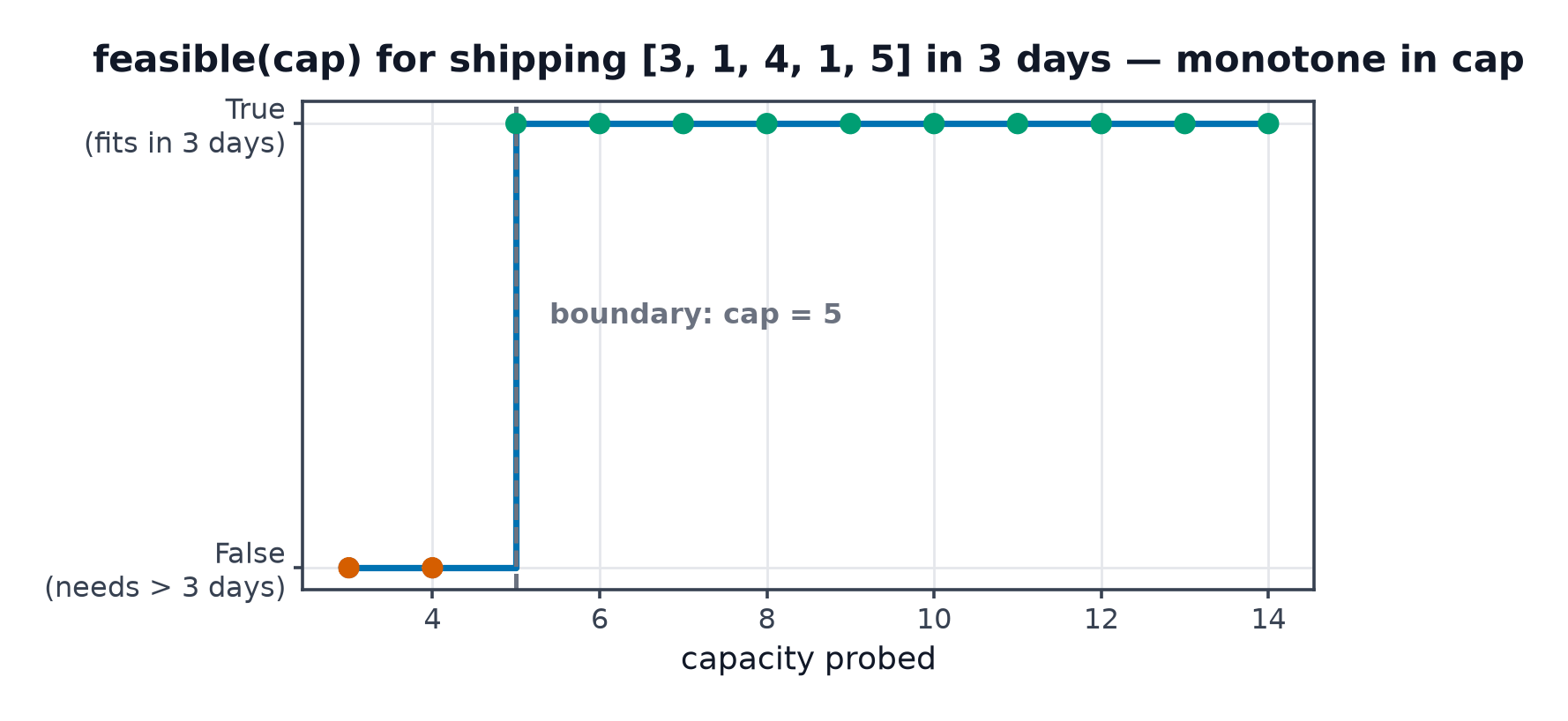
Minimum capacity to ship [3, 1, 4, 1, 5] within 3 days, loading packages onto a truck in order and
starting a new day whenever the next package would exceed the truck's capacity. The answer space is
[max(weights), sum(weights)] = [5, 14]; the trace below shows every probe:
weights = [3, 1, 4, 1, 5]   days = 3
answer space: lo = max(weights) = 5, hi = sum(weights) = 14

lo=5  hi=14  mid=9   feasible(9)?  day1=[3,1,4,1] (9)  day2=[5]                needed=2 <= 3  True   -> hi=9
lo=5  hi=9   mid=7   feasible(7)?  day1=[3,1] (4)  day2=[4,1] (5)  day3=[5]    needed=3 <= 3  True   -> hi=7
lo=5  hi=7   mid=6   feasible(6)?  day1=[3,1] (4)  day2=[4,1] (5)  day3=[5]    needed=3 <= 3  True   -> hi=6
lo=5  hi=6   mid=5   feasible(5)?  day1=[3,1] (4)  day2=[4,1] (5)  day3=[5]    needed=3 <= 3  True   -> hi=5
lo=5  hi=5   loop ends (lo == hi) -> answer = 5
Every probe in this trace happens to be feasible, because the true boundary sits exactly at lo, the
absolute floor set by the heaviest single package — a capacity below 5 could never fit that package on
any day, so 5 is both the initial lower bound and the answer. hi does all the shrinking; lo never
moves. This is not a special case the algorithm needs to detect — the loop above narrows toward the
first feasible value regardless of where it actually lies in the range.
- Python
- C++
def min_capacity(weights, days):
    """Smallest truck capacity that ships weights, in order, within `days` days."""
    def feasible(cap):                  # monotonic: if cap works, cap + 1 works too
        needed, load = 1, 0
        for w in weights:
            if load + w > cap:
                needed, load = needed + 1, 0
            load += w
        return needed <= days

    lo, hi = max(weights), sum(weights)  # lo: below this, one package alone overflows
    while lo < hi:                       # hi: trivially feasible, everything in one day
        mid = lo + (hi - lo) // 2
        if feasible(mid):
            hi = mid
        else:
            lo = mid + 1
    return lo
#include <algorithm>
#include <cassert>
#include <numeric>
#include <vector>

int min_capacity(const std::vector<int>& weights, int days) {
    auto feasible = [&](int cap) {              // monotonic: if cap works, cap + 1 works too
        int needed = 1, load = 0;
        for (int w : weights) {
            if (load + w > cap) { ++needed; load = 0; }
            load += w;
        }
        return needed <= days;
    };

    int lo = *std::max_element(weights.begin(), weights.end());
    int hi = std::accumulate(weights.begin(), weights.end(), 0);
    while (lo < hi) {
        int mid = lo + (hi - lo) / 2;
        if (feasible(mid)) hi = mid;
        else               lo = mid + 1;
    }
    return lo;
}
For packages and an answer range of size , each call to
feasible is worst case, and there are calls, for a total of worst
case — turning an optimisation problem into a small number of cheap simulations, rather than trying
every capacity from lo to hi in a linear scan.
Practical Usage
- Capacity problems — "smallest X that lets Y finish within Z" — are the most common phrasing: shipping capacity within a day count (above), minimum machine memory that lets a job finish within a time budget, minimum number of workers that finishes a task list by a deadline. The pattern is always the same feasibility check wrapped in the same template.
- Rate problems invert the direction slightly but stay monotonic. "Koko eating bananas" (find the
minimum integer eating speed
ksuch thatsum(ceil(pile / k) for pile in piles) <= h) is the canonical example:feasible(k)gets easier to satisfy askgrows, so it is monotonic in exactly the same sense, and the samelo, hi = 1, max(piles)half-open search finds the minimumk. - The floating-point variant. Some answer spaces are real-valued — minimum speed to arrive by a
deadline, the smallest real threshold that separates two classes of measurements.
lo < hias a loop condition never terminates on floats, since there is always a representable value between two distinct doubles that are not already bit-identical. Two fixes exist; only one is a good habit:
- Python
- C++
def min_feasible_float(feasible, lo, hi, iterations=100):
    """Smallest x in [lo, hi] for which feasible(x) holds — fixed iteration count, not epsilon."""
    for _ in range(iterations):
        mid = lo + (hi - lo) / 2
        if feasible(mid):
            hi = mid
        else:
            lo = mid
    return hi
template <typename Pred>
double min_feasible_float(Pred feasible, double lo, double hi, int iterations = 100) {
    for (int i = 0; i < iterations; ++i) {
        double mid = lo + (hi - lo) / 2;
        if (feasible(mid)) hi = mid;
        else               lo = mid;
    }
    return hi;
}
A fixed iteration count, not a comparison against an epsilon, is the stopping rule: 100 iterations
halve the initial range 100 times, which is far more precision than a double's ~15-17 significant
decimal digits (IEEE 754, as implemented by the platform's
double) can even represent — the loop converges to machine precision long before it runs out of
iterations, and it is guaranteed to terminate no matter what lo and hi are.
- Python
- C++
# checked on the traced input, plus a float sanity check
assert min_capacity([3, 1, 4, 1, 5], 3) == 5      # the traced search
assert min_capacity([1, 2, 3, 4, 5], 5) == 5      # one package per day: capacity = heaviest
assert abs(min_feasible_float(lambda x: x * x >= 2, 0.0, 2.0) - 2 ** 0.5) < 1e-9
int main() {
    assert((min_capacity({3, 1, 4, 1, 5}, 3) == 5));
    assert((min_capacity({1, 2, 3, 4, 5}, 5) == 5));
    double root2 = min_feasible_float([](double x) { return x * x >= 2.0; }, 0.0, 2.0);
    assert(root2 > 1.41421356 && root2 < 1.41421357);
}
Edge Cases & Pitfalls
- A non-monotonic predicate silently returns a wrong answer. There is no check possible from inside the search — verifying monotonicity is the caller's responsibility, done once on paper before writing any code, exactly as sortedness is for ordinary binary search.
- Choosing
loandhiincorrectly.lomust be a value the predicate is guaranteed to reject (or the trivial boundary case, as in the ship example wherelo = max(weights)is itself feasible), andhimust be a value it is guaranteed to accept. A wronghi— too small — makes the search return an infeasible answer without any error. - Comparing floats with
lo < hi. As above, this either loops forever or terminates on an arbitrary rounding accident. Use the fixed iteration count. - An feasibility check inside an outer loop is still total, not — a common estimation mistake when the check itself does real work per element.
Comparisons
| Binary search on an array | Binary search on the answer | Linear scan of the answer space | |
|---|---|---|---|
| Per probe | comparison | , problem-dependent | |
| Probes (worst case) | |||
| Requires | Sorted array | Monotonic predicate | Monotonic predicate (unused) |
| Materialises the search space | Yes — the array | No — an implicit range | No |
The predicate cost usually dominates: for the shipping problem, feasible is , so the whole
search is against a linear scan's — the same logarithmic win ordinary binary
search gets over a linear scan of an array, just paid per probe instead of per comparison.
Recall
References
- Cormen, Leiserson, Rivest & Stein, Introduction to Algorithms, 4th ed., §2.3 & Problem 2-4 — the general decrease-and-conquer argument this pattern specialises, applied to a monotone predicate.
- Sedgewick & Wayne, Algorithms, 4th ed., §1.1 & §1.4 — binary search as a special case of searching over a totally ordered set, not specifically an array.
- IEEE Standard for Floating-Point Arithmetic (IEEE 754)
— why two doubles need not ever become bit-identical under repeated averaging, which is exactly why
lo < hidoes not reliably terminate on a real-valued answer space.
Related Pages
- Binary Search — the half-open boundary template this page reuses on a range instead of an array.
- Sorting Algorithms — why the array form needs sorted data and this form does not need any data at all, only a predicate.
- Two Pointers & Sliding Window — another technique that turns an brute force into by exploiting monotonicity, in a different shape.