Exponential & Ternary Search
Both of these are binary search wearing a different hat. Exponential search still finds a target in a sorted sequence, but solves the problem of not knowing how long that sequence is — a stream, an unbounded array, an API that answers "is index i in range" without ever revealing the total count. Ternary search still discards a third of the range at every step, but answers a different question: not "where is this value" but "where is the peak (or valley) of this function."
Neither replaces ordinary binary search; each removes one specific assumption it relies on —
respectively, "you know n" and "you have a monotonic predicate rather than a unimodal function."
Read Binary Search first — both algorithms here are that one, run on a range found (exponential search) or shaped (ternary search) differently.
Core Concepts
| Term | Meaning |
|---|---|
| Exponential (galloping) search | Doubles a bound 1, 2, 4, 8, … until it overshoots the target, then binary searches the last doubling interval |
| Unbounded / streamed input | A sequence whose length is unknown or expensive to ask for up front — a generator, a socket, an array exposed only through an "is this index valid" check |
| Unimodal function | Strictly increases, then strictly decreases (or the mirror) — exactly one maximum (or minimum), no flat top and no second peak |
| Ternary search | Probes two interior points per iteration and discards the third of the range that provably cannot contain the extremum |
| Golden-section search | A refinement of ternary search that reuses one of the two probe points across iterations, halving the number of function evaluations |
Mechanism
Exponential search
Exponential search for 8 in an unbounded sorted stream: double a bound until it either overshoots the
target or hits the end of the (unknown) data, then binary search inside the last interval that bracketed
it.
stream (0-indexed, sorted, length unknown): index 0=1  1=2  2=4  3=8  4=16  5=32  6=64 ...
target = 8

bound doubling (stream[0]=1 != target, so start doubling from bound=1):
  bound=1   stream[1]=2    2 < 8  -> double the bound
  bound=2   stream[2]=4    4 < 8  -> double the bound
  bound=4   stream[4]=16  16 >= 8 -> overshot; stop doubling

binary search inside [bound/2, bound) = [2, 4):
  lo=2  hi=4  mid=3  stream[3]=8   8 >= 8 -> hi = 3
  lo=2  hi=3  mid=2  stream[2]=4   4 < 8  -> lo = 3
  lo=3  hi=3  loop ends -> check stream[3]

  stream[3] == 8 -> found at index 3
The doubling phase costs probes to reach an index that brackets the answer, and the
binary search phase inside a range of size costs another — for a combined
worst case, where is the position of the target (or where it would be), not the
length of the whole stream. This is the entire point: exponential search never needs to know n, and
its cost scales with how far in the answer is, not with the total size of the data.
- Python
- C++
def exponential_search(get, target):
    """Search a sorted, 0-indexed, unbounded sequence via get(i) (raises IndexError past the end)."""
    def safe_get(i):
        try:
            return get(i)
        except IndexError:
            return None

    if safe_get(0) == target:
        return 0

    bound = 1
    while True:
        v = safe_get(bound)
        if v is None or v >= target:
            break
        bound *= 2

    lo, hi = bound // 2, bound
    while lo < hi:
        mid = lo + (hi - lo) // 2
        v = safe_get(mid)
        if v is None or v >= target:
            hi = mid
        else:
            lo = mid + 1
    return lo if safe_get(lo) == target else -1
#include <cassert>
#include <functional>
#include <optional>

int exponential_search(const std::function<std::optional<int>(int)>& get, int target) {
    auto v0 = get(0);
    if (v0 && *v0 == target) return 0;

    int bound = 1;
    while (true) {
        auto v = get(bound);
        if (!v || *v >= target) break;
        bound *= 2;
    }

    int lo = bound / 2, hi = bound;
    while (lo < hi) {
        int mid = lo + (hi - lo) / 2;
        auto v = get(mid);
        if (!v || *v >= target) hi = mid;
        else                    lo = mid + 1;
    }
    auto found = get(lo);
    return (found && *found == target) ? lo : -1;
}
Ternary search
Ternary search narrows toward the peak of a unimodal function by comparing two interior probes,
m1 and m2, and discarding whichever outer third cannot contain the maximum:
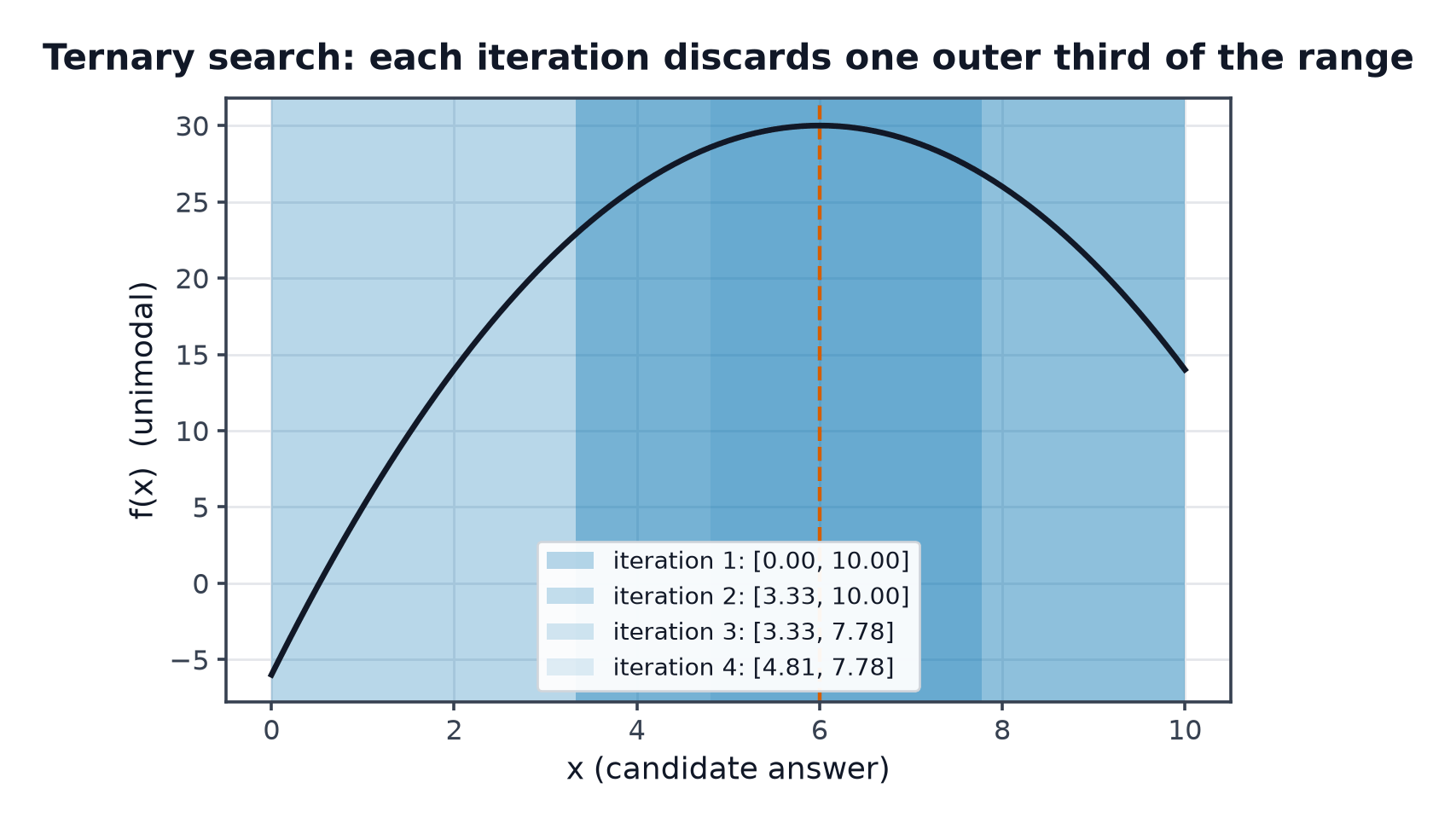
f(x) = -(x-6)^2 + 30   on [lo, hi] = [0, 10]

iter 1: m1=3.33  m2=6.67   f(m1)=22.87  f(m2)=29.55   f(m2) > f(m1) -> peak is right of m1 -> lo = 3.33
iter 2: m1=5.56  m2=7.78   f(m1)=29.81  f(m2)=26.83   f(m1) > f(m2) -> peak is left of m2  -> hi = 7.78
iter 3: m1=4.81  m2=6.30   f(m1)=28.58  f(m2)=29.91   f(m2) > f(m1) -> peak is right of m1 -> lo = 4.81
iter 4: m1=5.80  m2=6.79   f(m1)=29.96  f(m2)=29.38   f(m1) > f(m2) -> peak is left of m2  -> hi = 6.79
Each iteration discards one third of the remaining range, so after iterations the range has shrunk by — iterations to reach precision ε, a worse constant than binary search's despite the similar shape, because ternary search needs two function evaluations per iteration against binary search's one.
- Python
- C++
def ternary_search_max(f, lo, hi, iterations=100):
    """Argmax of a unimodal f on [lo, hi] — fixed iteration count, same reasoning as the float
    variant of binary search on the answer."""
    for _ in range(iterations):
        m1 = lo + (hi - lo) / 3
        m2 = hi - (hi - lo) / 3
        if f(m1) < f(m2):
            lo = m1
        else:
            hi = m2
    return (lo + hi) / 2
template <typename Func>
double ternary_search_max(Func f, double lo, double hi, int iterations = 100) {
    for (int i = 0; i < iterations; ++i) {
        double m1 = lo + (hi - lo) / 3;
        double m2 = hi - (hi - lo) / 3;
        if (f(m1) < f(m2)) lo = m1;
        else                hi = m2;
    }
    return (lo + hi) / 2;
}
# checked on the traced input and the ternary search above
assert exponential_search(lambda i: [1, 2, 4, 8, 16, 32, 64][i], 8) == 3
assert exponential_search(lambda i: [1, 2, 4, 8, 16, 32, 64][i], 5) == -1
peak = ternary_search_max(lambda x: -((x - 6) ** 2) + 30, 0.0, 10.0)
assert abs(peak - 6.0) < 1e-6
Practical Usage
- Why unimodality matters, and cannot be checked from inside the loop. A function with two local
maxima causes ternary search to converge on whichever one the first pair of probes happens to favour,
silently discarding the other — there is no way to detect this from the sequence of
fvalues alone. Verifying unimodality is a proof obligation before calling the function, exactly like verifying sortedness before ordinary binary search or monotonicity before binary search on the answer. - Binary search on the derivative usually beats ternary search outright. If is differentiable, is monotonic around the extremum (increasing then the sign flips, for a maximum), which is exactly the precondition for binary search on the answer applied to "is " — one function evaluation per iteration instead of ternary search's two, for the same iteration count. Sedgewick & Wayne's coverage of ternary search notes this trade-off directly: ternary search is the fallback for when a derivative is not available or not worth deriving, not the first choice when it is.
- Exponential search's real use is unbounded data, not sorted arrays whose length is already known — for a known-length array, plain binary search does the same job in fewer probes. It shows up when scanning a log stream for the first entry past a timestamp, or probing an external, paginated API that has no cheap "give me the length" call.
- Interpolation search, not covered in depth here, is a further refinement for uniformly distributed
numeric data: instead of always probing the midpoint, it estimates where the target should be
linearly between
loandhi's values, achieving average case (Sedgewick & Wayne, 4th ed., §3.1 exercises) at the cost of a worst case that degrades to on adversarial data.
Edge Cases & Pitfalls
- Doubling past the end of a truly finite sequence.
safe_get/std::optionalabove must treat "past the end" the same as "too large," or the doubling loop reads out of bounds instead of stopping. - Two flat plateaus at the same height defeat ternary search's comparison. If
f(m1) == f(m2)exactly, either branch is technically safe for a strictly unimodal function, but a function that is merely non-decreasing then non-increasing (a flat top) can have both probes land on the plateau with no information to act on — ternary search assumes strict unimodality, not the non-strict version. - Off-by-one in the doubling bound. Searching
[lo, hi] = [bound/2, bound]after doubling, rather than[0, bound], is what keeps exponential search at instead of re-scanning everything found so far — using the wrong lower bound silently degrades the complexity without breaking correctness. - Floating-point ternary search needs a fixed iteration count, for the identical reason given in
Binary Search on the Answer:
lo < hion doubles is not a reliable termination condition.
Comparisons
| Exponential search | Ternary search | Plain binary search | |
|---|---|---|---|
Needs n in advance | No | No (operates on a numeric range) | Yes (or an end sentinel) |
| Finds | An exact value | An extremum of a unimodal function | An exact value or boundary |
| Function evaluations per iteration | 1 (doubling) + (binary phase) | 2 | 1 |
| Worst case | |||
| Prefer when | Length unknown or expensive to obtain | No derivative available for the function | Length known, array materialised |
Recall
References
- Bentley, J. L. & Yao, A. C.-C., "An Almost Optimal Algorithm for Unbounded Searching," Information Processing Letters 5(3), 1976 — the original exponential/galloping search and its optimality proof.
- Sedgewick & Wayne, Algorithms, 4th ed., §3.1 "Symbol Tables" (exercises) — interpolation search's average and worst case, and ternary search versus derivative-based methods.
- Cormen, Leiserson, Rivest & Stein, Introduction to Algorithms, 4th ed., §9.3 — the selection problem's decrease-and-conquer structure, the same shape ternary search uses to discard a third of the range instead of a fixed fraction from one side.
Related Pages
- Binary Search — the underlying halving step both algorithms specialise.
- Binary Search on the Answer — the derivative-based alternative to ternary search, and the shared fixed-iteration stopping rule for floating-point ranges.
- Recurrences & the Master Theorem — why a shrink factor and a shrink factor both resolve to a logarithm, just with different constants.