Quickselect
Finding the k-th smallest element does not require sorting the whole array. Sorting throws away no information at all — every element's rank relative to every other becomes known — but a "find the median" or "find the 90th percentile" query only ever asks about one rank. Quickselect answers exactly that question, using quicksort's partition step but throwing away the side of the partition that cannot contain the answer, instead of recursing into both.
The result is an algorithm with the same worst-case pathology as quicksort — a bad pivot sequence still degrades it to — but an average case that is not , it is . That difference is not a rounding error: quicksort must still recurse into both halves to place every element, while quickselect only ever recurses into the one half that contains the k-th element, and each level of that recursion does geometrically less work than the one before.
Requires quicksort's partition step — this page reuses it rather than re-deriving it. Comfortable with recurrence relations helps for the average-case argument below.
Core Concepts
| Term | Meaning |
|---|---|
| k-th smallest | The element that would sit at index k (0-indexed) if the array were sorted |
| Partition | Rearranges the array around a pivot so everything ≤ pivot is left of it, everything > pivot is right — same operation as quicksort's |
| Selection | The general problem name: finding an order statistic without fully sorting |
| Median of medians | A pivot-selection scheme that guarantees worst case, at a large constant-factor cost |
nth_element | C++'s standard-library selection algorithm — a partial ordering around one position, not a full sort |
Mechanism
Quickselect partitions exactly as quicksort does, then looks at where the pivot landed relative to
k: if the pivot's final index equals k, that value is the answer. If the pivot landed to the
right of k, the answer is somewhere in the left partition and the right partition is discarded
entirely — no recursive call into it, not even to look. Symmetrically for the pivot landing left of
k. Unlike quicksort, at most one recursive call happens per level.
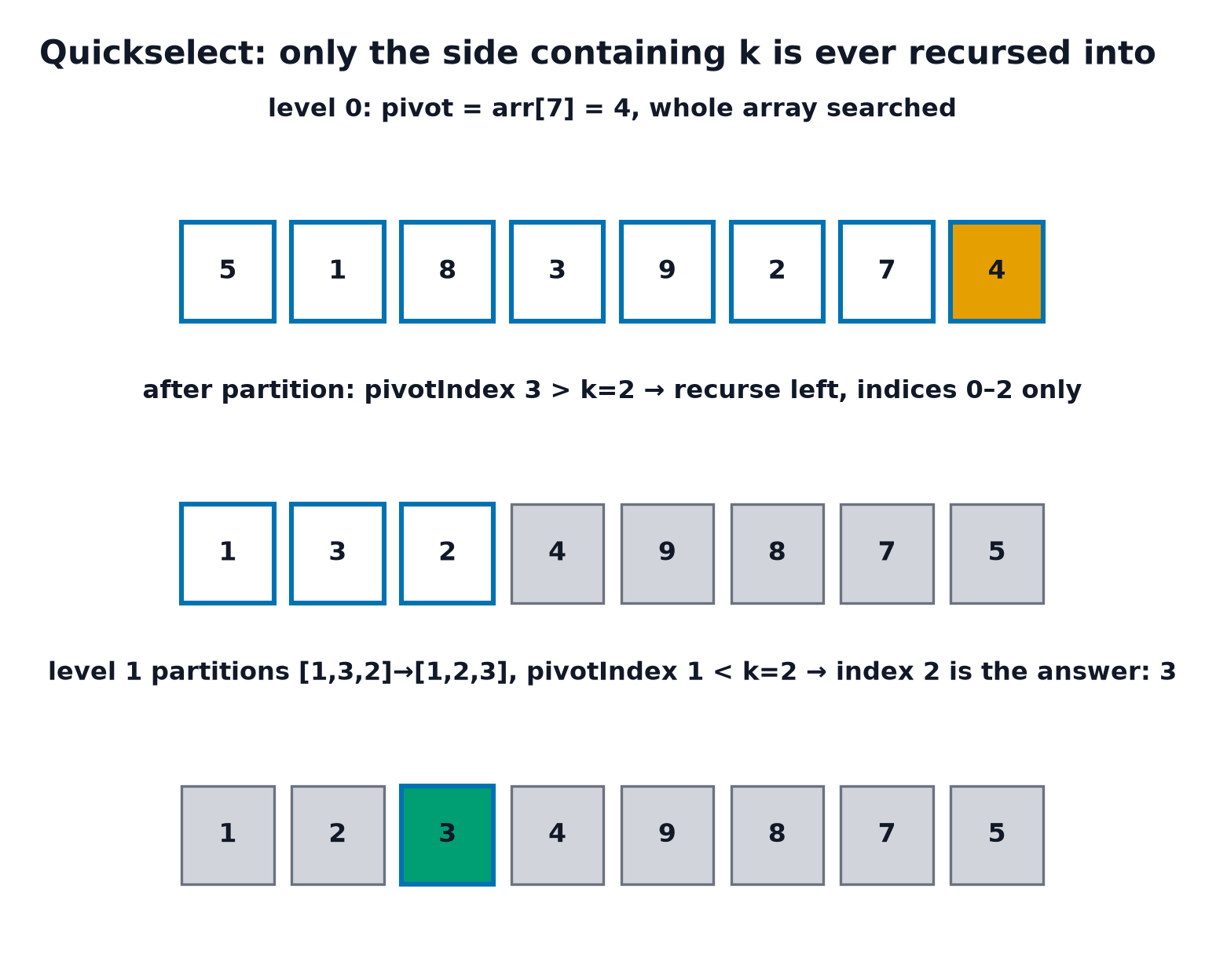
find the 3rd smallest (0-indexed k=2) of [5, 1, 8, 3, 9, 2, 7, 4]

level 0: arr = [5, 1, 8, 3, 9, 2, 7, 4], range [0, 7], pivot = arr[7] = 4
  partition (Lomuto, pivot last) -> [1, 3, 2, 4, 9, 8, 7, 5]
  pivot's final index = 3
  3 > k=2  -> answer is left of the pivot; discard indices [4, 7] entirely, recurse on [0, 2]

level 1: arr[0..2] = [1, 3, 2], range [0, 2], pivot = arr[2] = 2
  partition -> [1, 2, 3]  (only this sub-range changes; full array now [1, 2, 3, 4, 9, 8, 7, 5])
  pivot's final index = 1
  1 < k=2  -> answer is right of the pivot; discard index [0, 1], recurse on [2, 2]

level 2: range [2, 2] is a single element: arr[2] = 3
  return 3   -- the 3rd smallest, confirmed by the fully sorted array [1,2,3,4,5,7,8,9]
- Python
- C++
def partition(a, lo, hi):
    """Lomuto partition: pivot is a[hi]. Returns the pivot's final index."""
    pivot = a[hi]
    i = lo - 1
    for j in range(lo, hi):
        if a[j] <= pivot:
            i += 1
            a[i], a[j] = a[j], a[i]
    a[i + 1], a[hi] = a[hi], a[i + 1]
    return i + 1


def quickselect(a, k, lo=0, hi=None):
    """The k-th smallest element (0-indexed) of a[lo..hi], via one-sided recursion."""
    if hi is None:
        hi = len(a) - 1
    while True:                                # iterative: only one side ever recurses
        if lo == hi:
            return a[lo]
        p = partition(a, lo, hi)
        if p == k:
            return a[p]
        elif p > k:
            hi = p - 1                          # discard the right side outright
        else:
            lo = p + 1                          # discard the left side outright
#include <cassert>
#include <utility>
#include <vector>

int partition(std::vector<int>& a, int lo, int hi) {
    int pivot = a[hi];
    int i = lo - 1;
    for (int j = lo; j < hi; ++j) {
        if (a[j] <= pivot) std::swap(a[++i], a[j]);
    }
    std::swap(a[i + 1], a[hi]);
    return i + 1;
}

int quickselect(std::vector<int>& a, int k, int lo, int hi) {
    while (true) {
        if (lo == hi) return a[lo];
        int p = partition(a, lo, hi);
        if (p == k) return a[p];
        else if (p > k) hi = p - 1;
        else lo = p + 1;
    }
}
- Python
- C++
# checked on the traced input: 3rd smallest (0-indexed k=2) of [5, 1, 8, 3, 9, 2, 7, 4]
assert quickselect([5, 1, 8, 3, 9, 2, 7, 4], 2) == 3
assert quickselect([5, 1, 8, 3, 9, 2, 7, 4], 0) == 1     # the minimum
assert quickselect([5, 1, 8, 3, 9, 2, 7, 4], 7) == 9     # the maximum
assert quickselect([4], 0) == 4                           # single element, no partition needed
int main() {
    std::vector<int> a1 = {5, 1, 8, 3, 9, 2, 7, 4};
    assert(quickselect(a1, 2, 0, 7) == 3);
    std::vector<int> a2 = {5, 1, 8, 3, 9, 2, 7, 4};
    assert(quickselect(a2, 0, 0, 7) == 1);
    std::vector<int> a3 = {4};
    assert(quickselect(a3, 0, 0, 0) == 4);
}
Why the average case is , not
Quicksort's recurrence is T(n) = T(left) + T(right) + O(n) — both sides are paid for. Quickselect's
recurrence is T(n) = T(max(left, right)) + O(n) — only one side is ever paid for, because the other
is discarded without a call. With a random pivot, the expected size of the recursed-into side is at
most 3n/4 (the same "middle half" argument as in quicksort's average-case analysis), so the expected
total work follows a geometric series:
T(n) ≤ cn + T(3n/4) ≤ cn + c(3n/4) + T(9n/16) ≤ cn (1 + 3/4 + (3/4)² + (3/4)³ + …) = cn · 4 = O(n)
The partition-and-discard work at each level shrinks by a constant factor (roughly 3/4 per level, on
expectation), so the series converges to a constant multiple of the first term — the total is
dominated by the first partition, not by how many levels there are. This is the same style of argument
CLRS 4th ed. §9.2 formalises rigorously (with an indicator-variable expectation, not the sketch above)
for its randomized SELECT.
Practical Usage
- C++
std::nth_element(cppreference) is quickselect in the standard library: it partially reorders a range so the element at the given position is the one that would be there in a fully sorted range, and every element before it is ≤ every element after it — but neither side is otherwise sorted. The standard specifies its complexity as "linear on average" ([alg.nth.element]); libstdc++ and libc++ both implement introselect (quickselect that falls back to median-of-medians on excessive recursion depth) to bound the worst case, the same idea introsort applies to quicksort — see Choosing a Sort. - Python has no
nth_element.heapq.nsmallest(k, iterable)andheapq.nlargestsolve a related but different problem — the k smallest/largest values in order — using a heap, in (Python docs), not . For a single unordered k-th value,sorted(a)[k]is the simple correct answer at ; hand-rolled quickselect only pays off when the vs gap matters at your data size. - Streaming or unknown-size input. Neither quickselect nor
nth_elementapplies without the whole array in memory; a running k-th-order-statistic over a stream is a different problem (reservoir sampling or a bounded heap), not covered here.
Edge Cases & Pitfalls
- Off-by-one between "k-th smallest" and "index k". "The 3rd smallest" is index 2 in a 0-indexed array. Every call site needs to fix this convention once, in one place, rather than re-deriving it per call.
- Adversarial input against a fixed pivot rule. Exactly like quicksort: choosing
a[hi]as the pivot on an already-sorted or reverse-sorted array makes every partition maximally unbalanced, degrading to worst case. A random pivot (swap a random element intoa[hi]before partitioning) defeats an adversary that only sees the algorithm, not its random seed. - Recursing into both sides "to be safe". This silently turns quickselect back into a selection via quicksort — correct, but throws away the entire performance argument. The one-sided recursion is not an optimization detail, it is the whole point of the algorithm.
- Duplicate-heavy arrays. The Lomuto scheme above places all elements ≤ pivot on the pivot's side,
so an array of mostly-equal values partitions unevenly on every call (
pstays nearhi) — a three-way (Dutch national flag) partition to segregate<,==, and>avoids the degradation, the same fix quicksort uses for duplicate-heavy data.
Comparisons
| Best | Average | Worst | Space | Notes | |
|---|---|---|---|---|---|
| Quickselect | auxiliary (in-place partition) | The default answer; worst case needs an adversarial pivot sequence | |||
| Median of medians (deterministic pivot) | auxiliary for the grouping | Guaranteed worst case, at 4-10× quickselect's real-world constant | |||
Sort then index (sorted(a)[k]) | Simplest correct answer; wins when several different k are needed from the same array | ||||
Heap of size k (heapq.nsmallest) | Wins when k is small and fixed, or the input is a stream |
Median of medians guarantees worst case by choosing a pivot that is provably "good enough":
split the array into groups of 5, find each group's median (a fixed operation per group), then
recursively find the median of those medians and use it as the pivot. That pivot is guaranteed to be
greater than at least 30% and less than at least 30% of all elements, which bounds the recursion depth
and gives the recurrence T(n) ≤ T(n/5) + T(7n/10) + O(n) — CLRS 4th ed. §9.3 works through why the
two fractions sum to less than 1, which is exactly what makes the recursion terminate in linear total
work.
Nobody uses it in practice because the constant factor is large — grouping into fives, finding each group's median, and recursing on the medians costs several times what a random-pivot quickselect costs on ordinary data, for a worst-case guarantee that ordinary data essentially never triggers. Randomized quickselect combined with introselect's depth-limited fallback (switch to a guaranteed- method only if the recursion goes suspiciously deep) gets the same worst-case safety at a cost paid only on the inputs that need it.
Recall
References
- Cormen, Leiserson, Rivest & Stein, Introduction to Algorithms, 4th ed., §9.2 (randomized
SELECTand its expected linear-time proof), §9.3 (SELECTin worst-case linear time — median of medians). - Sedgewick & Wayne, Algorithms, 4th ed., §2.5 "Quicksort" closing exercises — selection as a quicksort variant, and the partial-ordering guarantee it leaves behind.
std::nth_element— cppreference — the exact partial-ordering postcondition and the "linear on average" complexity note.[alg.nth.element], ISO C++ working draft — the standard's own complexity wording fornth_element.heapq.nsmallest— Python docs — the heap-based k-smallest-in-order routine and its note.
Related Pages
- Quicksort — the partition step quickselect reuses, and the same adversarial-input weakness both algorithms share.
- Choosing a Sort — introselect's depth-limited fallback, the same defensive trick introsort applies to quicksort itself.
- Heaps — the structure behind
heapq.nsmallest's alternative when only a small, ordered top-k is needed. - Recurrences & the Master Theorem — the general tool the geometric-series argument above is a specific instance of.