Quicksort
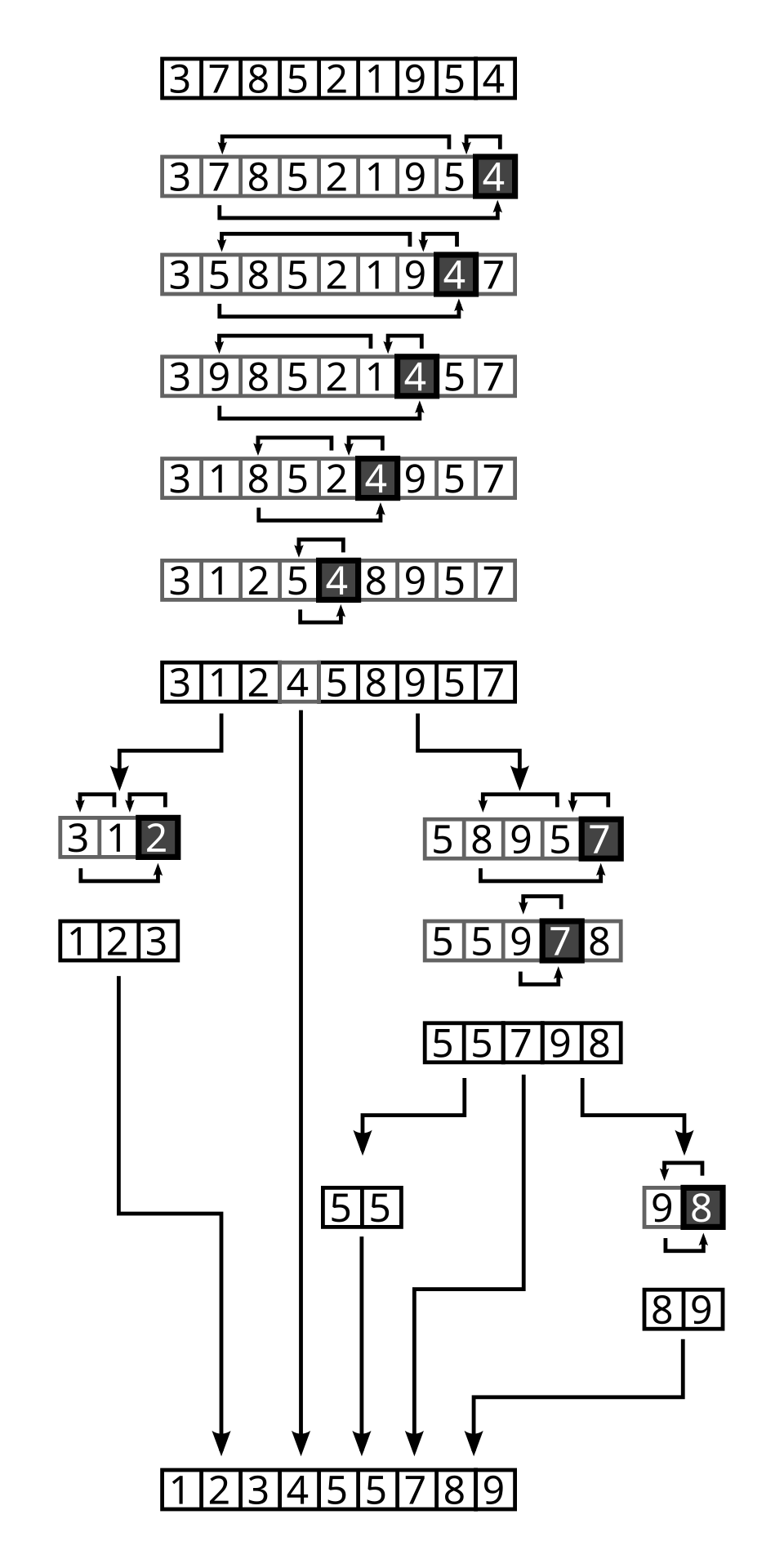
Quicksort picks an element as the pivot, rearranges the array so that everything smaller sits to its left and everything larger to its right, then recurses on both sides. After partitioning, the pivot is already in its final position and never moves again.
It is the mirror image of mergesort: mergesort splits trivially and does its work while combining, quicksort does its work while splitting and combines trivially. In practice quicksort is usually the faster of the two, despite a worst case that is quadratic.
Core Concepts
| Property | Value |
|---|---|
| Best case | — balanced partitions |
| Average | |
| Worst case | — maximally unbalanced partitions |
| Space | — recursion stack only |
| Stable | No |
| Adaptive | No (though pdqsort makes it partly so) |
| In place | Yes |
Mechanism
- Python
- C++
def quicksort(a, lo=0, hi=None):
    if hi is None:
        hi = len(a) - 1
    if lo >= hi:
        return a
    p = partition(a, lo, hi)
    quicksort(a, lo, p - 1)      # the pivot at p is already final
    quicksort(a, p + 1, hi)
    return a

def partition(a, lo, hi):
    """Lomuto scheme: pivot is the last element."""
    pivot = a[hi]
    i = lo                        # boundary of the "smaller than pivot" region
    for j in range(lo, hi):
        if a[j] < pivot:
            a[i], a[j] = a[j], a[i]
            i += 1
    a[i], a[hi] = a[hi], a[i]     # put the pivot between the two regions
    return i
#include <bit>
#include <cassert>
#include <utility>
#include <vector>

// Lomuto scheme: pivot is the last element.
int partition(std::vector<int>& a, int lo, int hi) {
    int pivot = a[hi];
    int i = lo;                       // boundary of the "smaller than pivot" region
    for (int j = lo; j < hi; ++j) {
        if (a[j] < pivot) {
            std::swap(a[i], a[j]);
            ++i;
        }
    }
    std::swap(a[i], a[hi]);           // put the pivot between the two regions
    return i;
}

void quicksort(std::vector<int>& a, int lo, int hi) {
    if (lo >= hi) return;
    int p = partition(a, lo, hi);
    quicksort(a, lo, p - 1);          // the pivot at p is already final
    quicksort(a, p + 1, hi);
}

void quicksort(std::vector<int>& a) {
    quicksort(a, 0, static_cast<int>(a.size()) - 1);
}
Tracing the Lomuto partition of [5, 1, 8, 3] with pivot a[hi] = 3 (the last element):
j | a[j] | a[j] < pivot? | Action | Array | i |
|---|---|---|---|---|---|
| start | — | — | — | [5, 1, 8, 3] | 0 |
| 0 | 5 | no | nothing | [5, 1, 8, 3] | 0 |
| 1 | 1 | yes | swap a[0] ↔ a[1], i += 1 | [1, 5, 8, 3] | 1 |
| 2 | 8 | no | nothing | [1, 5, 8, 3] | 1 |
| end | — | — | swap pivot into place: a[1] ↔ a[3] | [1, 3, 8, 5] | returns 1 |
The pivot 3 lands at index 1 — everything to its left (1) is smaller, everything to its right
(8, 5) is larger, and it will never move again. The recursion continues on [1] (already trivially
sorted) and [8, 5], which the same partition process reduces to [5, 8] on its next call.
Why it beats mergesort in practice despite equal complexity
- In place. No buffer, and no allocation in the hot path.
- Excellent locality. Partitioning is two sequential scans converging on each other, which the prefetcher handles perfectly. Mergesort's merges are also sequential but write to a separate buffer, doubling memory traffic.
- Tight inner loop. A comparison, a conditional swap, and a pointer bump.
The pivot choice is the whole game
The partition is balanced only if the pivot is near the median. Choosing badly gives partitions of size 0 and n−1, which makes the recursion n levels deep and the cost .
| Pivot strategy | Worst case triggered by | Verdict |
|---|---|---|
| First or last element | Already-sorted input | Dangerous — the most common real input |
| Random element | Nothing predictable | Good; becomes vanishingly unlikely |
| Median of three (first, middle, last) | Crafted "median-of-3 killer" inputs | Standard practice; cheap and effective |
| True median (median-of-medians) | Nothing — guaranteed | Too slow in practice |
Picking the first or last element as pivot means an already-sorted array partitions into an empty side and everything else, every time — n levels of recursion, comparisons, and stack depth, which on a large array is a stack overflow rather than merely slow.
Sorted or nearly-sorted input is extremely common. Never ship a quicksort with a fixed pivot position; randomise it or use median-of-three.
Hoare partitioning
The Lomuto scheme above is easier to read, but Hoare's original does about three times fewer swaps and handles duplicate-heavy input better:
- Python
- C++
def hoare_partition(a, lo, hi):
    pivot = a[(lo + hi) // 2]
    i, j = lo - 1, hi + 1
    while True:
        i += 1
        while a[i] < pivot:
            i += 1
        j -= 1
        while a[j] > pivot:
            j -= 1
        if i >= j:
            return j                  # note: returns a split point, not a pivot index
        a[i], a[j] = a[j], a[i]
int hoare_partition(std::vector<int>& a, int lo, int hi) {
    int pivot = a[lo + (hi - lo) / 2];
    int i = lo - 1, j = hi + 1;
    for (;;) {
        do { ++i; } while (a[i] < pivot);
        do { --j; } while (a[j] > pivot);
        if (i >= j) return j;         // note: returns a split point, not a pivot index
        std::swap(a[i], a[j]);
    }
}
Note the different contract — it returns a boundary, so the recursion becomes
quicksort(a, lo, j) and quicksort(a, j + 1, hi), with no element excluded. Mixing up the two
schemes' contracts is a classic source of infinite recursion.
Practical Usage
Production quicksorts are always hybrids:
- Python
- C++
# doc:no-run
# Illustrative fragment: insertion_sort_range() and heapsort_range() are not defined here.
def introsort(a, lo, hi, depth_budget):
    if hi - lo < 16:
        insertion_sort_range(a, lo, hi)          # small ranges: insertion sort wins
    elif depth_budget == 0:
        heapsort_range(a, lo, hi)                # too deep: bail out to a guaranteed O(n log n)
    else:
        p = partition(a, lo, hi)
        introsort(a, lo, p - 1, depth_budget - 1)
        introsort(a, p + 1, hi, depth_budget - 1)

# Entry point: budget of 2·log₂(n) partitions before giving up on quicksort
// doc:no-run
// Illustrative fragment: insertion_sort_range() and heapsort_range() are not defined here.
void introsort(std::vector<int>& a, int lo, int hi, int depth_budget) {
    if (hi - lo < 16) {
        insertion_sort_range(a, lo, hi);            // small ranges: insertion sort wins
    } else if (depth_budget == 0) {
        heapsort_range(a, lo, hi);                  // too deep: bail out to a guaranteed O(n log n)
    } else {
        int p = partition(a, lo, hi);
        introsort(a, lo, p - 1, depth_budget - 1);
        introsort(a, p + 1, hi, depth_budget - 1);
    }
}

// Entry point: budget of 2·log₂(n) partitions before giving up on quicksort
void introsort(std::vector<int>& a) {
    int n = static_cast<int>(a.size());
    introsort(a, 0, n - 1, 2 * std::bit_width(static_cast<unsigned>(n)));
}
Introsort — this exact structure — is what C++'s std::sort uses. It keeps quicksort's speed
while making the worst case unreachable, because exceeding the depth budget hands the range to
heapsort.
Also worth knowing: three-way partitioning (into < pivot, == pivot, > pivot) turns arrays
with many duplicate keys from a weakness into an best case. Without it, equal keys pile up on
one side.
- Python
- C++
# checked on the traced input
assert partition([5, 1, 8, 3], 0, 3) == 1
assert quicksort([5, 1, 8, 3]) == [1, 3, 5, 8]
assert quicksort([]) == []
int main() {
    std::vector<int> a{5, 1, 8, 3};
    assert(partition(a, 0, 3) == 1);
    std::vector<int> b{5, 1, 8, 3};
    quicksort(b);
    assert((b == std::vector<int>{1, 3, 5, 8}));
}
Edge Cases & Pitfalls
- Tail-recursion on the larger side risks stack overflow. Recurse into the smaller partition and loop on the larger, bounding stack depth to even in the worst case.
(lo + hi) // 2can overflow in fixed-width integer languages. Uselo + (hi - lo) // 2.- Quicksort is not stable, and cannot cheaply be made so — partitioning moves elements across long distances. If stability matters, use mergesort.
- Many equal elements degrade two-way partitioning to in some schemes. Use three-way.
Comparisons
| Quicksort | Mergesort | Heapsort | |
|---|---|---|---|
| Typical speed | Fastest | Good | Slowest |
| Worst case | |||
| Space | |||
| Stable | No | Yes | No |
| Used by | C++ std::sort, Rust sort_unstable | Python (as Timsort) | Introsort's fallback |
Recall
References
- Hoare, C.A.R. (1961), "Algorithm 64: Quicksort", Communications of the ACM — the original.
- Cormen, Leiserson, Rivest & Stein, Introduction to Algorithms, 4th ed., Ch. 7 — quicksort, randomised quicksort, and the average-case analysis.
- Musser, D. (1997), "Introspective Sorting and Selection Algorithms" — the paper introducing introsort.
Books & Videos
- VisuAlgo — Sorting — try it on sorted input with a first-element pivot to see the worst case appear.
Related Pages
- Mergesort — the stable, guaranteed- counterpart.
- Heapsort — introsort's escape hatch.
- Choosing a Sort — what standard libraries actually ship.