KMP & the Z-Algorithm
The naive substring scan tries the pattern at every text position and, on a mismatch, throws away
everything it just learned. Line up abacaba against abacabadabacaba, match six characters, fail on
the seventh — and the naive loop restarts at text index 1 with an empty memory, re-reading five
characters it has already seen. On a text of aaaa…a with pattern aaab that waste is the whole
algorithm: comparisons in the worst case, for a problem with n + m characters in it.
But the failed attempt was informative. Those six matched characters are known text: the text at
positions 0–5 is exactly abacab. If the pattern has a border — a prefix that is also a suffix of
what matched — then that prefix is already sitting in the text, correctly aligned, and there is no
need to re-verify it. abacab ends in ab, which is also how the pattern starts, so the pattern can
slide forward by four and resume comparing at pattern index 2 instead of 0. Every other alignment in
between is provably a mismatch and never needs to be tried.
The failure function is that reasoning precomputed for every prefix of the pattern, once, before
the search begins. fail[i] is the length of the longest proper prefix of pattern[0..i] that is
also a suffix of it. With it, the search pointer into the text only ever moves forward — which is what
makes KMP worst case and, more practically, what makes it usable on a stream you cannot
rewind. The Z-algorithm computes the same information in a different shape — for each position of
a string, how far it agrees with the string's own start — and the two are interconvertible.
Comfortable with arrays and 0-based index arithmetic. Nothing here depends on character encodings, but if the "characters" are Unicode see character encoding — KMP compares code units, and what counts as one character is your decision to make before the comparison.
Core Concepts
| Term | Meaning |
|---|---|
| Border | A string that is both a proper prefix and a proper suffix of another. aba is a border of abacaba |
| Proper | Excludes the whole string. Without this, fail[i] = i + 1 always, and the search never advances |
Failure function fail[i] | Length of the longest border of pattern[0..i]. Also written π (CLRS) or lps |
| Border chain | fail[i], fail[fail[i]−1], … enumerates every border, longest first. This is the mismatch fallback loop |
Z-array z[i] | Length of the longest common prefix of s and s[i..]. z[0] is defined as n (or left unused) |
Z-box [l, r) | The rightmost known match against the prefix, reused to initialise later z[i] without re-comparing |
Mechanism
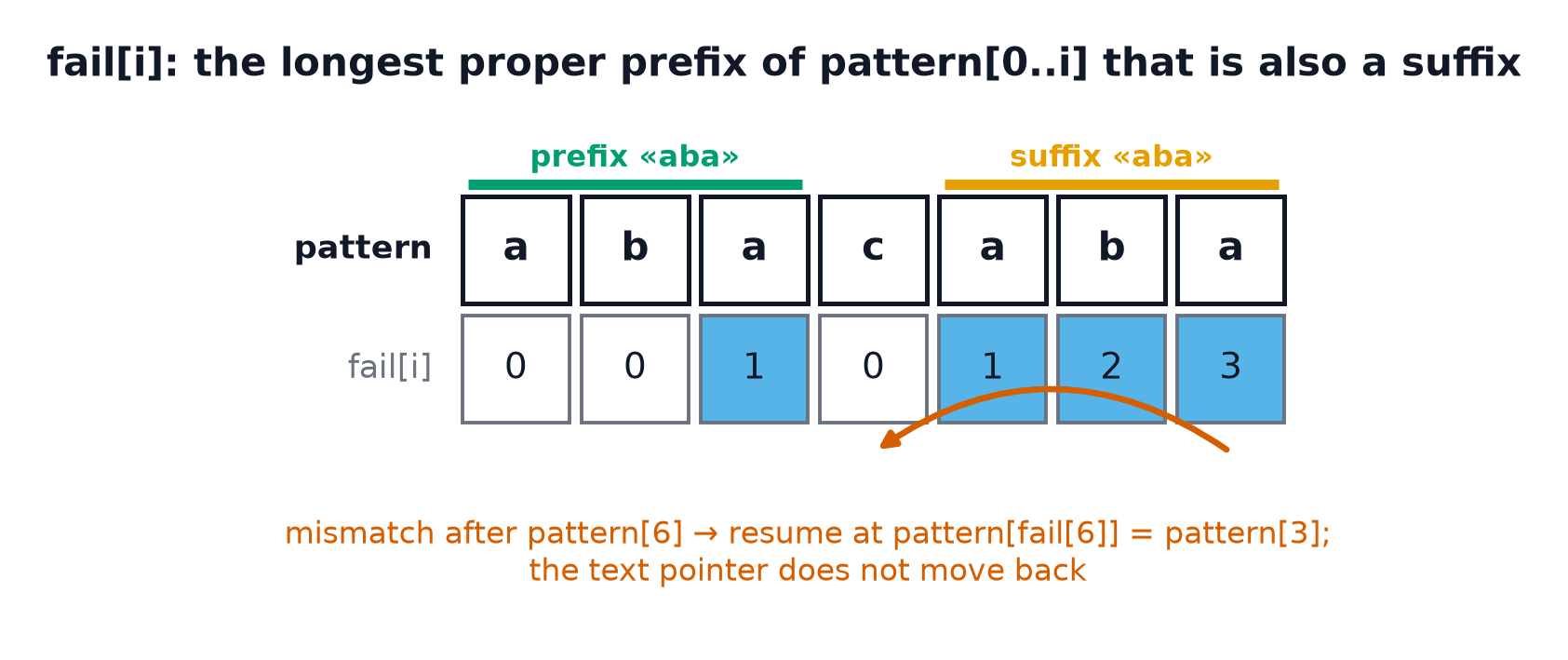
pattern = abacaba

  i    pattern[0..i]   longest proper prefix that is also a suffix   fail[i]
  0    a               —                                            0
  1    ab              —                                            0
  2    aba             a                                            1
  3    abac            —                                            0
  4    abaca           a                                            1
  5    abacab          ab                                           2
  6    abacaba         aba                                          3

search in text = abacabadabacaba

  text pos   pattern pos   action
  0..6       0..6          full match at text index 0
  7          7 → fail[6]=3 'd' vs pattern[3]='c' mismatch, slide to 3, then to fail[2]=1, then 0
  8..14      0..6          full match at text index 8
Two things to notice. After the match at index 0 the search does not reset k to 0 — it sets
k = fail[6] = 3, which is what lets KMP report overlapping occurrences. And at text position 7 the
fallback runs three times (3 → 1 → 0) without the text pointer moving; each of those steps strictly
decreases k, and k only ever increases by one per text character, so the total fallback work over
the whole search is bounded by the total increase — the amortized argument behind the search
bound (CLRS 4th ed. §32.4).
- Python
- C++
def failure(pattern):
    """fail[i] = length of the longest proper border of pattern[0..i]."""
    fail = [0] * len(pattern)
    k = 0                                     # length of the current candidate border
    for i in range(1, len(pattern)):          # from 1: fail[0] is 0 by definition
        while k and pattern[i] != pattern[k]:
            k = fail[k - 1]                   # fall back along the border chain
        if pattern[i] == pattern[k]:
            k += 1
        fail[i] = k
    return fail


def kmp_search(text, pattern):
    """Every start index where pattern occurs in text, overlaps included."""
    if not pattern:
        return list(range(len(text) + 1))     # the empty pattern matches everywhere
    fail, found, k = failure(pattern), [], 0
    for i, ch in enumerate(text):
        while k and ch != pattern[k]:
            k = fail[k - 1]                   # i never decreases — this is the whole point
        if ch == pattern[k]:
            k += 1
        if k == len(pattern):
            found.append(i - k + 1)
            k = fail[k - 1]                   # not 0: overlapping matches survive
    return found
#include <algorithm>
#include <cassert>
#include <string>
#include <string_view>
#include <vector>

std::vector<int> failure(std::string_view pattern) {
    std::vector<int> fail(pattern.size(), 0);
    int k = 0;
    for (std::size_t i = 1; i < pattern.size(); ++i) {
        while (k && pattern[i] != pattern[k]) k = fail[k - 1];
        if (pattern[i] == pattern[k]) ++k;
        fail[i] = k;
    }
    return fail;
}

std::vector<int> kmp_search(std::string_view text, std::string_view pattern) {
    std::vector<int> found;
    if (pattern.empty()) return found;
    const std::vector<int> fail = failure(pattern);
    int k = 0;
    for (std::size_t i = 0; i < text.size(); ++i) {
        while (k && text[i] != pattern[k]) k = fail[k - 1];
        if (text[i] == pattern[k]) ++k;
        if (k == static_cast<int>(pattern.size())) {
            found.push_back(static_cast<int>(i) - k + 1);
            k = fail[k - 1];                        // overlapping matches survive
        }
    }
    return found;
}
The Z-array
Same information, different question: z[i] is how far s[i..] agrees with s itself. The trick is
to remember the match that reached furthest right — the Z-box [l, r) — and reuse it, because
s[l..r) is by definition a copy of s[0..r−l), so z[i] starts out known and only the tail past
r needs real comparisons.
- Python
- C++
def z_array(s):
    z = [0] * len(s)
    if s:
        z[0] = len(s)
    left = right = 0                              # the rightmost Z-box, [left, right)
    for i in range(1, len(s)):
        if i < right:
            z[i] = min(right - i, z[i - left])    # copy from inside the box, but not past it
        while i + z[i] < len(s) and s[z[i]] == s[i + z[i]]:
            z[i] += 1                             # extend past the box, one real comparison each
        if i + z[i] > right:
            left, right = i, i + z[i]
    return z


def z_search(text, pattern, sep="\x00"):
    """Matching via Z: any position whose Z-value equals len(pattern) is an occurrence."""
    joined = pattern + sep + text                 # sep must not occur in either string
    z = z_array(joined)
    offset = len(pattern) + 1
    return [i - offset for i in range(offset, len(joined)) if z[i] == len(pattern)]
std::vector<int> z_array(std::string_view s) {
    const int n = static_cast<int>(s.size());
    std::vector<int> z(n, 0);
    if (n) z[0] = n;
    for (int i = 1, l = 0, r = 0; i < n; ++i) {
        if (i < r) z[i] = std::min(r - i, z[i - l]);
        while (i + z[i] < n && s[z[i]] == s[i + z[i]]) ++z[i];
        if (i + z[i] > r) { l = i; r = i + z[i]; }
    }
    return z;
}
Each is a rewriting of the other. z gives matching directly: run it over pattern + sep + text with
a separator that occurs in neither, and every position with z[i] == m is an occurrence — this is why
the Z-algorithm is often the easier one to remember, since there is no second search loop to get
wrong. Conversely, fail can be recovered from the pattern's own z: for each i with z[i] > 0,
the prefix of length z[i] is a border ending at i + z[i] − 1, so writing
fail[i + z[i] − 1] = max(fail[…], z[i]) and then propagating down the border chain reconstructs the
failure function. Both directions are worst case.
Practical Usage
You will rarely type any of this: the standard search routines are already worst-case-safe or better.
- Python
str.find/in/str.indexare not KMP. CPython uses a Boyer-Moore-Horspool-style scan with a bloom-filter skip table for short needles and switches to Crochemore & Perrin's two-way algorithm once the inputs are large enough — that note is in the CPython source and states the algorithm runs in "" time with constant space. The practical consequence: you do not need to hand-write KMP to avoid a quadratic blow-up in Python. - C++
std::searchwithstd::boyer_moore_searcher(<functional>, C++17) is the drop-in for a fixed pattern searched repeatedly, because the searcher object holds the preprocessed tables across calls. Note its standardised bound is weaker than KMP's: at most(last - first) * (pat_last - pat_first)applications of the predicate ([func.search.bm]) — Boyer-Moore is fast on average, not worst-case linear. - Streaming input. The real reason to write KMP yourself. The search loop touches each text
character exactly once and never seeks backwards, so it runs over a socket, a pipe, or a ring buffer
with only
kandfailretained — memory in the worst case, regardless of how much text goes past. - Fixed-size buffers. Matching across chunk boundaries falls out for free: carry
kfrom one chunk to the next and the match is found even when it straddles the seam.
- Python
- C++
# both implementations, checked on the traced input
assert failure("abacaba") == [0, 0, 1, 0, 1, 2, 3]
assert failure("aaaa") == [0, 1, 2, 3]              # every prefix is a border of the next
assert kmp_search("abacabadabacaba", "abacaba") == [0, 8]   # the traced search
assert kmp_search("aaaa", "aa") == [0, 1, 2]        # overlaps, which a "skip m" loop would miss

assert z_array("abacaba") == [7, 0, 1, 0, 3, 0, 1]
assert z_search("abacabadabacaba", "abacaba") == [0, 8]
assert z_search("aaaa", "aa") == [0, 1, 2]          # the two agree, as they must
int main() {
    assert((failure("abacaba") == std::vector<int>{0, 0, 1, 0, 1, 2, 3}));
    assert((kmp_search("abacabadabacaba", "abacaba") == std::vector<int>{0, 8}));
    assert((kmp_search("aaaa", "aa") == std::vector<int>{0, 1, 2}));  // overlaps kept
    assert((z_array("abacaba") == std::vector<int>{7, 0, 1, 0, 3, 0, 1}));
}
Edge Cases & Pitfalls
- The proper-prefix bug. If
fail[i]is allowed to bei + 1— the whole prefix counting as its own border — then on a run of identical characters the fallbackk = fail[k-1]never decreases and the search loop spins forever.fail[0] == 0always, and theforloop must start at index 1. - Empty pattern.
len(pattern) == 0makespattern[k]an index error on the first character. Decide the convention explicitly: the code above returns every position (str.findagrees —"abc".find("")is 0), and the C++ version returns nothing. Either is defensible; silently crashing is not. - Pattern longer than the text. Not a special case — the loop simply never reaches
k == mand returns empty. No guard needed, and adding one usually introduces an off-by-one. - Overlapping matches.
kmp_search("aaaa", "aa")is[0, 1, 2], not[0, 2]. Resettingk = 0after a match, or advancing the text index bym, silently drops the overlaps. Python'sstr.countcounts non-overlapping occurrences, so it disagrees with this function by design. - Signed/unsigned mixing in C++.
kisintwhilepattern.size()isstd::size_t; comparing them directly is a warning at best and a wrong comparison at worst. Cast once, deliberately.
Comparisons
| Best | Average | Worst | Extra space | Notes | |
|---|---|---|---|---|---|
| Naive scan | on random text | Fine until the alphabet is small and the pattern is periodic | |||
| KMP | Never re-reads text; the guarantee is the product | ||||
| Z-algorithm | Same bound; needs the concatenated string in memory | ||||
| Rabin-Karp | Hash collisions force verification; wins for multiple patterns | ||||
| Boyer-Moore | Sublinear in practice | as standardised | Skips ahead; the usual choice when the alphabet is large |
KMP is chosen for its worst case, not its average — Boyer-Moore beats it on ordinary English text because it examines only a fraction of the characters. Rabin-Karp is the right answer when the question is "which of these 10,000 patterns appear", since one rolling hash serves them all. See CLRS 4th ed. §32.2 for Rabin-Karp's analysis and Sedgewick & Wayne §5.3 for the empirical comparison.
Recall
References
- Cormen, Leiserson, Rivest & Stein, Introduction to Algorithms, 4th ed., §32.4 — the failure function ("prefix function π"), its correctness proof, and the amortized argument for the search.
- Sedgewick & Wayne, Algorithms, 4th ed., §5.3 "Substring Search" — KMP as a DFA, plus Boyer-Moore and Rabin-Karp measured against each other on real inputs.
- D. E. Knuth, J. H. Morris & V. R. Pratt, "Fast Pattern Matching in Strings", SIAM J. Computing 6(2), 1977 — the original, including the observation that the whole thing came out of a linear-time palindrome recogniser.
- D. Gusfield, Algorithms on Strings, Trees, and Sequences, 1997, §1.3–1.4 — the Z-algorithm as the primitive from which KMP is derived, rather than the other way round.
- CPython's two-way search notes
— what
str.findactually does, and why it is not KMP.
Related Pages
- Strings & Text Introduction — how this page's guarantee fits among the folder's other matchers.
- String Fundamentals — the comparison cost this algorithm is built to never pay twice.
- Naive Matching & Rabin-Karp — the baseline this page's failure function eliminates, and the hash-based alternative for multiple patterns.
- Suffix Structures & Autocomplete — when the pattern isn't known until query time, a structure built once from the text replaces re-running this search per query.
- Arrays — the contiguous buffer both algorithms scan, and the index arithmetic they live on.