Calling Conventions and the Stack
When one function calls another, both sides need to agree on where the arguments go, where the
return value comes back, and which registers each side is allowed to clobber without asking. This
agreement — a calling convention — is exactly what makes it possible for code compiled by
different compilers (or written directly in assembly) to call each other correctly. On Linux and
macOS, x86-64 code follows the System V AMD64 ABI; this page walks through its argument-register
order and the stack-frame layout it implies, backed by real gcc -S -O0 output.
Core Concepts
| Term | Meaning |
|---|---|
| Calling convention | The rules for argument passing, return values, and register ownership between caller and callee. |
| System V AMD64 ABI | The calling convention used on Linux, macOS, and other Unix-like x86-64 systems. |
| Caller-saved register | A register the callee may freely overwrite; the caller must save its value first if it needs it after the call. |
| Callee-saved register | A register the callee must restore to its original value before returning if it uses it. |
| Stack frame | The region of the stack allocated to one function invocation: return address, saved registers, and locals. |
| Prologue / epilogue | The instructions at a function's start/end that set up and tear down its stack frame. |
Base pointer (rbp) | A register conventionally used to hold a fixed reference point into the current stack frame, so locals can be addressed with constant offsets. |
The System V AMD64 ABI
For integer/pointer arguments, the first six are passed in registers, in this order; any further arguments go on the stack:
| Argument # | Register | Notes |
|---|---|---|
| 1 | rdi | |
| 2 | rsi | |
| 3 | rdx | |
| 4 | rcx | |
| 5 | r8 | |
| 6 | r9 | |
| 7+ | stack | pushed right-to-left before the call |
The integer return value comes back in rax (128-bit results split across rax:rdx).
Floating-point arguments/returns use xmm0-xmm7 instead.
Registers are also split into two ownership classes:
| Caller-saved (a call may clobber these) | Callee-saved (a function must preserve these) |
|---|---|
rax, rcx, rdx, rsi, rdi, r8-r11 | rbx, rbp, rsp, r12-r15 |
r10 and r11 are caller-savedThe ABI deliberately leaves r10/r11 caller-saved and unused for argument passing so that
trampoline/PLT (dynamic linking) stubs and syscall wrappers have scratch registers available without
having to spill anything.
The Linux syscall convention
The System V AMD64 ABI above governs ordinary C function calls. Asking the kernel for something — a syscall — is a different, separate convention, even though it reuses several of the same registers:
| Purpose | Register |
|---|---|
| Syscall number | rax |
| Argument 1 | rdi |
| Argument 2 | rsi |
| Argument 3 | rdx |
| Argument 4 | r10 |
| Argument 5 | r8 |
| Argument 6 | r9 |
| Return value | rax |
r10 takes the place of rcx — the one surprising detailThe function-call ABI's fourth argument register is rcx. The syscall convention's fourth
argument register is r10 instead. This isn't an oversight: the SYSCALL instruction itself
uses rcx to hold the return address (and r11 to hold RFLAGS) as part of entering the
kernel, so rcx is unavailable for argument passing at the exact moment a syscall argument would
need to sit in it. r10 is used in its place for no reason other than being free.
Because SYSCALL uses rcx and r11 internally, their prior contents are not preserved
across a syscall — code that has live values in rcx or r11 immediately before a syscall must
treat them as clobbered afterward, exactly like a caller-saved register across an ordinary call,
except unconditionally rather than only when the callee happens to use them.
See ../../linux/05-syscalls-and-the-boundary/arguments-return-values-and-errno.md
for how argument marshaling and errno actually work on top of this convention.
Mechanism: Stack Frame Anatomy
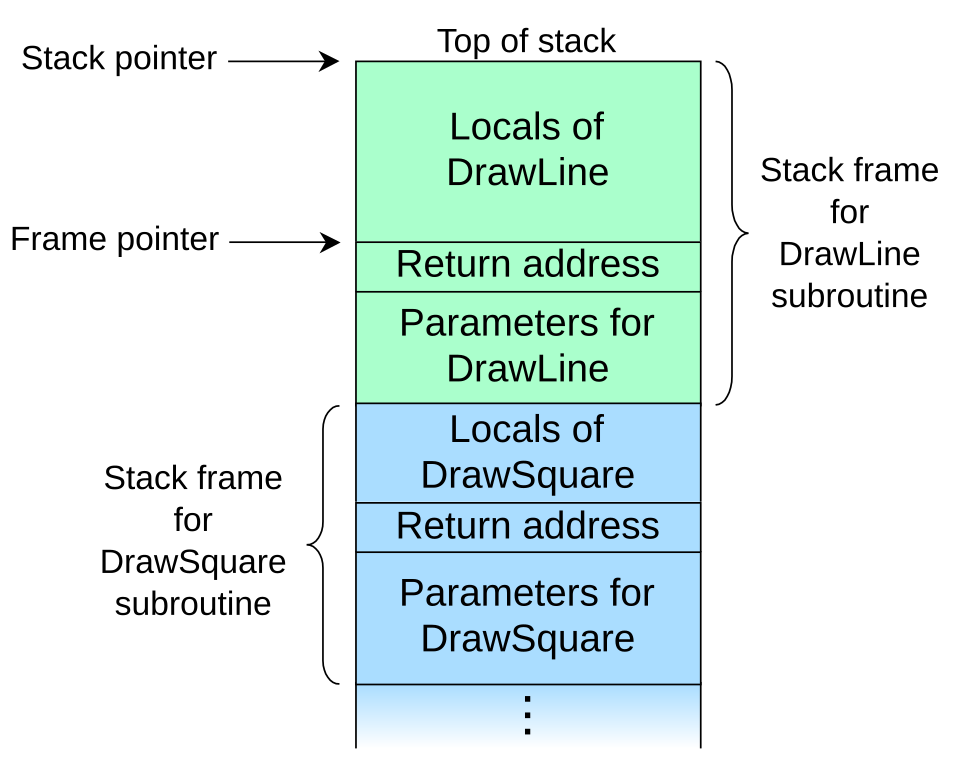
On x86-64 the stack grows toward lower addresses, so a real memory dump is that picture flipped:
the caller's frame sits at a higher address than the callee's, and push decrements rsp. Concretely,
for a function called on System V AMD64:
higher addresses
    ...caller's frame...
    argument 7, 8, ...        <- only args beyond the 6 register-passed ones
    return address            <- pushed by `call`
    saved rbp                 <- pushed by the prologue; rbp points here
    local variables
    ...                       <- rsp points at the lowest occupied byte
lower addresses
A typical (unoptimized) function prologue does three things: push the caller's base pointer to save
it, make rbp point at the current frame, and reserve space for locals by moving rsp. The epilogue
reverses this exactly before ret.
Practical Usage: A Real Worked Example
// add.c
int add(int a, int b, int c, int d, int e, int f, int g) {
    int sum = a + b + c + d + e + f + g;
    return sum;
}
Compiled with gcc -S -O0 -fno-stack-protector -fno-asynchronous-unwind-tables -masm=intel add.c -o add.s
(the extra flags trim unwind/stack-protector clutter so the frame logic is easy to read):
add:
    endbr64
    push    rbp                     ; prologue: save caller's rbp
    mov     rbp, rsp                ; prologue: rbp now anchors this frame
    mov     DWORD PTR -20[rbp], edi ; spill arg 1 (a) from rdi to the stack
    mov     DWORD PTR -24[rbp], esi ; spill arg 2 (b) from rsi
    mov     DWORD PTR -28[rbp], edx ; spill arg 3 (c) from rdx
    mov     DWORD PTR -32[rbp], ecx ; spill arg 4 (d) from rcx
    mov     DWORD PTR -36[rbp], r8d ; spill arg 5 (e) from r8
    mov     DWORD PTR -40[rbp], r9d ; spill arg 6 (f) from r9
    mov     edx, DWORD PTR -20[rbp]
    mov     eax, DWORD PTR -24[rbp]
    add     edx, eax
    mov     eax, DWORD PTR -28[rbp]
    add     edx, eax
    mov     eax, DWORD PTR -32[rbp]
    add     edx, eax
    mov     eax, DWORD PTR -36[rbp]
    add     edx, eax
    mov     eax, DWORD PTR -40[rbp]
    add     edx, eax
    mov     eax, DWORD PTR 16[rbp]  ; arg 7 (g): read from the stack, above the return address
    add     eax, edx
    mov     DWORD PTR -4[rbp], eax  ; sum
    mov     eax, DWORD PTR -4[rbp] ; return value goes in eax (low 32 bits of rax)
    pop     rbp                     ; epilogue: restore caller's rbp
    ret                             ; pop return address into rip
Two things this real example makes concrete:
- The first six
intarguments arrive inedi,esi,edx,ecx,r8d,r9d— exactly the System V order — and get spilled to the stack immediately because this is unoptimized (-O0) code that keeps every local addressable by a fixedrbpoffset for easy debugging. - The 7th argument (
g) is read from16[rbp]— above the savedrbp(at offset 0) and the return address (at offset 8) — because it was passed on the stack, not in a register.
Edge Cases & Pitfalls
The System V ABI requires rsp to be 16-byte aligned at the point of a call instruction. Manually
written assembly that pushes an odd number of 8-byte values before calling a function that uses SSE
instructions (which often require 16-byte-aligned memory operands) can crash with an alignment fault
that only reproduces intermittently, depending on the caller's stack depth.
Calling a function compiled for the Microsoft x64 calling convention (Windows: rcx, rdx, r8,
r9) from code that assumes System V (rdi, rsi, rdx, rcx, ...) will read garbage arguments
with no compiler error — the mismatch is a link-time/runtime problem, not a type error. This is why
cross-platform C libraries must be recompiled per-platform rather than shared as raw binaries.
- Forgetting to preserve a callee-saved register (
rbx,rbp,r12-r15) in hand-written assembly silently corrupts the caller's state — often manifesting as a seemingly unrelated bug far later in the program. - Variadic functions (
printf-style) need the caller to additionally track how many integer/SSE registers were used, viaal, for the callee to find all the arguments — see the ABI spec for details.
Comparisons
| Aspect | System V AMD64 (Linux/macOS) | Microsoft x64 (Windows) |
|---|---|---|
| First 4 integer args | rdi, rsi, rdx, rcx | rcx, rdx, r8, r9 |
| Args passed in registers | Up to 6 integer + 8 SSE | Up to 4 (shared integer/float slots) |
| Return value | rax (rax:rdx for 128-bit) | rax |
| Stack shadow space | None required | Caller must reserve 32 bytes ("shadow space") even for register args |
| Red zone | 128-byte scratch area below rsp a leaf function may use without adjusting rsp | Not available |
References
- System V Application Binary Interface, AMD64 Architecture Processor Supplement — the authoritative specification for the calling convention described here.
- Microsoft, x64 calling convention — the Windows-side counterpart.
- Application Binary Interface — the broader ABI concept (name mangling, object layout) this page's calling convention is one part of.
Books & Videos
- Bryant & O'Hallaron, Computer Systems: A Programmer's Perspective — "Machine-Level Representation of Programs" is the standard teaching reference for exactly this material.
- Jonathan Bartlett, Programming from the Ground Up — a free, well-regarded introduction to x86 assembly and stack mechanics on Linux.