CPU & Processor Architecture — Overview
The CPU (Central Processing Unit) is the component that actually executes a program: it repeatedly reads an instruction from memory, figures out what it means, and carries it out. Everything else in a computer — RAM, storage, the network card — exists to feed the CPU with instructions and data, or to receive the results. Understanding the CPU's internal structure explains why code has the performance characteristics it does: why branches can be expensive, why cache-friendly code is faster, and why "more cores" doesn't automatically mean "faster program."
Core Concepts
| Component | Role |
|---|---|
| ALU (Arithmetic Logic Unit) | Performs arithmetic (add, subtract, multiply) and logic (AND, OR, shift) operations on register values. |
| Control Unit (CU) | Decodes instructions and generates the control signals that drive every other component — the "conductor." |
| Registers | A handful of very small, very fast storage locations inside the CPU (tens to a few hundred bytes total) used to hold operands and results. |
| Program Counter (PC) | A register holding the memory address of the next instruction to fetch. |
| Clock | A signal that ticks at a fixed frequency (e.g., 3.5 GHz); each tick advances the CPU's internal state machine by one step. |
| Instruction Set Architecture (ISA) | The vocabulary of operations the CPU understands, and how they're encoded as bits — the contract between hardware and software. |
| Microarchitecture | How a specific chip implements an ISA internally (pipeline depth, cache sizes, branch predictor design). Two CPUs can share an ISA (e.g., x86-64) but have very different microarchitectures and performance. |
This distinction matters: the ISA is the stable interface (your compiled binary works on any x86-64 chip); the microarchitecture is the implementation detail that changes every chip generation and is where most performance engineering happens. See Instruction Set Architecture.
Mechanism
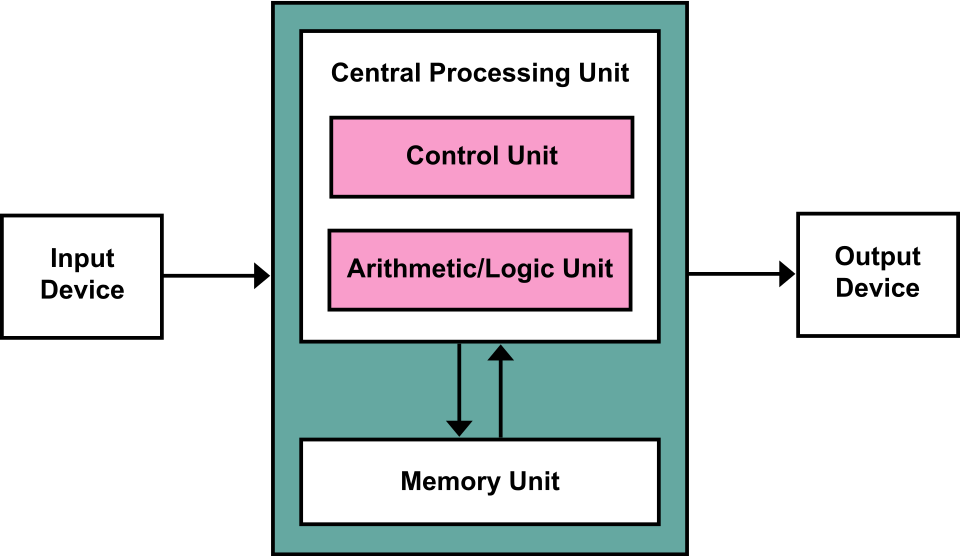
The single detail that matters most here is that instructions and data share one memory. That is what makes programs storable, compilers possible, and self-modifying code (and buffer-overflow exploits) conceivable — and it is also the origin of the von Neumann bottleneck, the single path to memory that the entire memory hierarchy exists to widen.
At the highest level, a CPU is a loop: fetch the instruction the PC points to, decode it to figure out which operation and which registers/memory it touches, execute it (usually in the ALU), and write back the result. This is the fetch-decode-execute cycle, detailed in its own page.
In This Section
- Instruction Set Architecture — the CPU's vocabulary: CISC vs. RISC, x86 vs. ARM vs. RISC-V.
- Fetch-Decode-Execute Cycle — the basic instruction loop, step by step.
- Pipelining — overlapping instructions to increase throughput, and the hazards that get in the way.
- Superscalar & Out-of-Order Execution — modern CPUs execute far more than "one instruction at a time."
- Multicore & Parallelism — why chips stopped getting faster per-core and started adding cores instead.
Edge Cases & Pitfalls
- Clock speed is not performance. Instructions-per-cycle (IPC) and the number of cores matter as much as clock frequency; a 3 GHz chip can easily outperform a 4 GHz chip with a shallower pipeline or weaker branch predictor.
- "CPU-bound" is a category, not a diagnosis. A CPU-bound program might be bound by ALU throughput, by branch mispredictions, or by waiting on cache/memory — each has a different fix.
References
- Patterson & Hennessy, Computer Organization and Design — the standard undergraduate textbook for this entire section; each subtopic page also cites more specialized sources.
- Hennessy & Patterson, Computer Architecture: A Quantitative Approach — the graduate-level, industry-standard reference once you're past the fundamentals.
Books & Videos
- Matt Godbolt's Computerphile series, e.g. CPU Pipeline and How Branch Prediction Works in CPUs — short, accurate video explanations from the creator of Compiler Explorer (godbolt.org).
- Matt Godbolt's Compiler Explorer — not a video/book, but the fastest way to see how source code maps to real machine instructions on real ISAs; used throughout the Assembly section.
Related Pages
- How Computers Work — Overview
- Memory Hierarchy & RAM — what happens when the CPU needs data it doesn't have in registers.
- Assembly & Low-Level Programming — the concrete syntax programmers use to talk to an ISA.