Multicore & Parallelism
Making a single CPU core faster (higher clock speed, deeper pipelines, wider superscalar execution) ran into physical limits in the mid-2000s: higher clock speeds need more voltage, which increases power draw and heat roughly quadratically (dynamic power ∝ voltage² × frequency). Chipmakers hit a "power wall" and pivoted from making one core faster to putting multiple cores on one chip. This changed the fundamental question for performance from "how fast is one thread?" to "how much of this workload can run in parallel?"
Core Concepts
| Term | Meaning |
|---|---|
| Core | An independent processing unit within a CPU chip, with its own fetch/decode/execute pipeline. |
| SMP (Symmetric Multiprocessing) | Multiple identical cores share the same memory, all running under one OS scheduler. |
| Hyper-Threading / SMT (Simultaneous Multithreading) | One physical core presents itself as two (or more) logical cores by duplicating some hardware (registers) and sharing others (execution units) — increases utilization when one thread stalls (e.g., on a cache miss), but doesn't double real throughput. |
| Cache coherence | The protocol (e.g., MESI) that keeps each core's view of shared memory consistent when multiple cores cache the same address — see Memory Hierarchy & RAM. |
| Amdahl's Law | A formula for the maximum speedup from parallelizing part of a program, given the fraction that must remain serial. |
Mechanism
Each core has its own private L1/L2 cache but typically shares a larger L3 cache and the memory bus with every other core on the chip. This sharing is why memory-bandwidth-heavy workloads don't scale linearly with core count — every core is competing for the same path to RAM.
Real hardware is messier than the sketch. lstopo (from hwloc) prints the actual topology of the
machine you are sitting at:
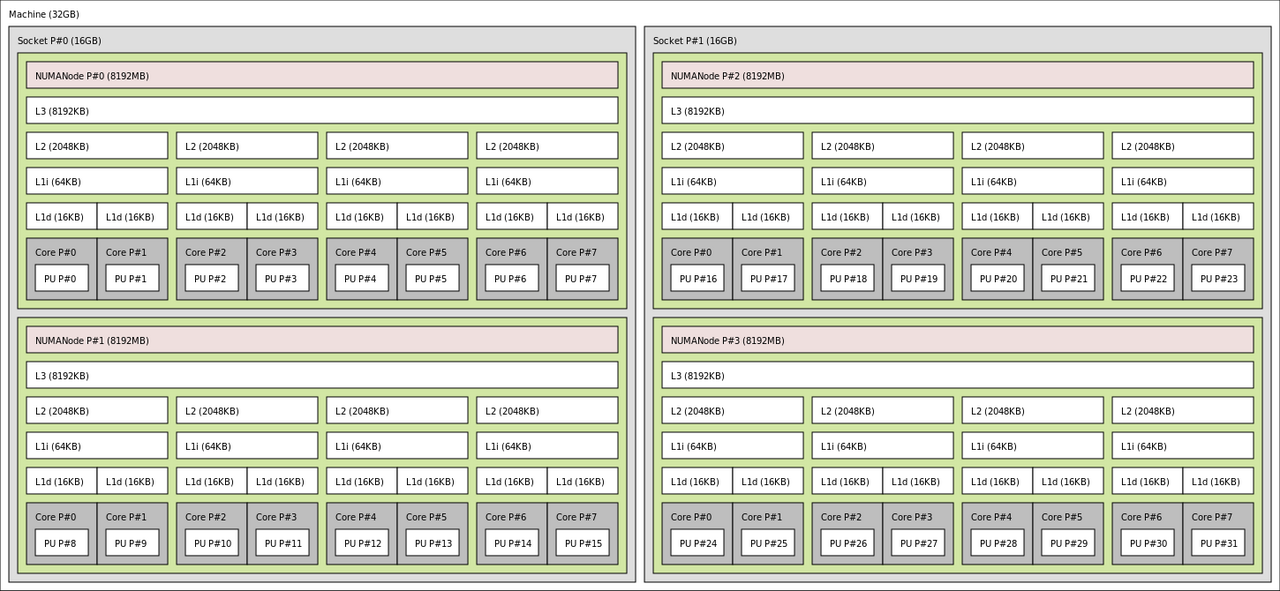
lstopo-no-graphics (Linux/macOS, from the hwloc package) prints this as text in a terminal. It is
the fastest way to find out how many physical cores you have, which ones share an L3, and whether
the box has more than one NUMA node — all things that change how you should pin threads.
Amdahl's Law
If a fraction p of a program's execution time can be parallelized across N processors, and the rest (1 − p) must run serially, the maximum possible speedup is:
Speedup(N) = 1 / ((1 − p) + p / N)
| Parallel fraction (p) | Speedup at N=4 | Speedup at N=64 | Speedup at N=∞ |
|---|---|---|---|
| 50% | 1.6x | 1.9x | 2x |
| 90% | 3.1x | 7.8x | 10x |
| 99% | 3.9x | 39.3x | 100x |
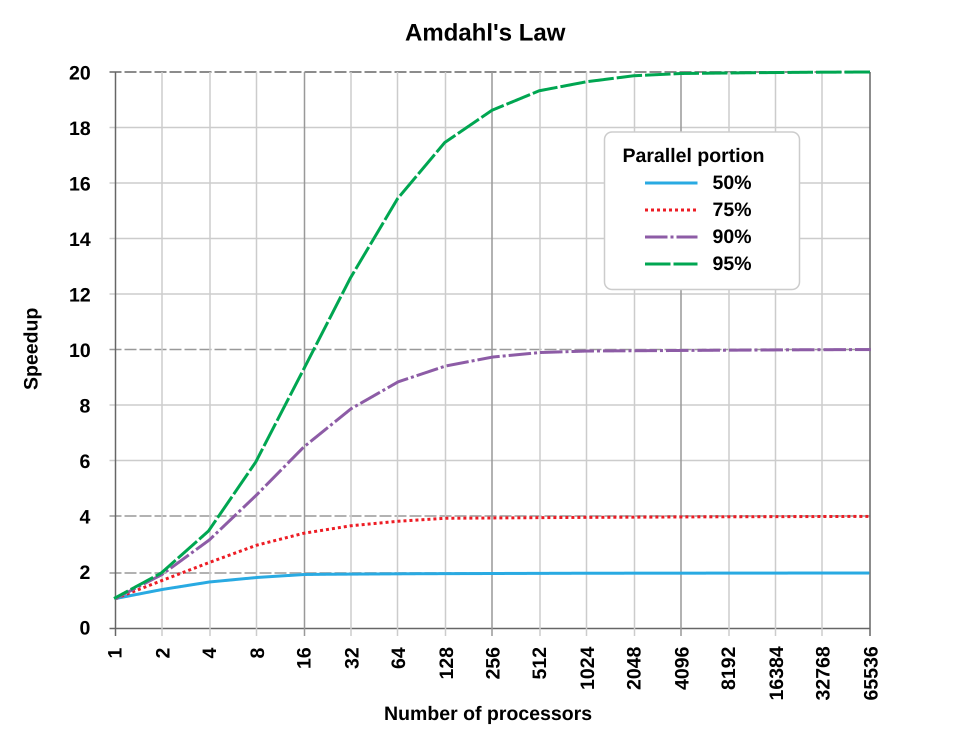
Even a small serial fraction caps your maximum speedup, no matter how many cores you add. Finding and eliminating serial bottlenecks (locks, single-threaded I/O, a shared queue) usually matters more than adding more cores.
Practical Usage
// Naive: false sharing hurts multicore scaling
struct Counters { int a; int b; }; // a and b likely share one cache line
// If thread 1 writes 'a' and thread 2 writes 'b', every write invalidates
// the whole cache line for the other core — cache coherence traffic dominates.

// Fixed: pad to separate cache lines (typically 64 bytes)
struct alignas(64) PaddedCounter { int value; char padding[60]; };
PaddedCounter a, b; // now on different cache lines, no false sharing
Edge Cases & Pitfalls
- False sharing: independent variables that happen to sit on the same cache line cause unnecessary cache-coherence traffic between cores, silently destroying multicore scaling — see the example above.
- Hyper-Threading is not "free" cores. Two logical cores on one physical core still share execution units; expect noticeably less than 2x throughput, and sometimes worse performance for cache- or ALU-bound workloads that don't have stalls to hide.
- More cores ≠ automatically faster. Per Amdahl's Law, workloads dominated by serial sections (locking, single producer/consumer pipelines) see rapidly diminishing returns from added cores.
Comparisons
| Approach | Scales with | Bottleneck |
|---|---|---|
| Single fast core | Clock speed, IPC | Power/heat wall (~5 GHz practical ceiling) |
| Multicore (SMP) | Core count, for parallel workloads | Shared memory bandwidth, serial code sections (Amdahl's Law) |
| SMT / Hyper-Threading | Utilization of stalls within one core | Shared execution units, cache contention |
References
- Gene Amdahl, "Validity of the Single Processor Approach to Achieving Large Scale Computing Capabilities" (1967) — the original paper defining Amdahl's Law.
- Hennessy & Patterson, Computer Architecture: A Quantitative Approach — multiprocessor and cache coherence chapters.
Books & Videos
- Computerphile, Multithreading Code — Dr. Steve Bagley on what a thread actually is and what the OS has to track for it, versus a process.
Related Pages
- Superscalar & Out-of-Order Execution
- Memory Hierarchy & RAM — cache coherence protocols referenced above.
- Operating Systems — how the OS scheduler assigns threads to cores.
- Memory Ordering and Consistency and Atomic Operations in Hardware — what lets these cores share memory safely.
- Cache Coherence and MESI and NUMA and Memory Topology — the coherence protocol behind the picture above, and what happens once cores stop sharing one memory controller.