Superscalar & Out-of-Order Execution
A simple pipeline gets throughput to about one instruction per cycle. Modern high-performance CPUs go further: they fetch and decode multiple instructions per cycle (superscalar), and execute instructions in whatever order their data is ready — not necessarily program order (out-of-order, OoO, execution) — then make the results appear in the original order again. This is why a modern x86-64 or ARM64 core can retire 4-8 instructions per cycle despite running at "only" a few GHz.
Core Concepts
| Term | Meaning |
|---|---|
| Instruction-Level Parallelism (ILP) | Independent instructions in a program that could, in principle, execute simultaneously. |
| Superscalar | A CPU with multiple execution units (ALUs, load/store units) that can issue and execute more than one instruction per cycle. |
| Out-of-order execution | Instructions execute as soon as their operands are ready, rather than strictly in program order. |
| Reorder buffer (ROB) | Hardware structure that tracks in-flight instructions so results can be committed (retired) in original program order, even though they executed out of order. |
| Branch prediction | A hardware guess about which way a conditional branch will go, made before the branch condition is actually known. |
| Speculative execution | Executing instructions based on a predicted branch outcome, before it's confirmed correct. |
Mechanism
A scalar pipeline starts one instruction per cycle. A superscalar pipeline widens every stage so it can start several:
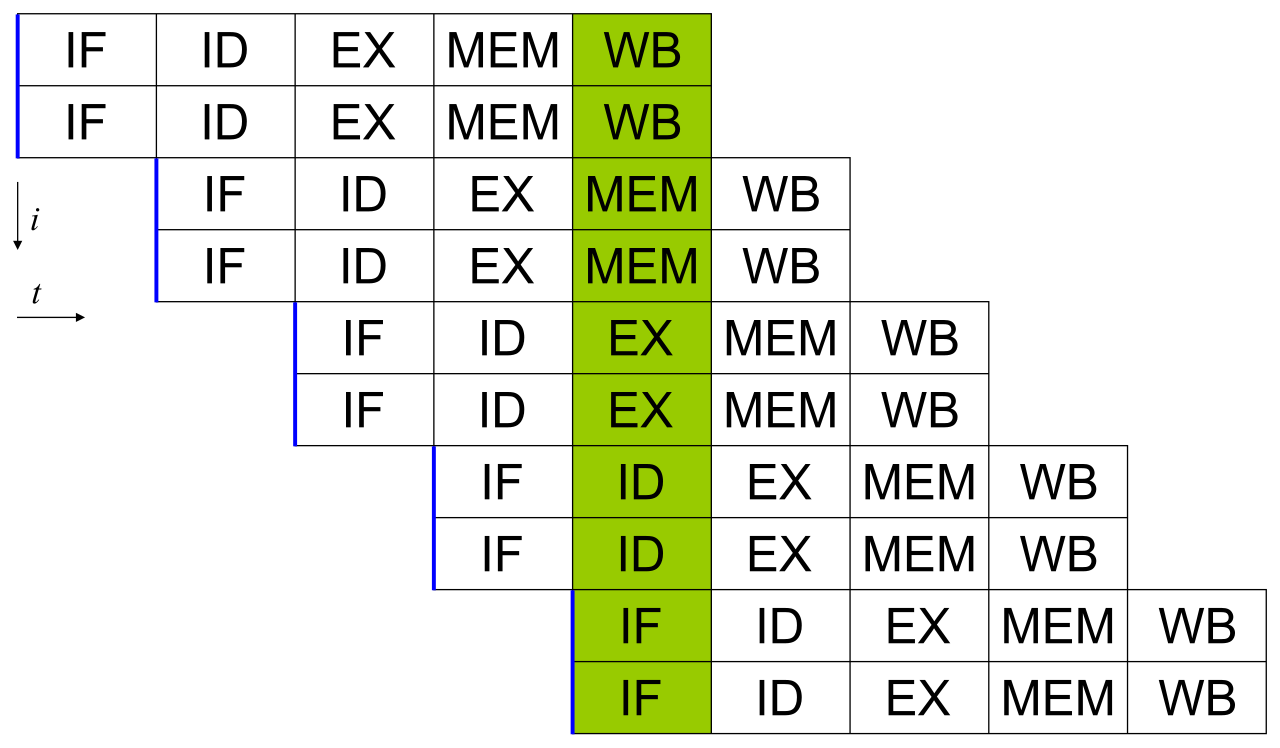
Widening the pipeline is the easy half. The hard half is finding enough independent instructions to fill those slots every cycle, which is what the machinery below exists to do:
Register renaming solves a subtle problem: two unrelated instructions that happen to reuse the
same architectural register (say, both write to rax) don't actually have a data dependency — the
CPU internally maps them to different physical registers so they can execute independently, then
resolves which value rax should hold when each instruction retires.
Branch prediction solves the control-hazard problem from pipelining: instead of stalling until a branch's condition is known, the CPU predicts the outcome (using history tables of recently-taken branches) and speculatively executes down the predicted path. If the prediction was right, this "guessed" work is free performance. If wrong, the pipeline flushes the speculative instructions and restarts — the cost pipelining pages describe.
Practical Usage: Why Branch Predictability Matters
// Unpredictable: random data defeats the branch predictor
for (int i = 0; i < n; ++i) {
    if (data[i] > threshold)  // ~50% taken, ~50% not — hard to predict
        sum += data[i];
}

// Predictable / branch-free: sort first, or use branchless select
std::sort(data.begin(), data.end());
for (int i = 0; i < n; ++i) {
    if (data[i] > threshold)  // now mostly one direction — predictor learns it
        sum += data[i];
}
This is the famous "sorting makes the loop faster" observation: sorting doesn't change how much work the ALU does — it changes how predictable the branch is, which changes how often the pipeline flushes.
Edge Cases & Pitfalls
Speculative execution can transiently access data (e.g., read past an array bound during a mispredicted branch) that never architecturally "happens" — the instruction is squashed on misprediction. But the speculative access can leave measurable side effects in the CPU cache. This is the root mechanism behind the Spectre and Meltdown vulnerability classes (2018): an attacker can use cache-timing side channels to infer secret data that was only speculatively touched.
- Out-of-order execution has diminishing returns: real programs have limited ILP, and the hardware needed to track more in-flight instructions (bigger reorder buffers, more reservation stations) grows faster than the performance gained.
- Not all workloads benefit equally — code with long, serial dependency chains (see the pipelining
page's
sum +=example) limits how much OoO execution can help regardless of how wide the CPU is.
Comparisons
| Design | Instructions issued/cycle | Complexity/power cost | Where used |
|---|---|---|---|
| In-order scalar | 1 | Low | Simple embedded cores |
| In-order superscalar | 2-4 | Medium | Some low-power/embedded designs (e.g., early ARM Cortex-A) |
| Out-of-order superscalar | 4-8+ | High | Modern desktop/server CPUs (Intel Core, AMD Zen, Apple Silicon) |
References
- Hennessy & Patterson, Computer Architecture: A Quantitative Approach — Tomasulo's algorithm and out-of-order execution design.
- Kocher et al., "Spectre Attacks: Exploiting Speculative Execution" — original research paper.
Books & Videos
- Computerphile, How Branch Prediction Works in CPUs — Matt Godbolt walks through predictor design and the cost of a misprediction.
- Computerphile, Spectre & Meltdown — an accessible explanation of how speculative execution's cache side effects became the Spectre/Meltdown vulnerability class.
Related Pages
- Pipelining
- Multicore & Parallelism
- Memory Hierarchy & RAM — cache-timing side channels rely on cache behavior described here.