Relational Model & SQL
The relational model, introduced by Edgar F. Codd in 1970, represents all data as relations (tables) of tuples (rows) with a fixed set of typed attributes (columns). SQL (Structured Query Language) is the standard language for defining and querying data in that model. The model's staying power comes from a simple idea: if you avoid storing the same fact in more than one place, you avoid the many ways redundant copies can quietly drift out of sync — which is the entire motivation behind normalization.
Core Concepts
| Term | Meaning |
|---|---|
| Table (relation) | A named collection of rows sharing the same columns. |
| Row (tuple) | A single record in a table. |
| Column (attribute) | A named, typed field present in every row of a table. |
| Primary key | One or more columns whose value uniquely identifies a row within its table. |
| Foreign key | A column (or set of columns) in one table that references the primary key of another table, enforcing referential integrity. |
| Normalization | A set of design rules (normal forms) for structuring tables to eliminate redundant data and the update/insert/delete anomalies it causes. |
| Join | An operation that combines rows from two or more tables based on a related column, typically a foreign key. |
Mechanism
The model's vocabulary maps onto a table in exactly three places:
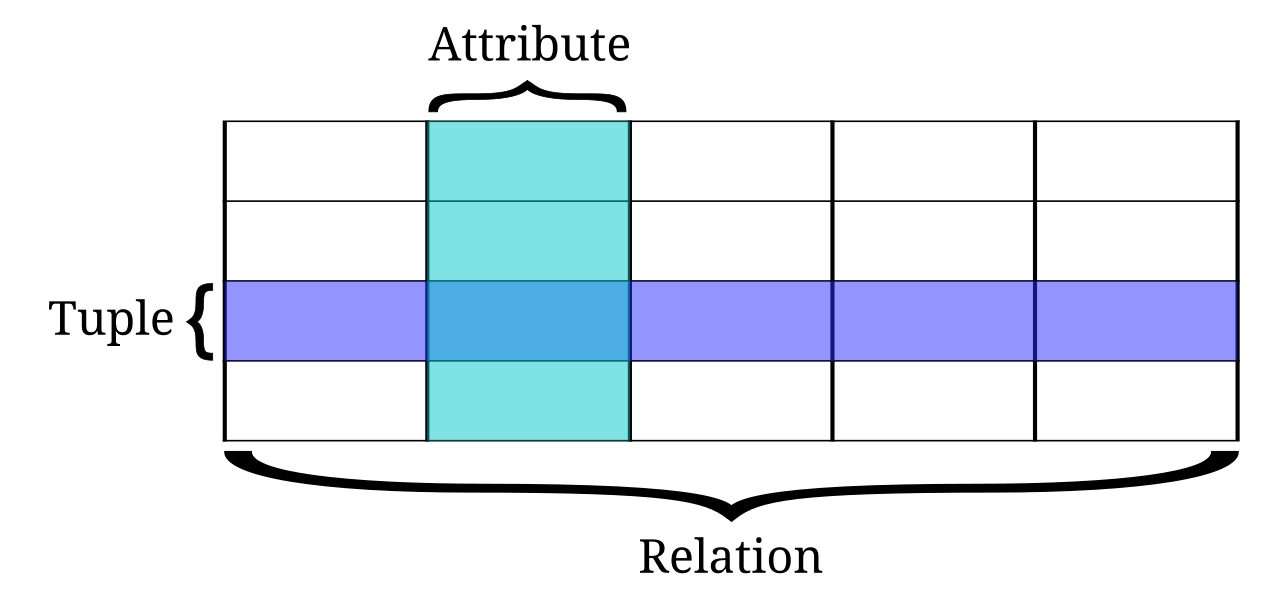
One consequence of the formal definition is worth holding onto: a relation is a set of tuples, so
it has no inherent order and no duplicates. SQL departs from this on both counts — tables are
bags that permit duplicate rows, and SELECT returns rows in whatever order the engine finds
convenient. That is why a query without ORDER BY has no guaranteed ordering, however stable it may
look in testing.
Foreign keys are what let a normalized schema be split across many small tables without losing the
ability to reconstruct the full picture — a JOIN follows the foreign key back to the row it
references at query time, instead of that data being copied everywhere it's needed.
Why normalization exists: a worked example
Imagine a single, "flat" table that seems convenient at first:
| order_id | customer_name | customer_email | product_name | product_price | quantity |
|---|---|---|---|---|---|
| 1 | Alice | alice@example.com | Widget | 9.99 | 3 |
| 2 | Alice | alice@example.com | Gadget | 19.99 | 1 |
| 3 | Bob | bob@example.com | Widget | 9.99 | 5 |
This single table has three concrete problems, all stemming from the same root cause — storing the same fact (a customer's email, a product's price) redundantly in multiple rows:
- Update anomaly: if Alice changes her email, every row containing "Alice" must be updated consistently, or her rows disagree about her own email.
- Insertion anomaly: you cannot record a new customer until they place an order, because there's nowhere to put a customer without an order row.
- Deletion anomaly: deleting Bob's only order deletes all record that Bob exists as a customer.
Normalizing splits this into separate tables, each storing one fact exactly once, related by keys —
the CUSTOMERS, ORDERS, ORDER_ITEMS, PRODUCTS structure in the diagram above. Now Alice's email
lives in exactly one row, updated in exactly one place.
1NF requires atomic (non-repeating) column values. 2NF removes columns that depend on only part of a composite key. 3NF removes columns that depend on other non-key columns rather than the key itself. Most practical schema design stops at 3NF; further normalization is rarely worth the extra joins.
Practical Usage
CREATE TABLE customers (
    customer_id  INTEGER PRIMARY KEY,
    name         VARCHAR(100) NOT NULL,
    email        VARCHAR(255) NOT NULL UNIQUE
);

CREATE TABLE orders (
    order_id     INTEGER PRIMARY KEY,
    customer_id  INTEGER NOT NULL,
    order_date   DATE NOT NULL,
    FOREIGN KEY (customer_id) REFERENCES customers(customer_id)
);

-- Reconstruct the flat view above with a JOIN, without ever duplicating
-- the customer's name/email on disk:
SELECT o.order_id, c.name, c.email, o.order_date
FROM orders o
JOIN customers c ON o.customer_id = c.customer_id
WHERE o.order_date >= '2024-01-01';
Edge Cases & Pitfalls
Splitting data into too many tables can turn simple reads into deep join chains, hurting read performance. Read-heavy analytical systems often deliberately denormalize (duplicate some data) to avoid joins — the opposite trade-off, made intentionally rather than by accident.
- A foreign key constraint doesn't stop you from designing a bad schema — it only stops you from inserting an order for a customer that doesn't exist. Normalization is a design discipline, not something the database enforces automatically.
NULLin a foreign key column usually means "no relationship" (e.g., an optional reference), but it silently excludes that row from an innerJOIN— a common source of "missing rows" bugs.
Comparisons
| Approach | Redundancy | Read performance | Write/update safety |
|---|---|---|---|
| Flat/unnormalized table | High (facts repeated per row) | Fast (no joins) | Poor — update/insert/delete anomalies |
| Normalized (3NF) schema | Low (each fact stored once) | Requires joins | Strong — one place to update each fact |
| Denormalized (deliberate) | Reintroduced intentionally | Fast (fewer joins) | Requires application-level consistency handling |
References
- ISO/IEC 9075 (SQL) — the ANSI/ISO SQL standard.
- E. F. Codd, "A Relational Model of Data for Large Shared Data Banks" (1970) — the original paper defining the relational model.
Books & Videos
- Silberschatz, Korth, Sudarshan, Database System Concepts — the relational model, ER diagrams, and normal forms chapters.
- CMU 15-445/645 Intro to Database Systems (Andy Pavlo) — "Relational Model & Algebra".