Concurrency & Synchronization
Threads within a process share memory, which makes communication cheap but introduces a real hazard: if two threads read and write the same data without coordination, the outcome depends on the exact interleaving of their instructions — a race condition. Synchronization primitives (mutexes, semaphores, condition variables) exist to make specific interleavings impossible, at the cost of threads sometimes having to wait for each other.
Core Concepts
| Term | Meaning |
|---|---|
| Race condition | A bug where the correctness of a result depends on the relative timing/order of concurrent operations. |
| Critical section | A block of code that accesses shared state and must not be executed by more than one thread at the same time. |
| Mutex (lock) | A primitive with ownership: whoever locks it must be the one to unlock it; protects a critical section so only one thread is inside at a time. |
| Semaphore | A primitive based on signaling: an integer counter with atomic increment (post) and decrement-and-wait-if-zero (wait) operations; any thread can signal it, not just the one that waited. |
| Deadlock | A cycle of threads each waiting on a resource held by another, so none can ever proceed. |
| Monitor / condition variable | A mutex paired with a wait queue that lets a thread sleep until some condition becomes true, atomically releasing the mutex while it sleeps and reacquiring it on wake. |
Mechanism
Mutexes vs. semaphores — the actual difference
It's tempting to think of a semaphore with a max value of 1 ("binary semaphore") as "the same as a mutex," but the conceptual difference matters:
- A mutex has an owner. Only the thread that locked it is allowed to unlock it; a mutex encodes mutual exclusion over a critical section.
- A semaphore has no owner. It's a counter representing "how many units of some resource are available right now," and any thread can signal it — including a thread that never waited on it. This makes semaphores the right tool for producer/consumer-style signaling (e.g., "N buffer slots are free"), not just mutual exclusion.
The four Coffman conditions for deadlock
The canonical illustration is Dijkstra's dining philosophers: five philosophers around a table, one fork between each adjacent pair, and a philosopher needs both neighbouring forks to eat.
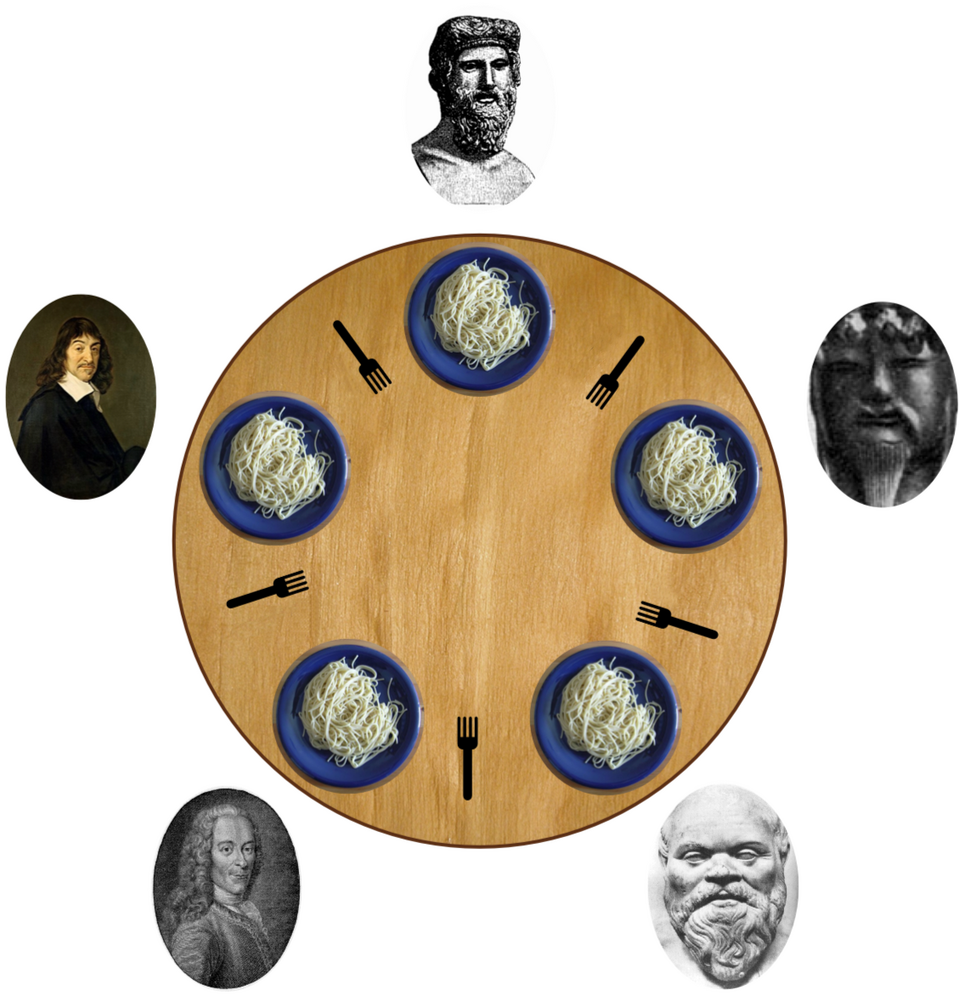
The reason this example endures is that it exhibits all four conditions below at once, and that the obvious fix — "just pick up the left fork, then the right" — is precisely what causes the deadlock rather than preventing it. Making one philosopher reach right-then-left breaks the symmetry, and with it the cycle; that asymmetry is lock ordering in disguise.
A deadlock can only occur if all four of these hold simultaneously:
- Mutual exclusion — resources can't be shared; only one thread can hold a given resource.
- Hold and wait — a thread holding one resource can request another while still holding the first.
- No preemption — a resource can't be forcibly taken away; it must be released voluntarily.
- Circular wait — there's a cycle of threads, each waiting on a resource held by the next.
Breaking any single condition prevents deadlock. The most common practical strategy is attacking
circular wait: impose a global lock-acquisition ordering (e.g., always lock the lower-address or
lower-ID mutex first) so a cycle can never form. Other strategies include requesting all needed
resources up front (attacks hold-and-wait) or using timeouts/try_lock with backoff-and-retry (attacks
no-preemption, since a thread voluntarily gives up what it holds if it can't get everything it needs).
Practical Usage
A classic race condition — two threads incrementing a shared counter without protection — and the fix:
#include <pthread.h>

int counter = 0;
pthread_mutex_t lock = PTHREAD_MUTEX_INITIALIZER;

void *increment(void *arg) {
    for (int i = 0; i < 100000; i++) {
        // BUG (no lock): "counter++" is read-modify-write, not atomic.
        // Two threads can both read the same old value before either writes
        // back, silently losing an increment.
        pthread_mutex_lock(&lock);
        counter++;                 // now a protected critical section
        pthread_mutex_unlock(&lock);
    }
    return NULL;
}

int main(void) {
    pthread_t t1, t2;
    pthread_create(&t1, NULL, increment, NULL);
    pthread_create(&t2, NULL, increment, NULL);
    pthread_join(t1, NULL);
    pthread_join(t2, NULL);
    // Without the mutex, 'counter' unpredictably ends up less than 200000.
    return 0;
}
A monitor-style wait for a condition, using a POSIX condition variable (note the mutex + condvar pairing, and that the predicate is re-checked in a loop because of possible spurious wakeups):
pthread_mutex_lock(&lock);
while (!ready) {
    pthread_cond_wait(&cond, &lock);  // atomically unlocks 'lock' while waiting
}
// ... proceed now that 'ready' is true, still holding 'lock' ...
pthread_mutex_unlock(&lock);
Edge Cases & Pitfalls
If thread A locks mutex 1 then tries to lock mutex 2, while thread B locks mutex 2 then tries to lock mutex 1, both can end up waiting on each other forever. This is a circular-wait deadlock — the fix is a consistent global lock ordering, as noted above.
pthread_cond_wait() can return even if no one called signal/broadcast (a "spurious wakeup" is
explicitly permitted by POSIX), so the awaited condition must always be re-checked in a loop, not
assumed true on wakeup. Conversely, signaling a condition variable before a waiter starts waiting
(rather than via the counter/state that the predicate checks) loses the signal entirely — always
signal through checked, mutex-protected state, never rely on wakeup timing alone.
- A double-checked, unprotected read of shared state ("I'll just check without locking, it's probably fine") is still a race condition even if it's "usually correct" — it will fail intermittently and disproportionately in production under load.
- Uncontended locks are cheap on modern CPUs, but heavily contended locks serialize threads and can turn a "parallel" program back into an effectively single-threaded one for that critical section.
Comparisons
| Primitive | Has ownership? | Typical use | Can be signaled by a non-owner? |
|---|---|---|---|
| Mutex | Yes | Protecting a critical section | No |
| Semaphore | No | Counting available resources, producer/consumer signaling | Yes |
| Condition variable | Used with a mutex | Waiting for a state change (not just exclusion) | Yes (via signal/broadcast) |
References
- Edsger W. Dijkstra, "Cooperating Sequential Processes" (1965/1968) — the origin of the semaphore.
- E. G. Coffman, M. Elphick, A. Shoshani, "System Deadlocks," ACM Computing Surveys, 1971 — the original four-conditions formulation.
pthread_mutex_lock(3),pthread_cond_wait(3p),sem_wait(3)— Linux/POSIX man-pages.- Remzi H. Arpaci-Dusseau & Andrea C. Arpaci-Dusseau, Operating Systems: Three Easy Pieces — the entire "Concurrency" part (Locks, Condition Variables, Semaphores, Deadlock).
Books & Videos
- Remzi H. Arpaci-Dusseau & Andrea C. Arpaci-Dusseau, Operating Systems: Three Easy Pieces — free online at ostep.org.
- Michael Kerrisk, The Linux Programming Interface — the POSIX threads, mutex, and condition variable chapters, with the exact API semantics used above.
- Andrew S. Tanenbaum & Herbert Bos, Modern Operating Systems — deadlock chapter.
Related Pages
- Processes & Threads — why threads share memory in the first place.
- Scheduling — priority inversion, a scheduling problem caused by locking.
- Inter-Process Communication — coordination across, rather than within, address spaces.
- Memory Ordering and Consistency, Atomic Operations in Hardware, and Cache Coherence and MESI — the hardware these primitives ultimately rest on.
../../linux/09-concurrency-and-locking/why-kernel-concurrency-is-different.md— how a kernel uses them.