HTTP and HTTPS
HTTP is the request/response protocol underlying the Web and most modern APIs: a client sends a request for a resource, a server sends back a response. HTTPS is simply HTTP layered on top of TLS (see TLS & Encryption Basics) so that request and response are encrypted and authenticated in transit. HTTP has gone through three major versions — HTTP/1.1, HTTP/2, and HTTP/3 — each addressing performance limitations of the last while keeping the same core request/response semantics.
Core Concepts
| Term | Meaning |
|---|---|
| Method | The action a request performs — GET, POST, PUT, DELETE, PATCH, HEAD, OPTIONS. |
| Status code | A 3-digit response code indicating the outcome, grouped into classes (see below). |
| Header | A key-value metadata field on a request or response (Content-Type, Authorization, Cache-Control, etc.). |
| Statelessness | Each HTTP request is independent by default — the protocol itself carries no memory of previous requests. |
| Cookie | A small piece of state the server asks the client to store and re-send on future requests — the usual way statelessness is worked around. |
| Multiplexing | Sending multiple logical requests/responses concurrently over a single connection (HTTP/2 and HTTP/3; not possible in HTTP/1.1 without multiple connections). |
Status Code Classes
| Range | Class | Examples |
|---|---|---|
| 1xx | Informational | 100 Continue |
| 2xx | Success | 200 OK, 201 Created, 204 No Content |
| 3xx | Redirection | 301 Moved Permanently, 304 Not Modified |
| 4xx | Client error | 400 Bad Request, 401 Unauthorized, 404 Not Found |
| 5xx | Server error | 500 Internal Server Error, 503 Service Unavailable |
Mechanism
Statelessness and Cookies
HTTP itself doesn't know "this request and that request came from the same user" — the server
issues a cookie via Set-Cookie, the client re-sends it via the Cookie header on every subsequent
request to that domain, and the server uses it as a lookup key into its own session store. This is
an application-level convention layered on top of a genuinely stateless protocol, not a feature of
HTTP's wire format itself.
HTTP/1.1 vs. HTTP/2 vs. HTTP/3
Even before multiplexing, HTTP/1.1's most valuable change was simply not tearing the connection down after every response:
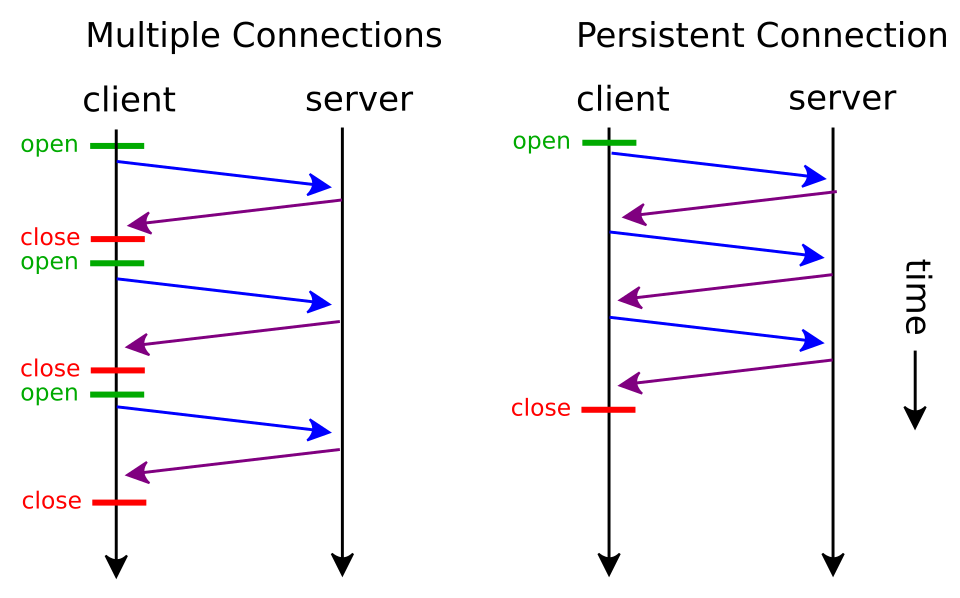
Each open on the left is the full TCP handshake
— and over HTTPS, a TLS handshake on top of it. Persistent connections (Connection: keep-alive,
the default since HTTP/1.1) are why that cost is paid once per page rather than once per image.
- HTTP/1.1: text-based, one request waits for one response per connection at a time; browsers work around this by opening several parallel TCP connections to the same host.
- HTTP/2: binary framing, true multiplexing of many concurrent requests/responses over a single TCP connection, plus header compression (HPACK) and server push. Still built on TCP, so a single lost packet stalls all multiplexed streams until it's retransmitted (TCP-level head-of-line blocking).
- HTTP/3: keeps HTTP/2's multiplexing model but runs over QUIC, a transport built on UDP that implements its own reliability and congestion control per-stream — so one lost packet only stalls the stream it belongs to, not the whole connection. QUIC also folds in TLS 1.3 at the transport level, shaving round trips off connection setup.
Practical Usage: A Raw HTTP Request and Response
What actually goes over the wire for a simple GET (as seen with curl -v or a raw nc/openssl s_client session):
GET /index.html HTTP/1.1
Host: example.com
User-Agent: curl/8.4.0
Accept: */*
HTTP/1.1 200 OK
Content-Type: text/html; charset=UTF-8
Content-Length: 1256
Cache-Control: max-age=604800
Date: Wed, 12 Feb 2026 10:15:30 GMT

<!doctype html>
<html>
<head><title>Example Domain</title></head>
...
Using curl -v shows this exchange plus the TLS and connection setup around it:
$ curl -v https://example.com/ -o /dev/null
* Connected to example.com (93.184.216.34) port 443
* TLS handshake, Client hello (1)
* TLS handshake, Server hello (2)
...
> GET / HTTP/2
> Host: example.com
> user-agent: curl/8.4.0
> accept: */*
>
< HTTP/2 200
< content-type: text/html; charset=UTF-8
< content-length: 1256
Note curl negotiated HTTP/2 here (visible in the >/< request/response lines) via TLS's ALPN
extension during the handshake — this is how a client and server agree on an HTTP version without
an extra round trip.
Edge Cases & Pitfalls
Anyone on the network path between client and server (a public Wi-Fi operator, an ISP, an on-path attacker) can read and modify plain HTTP traffic. This includes injecting ads, tracking scripts, or malware into unencrypted pages — a real, historically documented practice by some ISPs, not a theoretical risk. See TLS & Encryption Basics.
GETandHEADare specified as safe/idempotent (repeating them should have no side effects) — building aGETendpoint that deletes data violates this contract and breaks caches, prefetching, and retries in ways that are hard to debug.- Caching intermediaries (browsers, CDNs, proxies) key heavily off status codes and headers like
Cache-Control/ETag— a200 OKresponse with no cache headers is often still cached somewhere unexpectedly, or not cached when you wanted it to be. - HTTP/2's server push turned out to be rarely used effectively in practice and was removed from most major browsers/HTTP/3 implementations — not every feature that ships in a spec sticks.
Comparisons
| Version | Transport | Multiplexing | Head-of-line blocking |
|---|---|---|---|
| HTTP/1.1 | TCP | No (needs multiple connections) | Per-connection |
| HTTP/2 | TCP | Yes, one connection | Still possible at the TCP level |
| HTTP/3 | QUIC (UDP) | Yes, one connection | Avoided — per-stream reliability |
References
- IETF, RFC 9110 — HTTP Semantics (methods, status codes, headers — version-independent).
- IETF, RFC 9112 — HTTP/1.1.
- IETF, RFC 9113 — HTTP/2.
- IETF, RFC 9114 — HTTP/3.
Books & Videos
- Kurose & Ross, Computer Networking: A Top-Down Approach — the application-layer chapter starts with HTTP as its running example.
- Ilya Grigorik, High Performance Browser Networking (free online) — Part II covers HTTP/1.1 and HTTP/2 performance characteristics in depth.