Thread Block Clusters
Blocks are independent by design: no portable synchronization between them, no shared on-chip memory, and no guarantee two blocks even run at the same time. That independence is what lets a kernel scale from a laptop GPU to a data-center one, but it also means algorithms that need a little cross-block cooperation — a bit more shared memory than one block's SM can hold, or a barrier across a handful of blocks — have nowhere to turn. A thread block cluster relaxes exactly that restriction, for a small group of blocks the hardware guarantees will be co-resident on the same GPU Processing Cluster (GPC) at the same time.
Why a level between grid and block
A cluster sits between the grid and the block in the hierarchy shown in Threads, Blocks, and Grids: the grid still contains many blocks, but those blocks are now grouped into clusters, and every block in a cluster is guaranteed to launch on the same GPC, co-resident with the rest of its cluster. That guarantee is the whole point — it is what makes distributed shared memory and cluster-wide barriers possible, neither of which the plain grid-of-blocks model can offer.
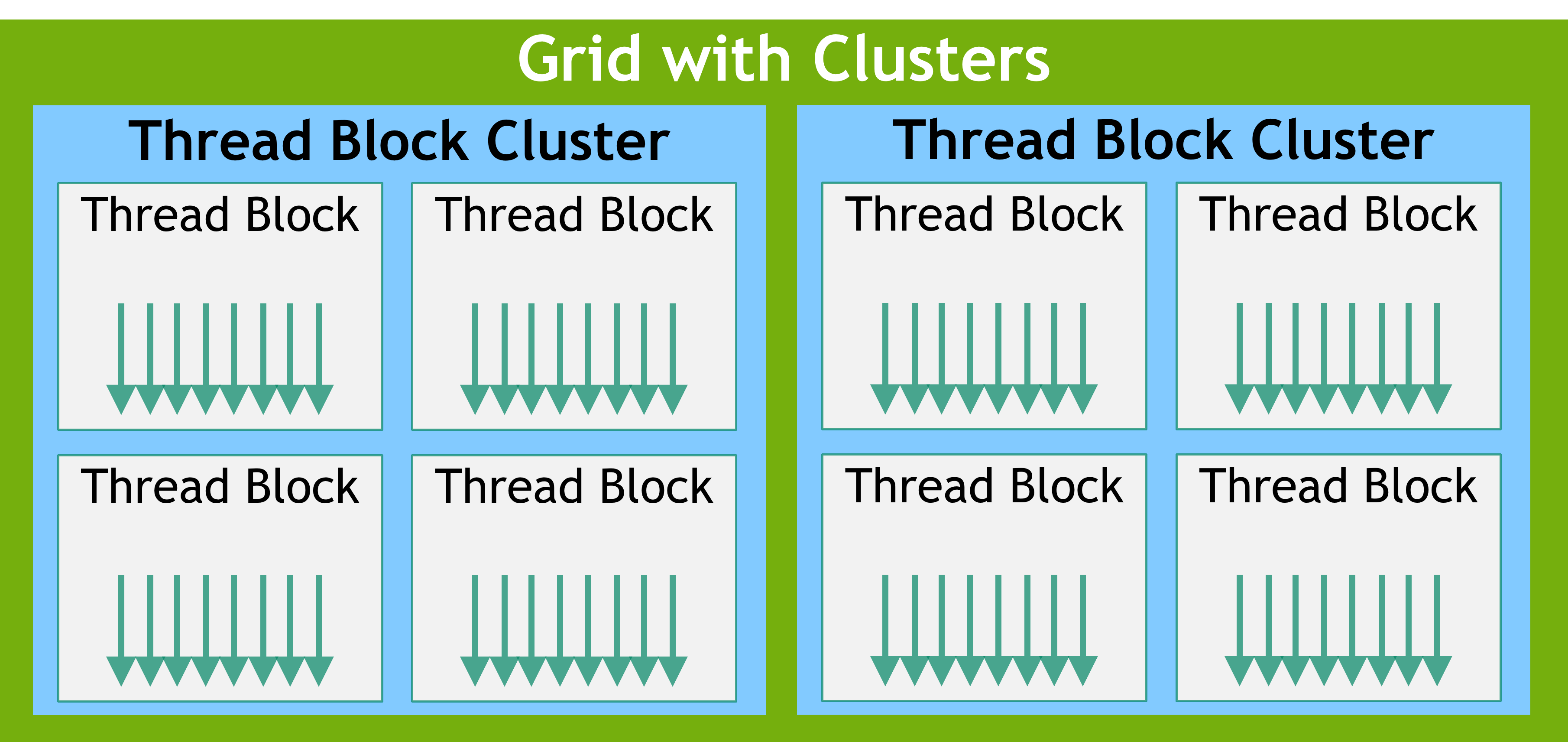 Source: NVIDIA CUDA C++ Programming Guide
Thread block clusters are a Hopper-and-later feature. Check Compute Capability before relying on them.
Declaring a cluster
The simplest way to launch a cluster is to fix its dimensions at compile time with the __cluster_dims__ attribute on the kernel itself:
// Form 1: compile-time cluster dimensions
__global__ void __cluster_dims__(2, 1, 1) kernel_a(float* out) {
    namespace cg = cooperative_groups;
    cg::cluster_group cluster = cg::this_cluster();
    cluster.sync();
    // ...
}
kernel_a is still launched with the ordinary <<<grid, block>>> syntax; __cluster_dims__(2, 1, 1) fixes the cluster shape to 2 blocks along x, so the grid's block count must be a multiple of 2.
Launching with cudaLaunchKernelEx
When the cluster dimensions need to vary at runtime — chosen from cudaOccupancyMaxPotentialClusterSize, for instance — use cudaLaunchKernelEx with a cudaLaunchAttributeClusterDimension attribute instead of a compile-time attribute on the kernel:
// Form 2: runtime cluster dimensions
cudaLaunchConfig_t config = {};
config.gridDim = dim3(numBlocks, 1, 1);
config.blockDim = dim3(256, 1, 1);

cudaLaunchAttribute attrs[1];
attrs[0].id = cudaLaunchAttributeClusterDimension;
attrs[0].val.clusterDim.x = 2;
attrs[0].val.clusterDim.y = 1;
attrs[0].val.clusterDim.z = 1;
config.attrs = attrs;
config.numAttrs = 1;

CUDA_CHECK(cudaLaunchKernelEx(&config, kernel_b, d_out));
CUDA_CHECK is the return-code wrapper introduced in Error Handling and Checking; every launch in this section that can fail should be wrapped in it.
Guaranteed co-residency
The guarantee a cluster provides is narrow but load-bearing: every block named in the cluster is resident on the same GPC before any of them starts running, so a block can assume its cluster-mates are already scheduled rather than racing to launch them. This is what makes it safe to reach into another block's shared memory — covered in Distributed Shared Memory — instead of routing everything through global memory the way non-cluster blocks must.
Cluster synchronization
Cooperative Groups exposes the cluster as cg::cluster_group, obtained with cg::this_cluster() as in the snippet above. cluster.sync() is a barrier across every block in the cluster — the cluster-scoped analogue of __syncthreads() inside a block — and it is the mechanism that makes it safe to assume every block's contribution to distributed shared memory is visible before continuing. Cooperative Groups covers the rest of the API this type belongs to.
Sizing and portability
The portable maximum is 8 blocks per cluster — any kernel that only ever asks for up to 8 will run on every CC 9.0+ GPU. Larger cluster sizes are hardware- and configuration-dependent and must be queried, not assumed; cudaOccupancyMaxPotentialClusterSize returns the actual ceiling for a given kernel and launch configuration rather than a number baked into the source.
A kernel launched with a non-trivial cluster size fails outright on pre-Hopper hardware — there is no silent fallback to non-clustered execution. Guard the launch with a cudaDeviceProp::major check (9 or higher) before choosing a cluster path, or ship two versions of the kernel and select between them at runtime.
See also
- Threads, Blocks, and Grids — where clusters sit in the full hierarchy.
- Distributed Shared Memory — what co-residency actually buys a cluster.
- Cooperative Groups — the
cg::cluster_groupAPI in full. - Compute Capability — checking whether a target GPU supports clusters.
- GPU & Accelerators — the section index and its three learning paths.