Threads, Blocks, and Grids
A kernel launch like saxpy<<<blocks, threads>>>(...) doesn't just start "some threads" — it starts a precisely structured hierarchy, and the shape of that hierarchy is what lets the same compiled kernel run correctly on a small laptop GPU and a data-center accelerator with an order of magnitude more SMs. Understanding the levels of that hierarchy, and which ones can and can't communicate, is the difference between a kernel that scales and one that only happens to work on the GPU it was tested on.
The hierarchy
A launch creates a grid of blocks, each block a group of threads. The hardware executes threads in groups of 32 called warps (covered fully in Warps and Warp Schedulers), and on compute capability 9.0+ GPUs, blocks can additionally be grouped into clusters — an optional level between grid and block that lets blocks in the same cluster cooperate more directly than blocks elsewhere in the grid.
Thread block clusters are a Hopper-and-later feature. See Compute Capability for how to check a target GPU supports them, and Thread Block Clusters for how to launch one.
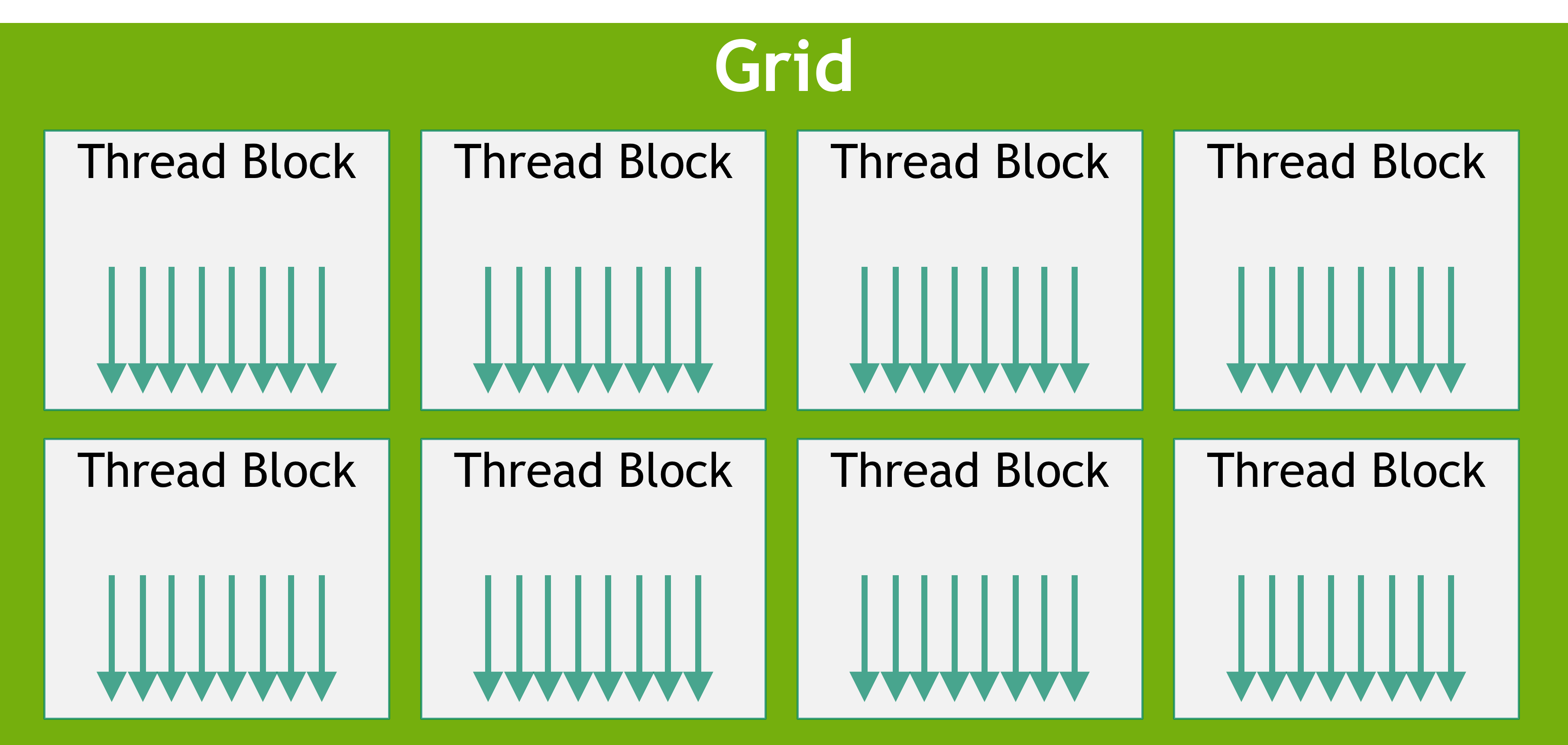 Source: NVIDIA CUDA C++ Programming Guide
dim3 and multi-dimensional launches
Grid and block dimensions are each a dim3 — three integers (x, y, z), any of which can be left at 1. saxpy<<<blocks, threads>>> is shorthand for a 1-D launch where blocks and threads are implicitly dim3(blocks, 1, 1) and dim3(threads, 1, 1); declaring the dim3 explicitly is what enables 2-D or 3-D launches, which are convenient whenever the data itself is naturally 2-D or 3-D, such as an image.
dim3 threadsPerBlock(16, 16);
dim3 numBlocks((width + threadsPerBlock.x - 1) / threadsPerBlock.x,
               (height + threadsPerBlock.y - 1) / threadsPerBlock.y);

processImage<<<numBlocks, threadsPerBlock>>>(d_image, width, height);
Inside the kernel, blockIdx and threadIdx are themselves dim3 values, so blockIdx.y * blockDim.y + threadIdx.y gives the row and the analogous .x expression gives the column — the 2-D generalization of the same formula Your First Kernel used in one dimension. Thread Indexing covers this in depth.
Why blocks must be independent
Blocks may run in any order, concurrently or serially, on any SM the hardware assigns them to, and there is no portable way to synchronize across blocks within a plain kernel launch — no barrier a thread in one block can use to wait on a thread in another. This is not a missing feature; it's the property that makes the hierarchy scale: because the runtime is never required to run all blocks at once, the same grid can be spread across a GPU with 20 SMs or one with 130, in whatever order the scheduler finds convenient, and the result is identical either way. Grid-Wide Synchronization covers the one mechanism — cooperative launches — that relaxes this rule at the cost of giving up that flexibility.
How blocks map to SMs
The hardware scheduler assigns whole blocks to SMs — a block never splits across two SMs, and all of a block's threads execute on the same SM for the block's lifetime, which is what lets threads within a block share on-chip resources like shared memory and use __syncthreads() to coordinate. An SM can hold several resident blocks at once, up to whatever the register file, shared memory, and thread-slot limits allow — the exact calculation is The Register File and Occupancy's subject.
The limits
| Limit | Value |
|---|---|
| Max threads per block | 1024 |
| Max block dimensions (x, y, z) | 1024, 1024, 64 (product ≤ 1024) |
| Max grid dimensions (x, y, z) | 2³¹−1, 65535, 65535 |
| Warp size | 32 |
These are architectural ceilings, not tuning targets — most kernels use far fewer than 1024 threads per block. They, along with the resource limits from the previous section, are queryable at runtime via cudaDeviceProp rather than hardcoded, since they can vary across compute capabilities.
See also
- Thread Indexing — turning
blockIdx/threadIdxinto the array index a thread should touch. - Thread Block Clusters — the optional CC 9.0+ level shown above.
- Warps and Warp Schedulers — how a block's threads are actually scheduled in groups of 32.
- Grid-Wide Synchronization — the cooperative-launch exception to block independence.
- GPU & Accelerators — the section index and its three learning paths.