The Source Tree, Mapped
Every top-level directory in a line, the four that matter expanded, and a lookup table from question to location.
The tree is not organised by importance and it is not organised by subject — it is organised by what kind of thing the code is: core kernel logic in one place, memory management in another, every filesystem under one directory regardless of how different they are from each other, every driver under one directory regardless of what it drives. Once that's clear, "where does the answer to this question live" stops being a search problem and becomes mechanical: identify what kind of thing you're asking about, and you already know the top-level directory.
The whole tree, one line each
Every top-level directory in v6.18, in the order ls gives you:
| Directory | What lives there |
|---|---|
Documentation/ | Kernel documentation source — the reStructuredText that builds into the published kernel docs (docs.kernel.org); prose, not code. |
LICENSES/ | SPDX license texts referenced by the SPDX-License-Identifier tag at the top of most kernel source files. |
arch/ | Architecture-specific code — one subdirectory per CPU architecture (x86/, arm64/, …), each a nearly-complete miniature port: boot code, low-level memory management, the syscall entry path. |
block/ | The block layer: request queues, I/O schedulers, and the code every block device driver and every filesystem's I/O path goes through. |
certs/ | Certificates and keys used to verify signed kernel modules and, on some configurations, the kernel image itself. |
crypto/ | The kernel's own cryptographic algorithm implementations and the crypto API that dm-crypt, IPsec, and others build on. |
drivers/ | Device drivers — the single largest directory in the tree by a wide margin, organised by device class (net/, gpu/, usb/, …), not by vendor. |
fs/ | Filesystems: one subdirectory per filesystem type, plus the VFS layer that gives them a common interface. |
include/ | Public and internal headers — the declarations everything else in the tree, and every out-of-tree module, compiles against. |
init/ | The earliest generic kernel startup code, including start_kernel() itself. |
io_uring/ | The io_uring asynchronous I/O interface — large and active enough to have graduated out of fs/ into its own top-level directory. |
ipc/ | System V and POSIX inter-process communication: message queues, semaphores, shared memory. |
kernel/ | Core kernel subsystems that aren't specific to memory, filesystems, or a device class: the scheduler, locking primitives, module loading, timekeeping, cgroups, tracing. |
lib/ | Generic library code shared across the tree — string functions, data structures (rbtree, list), checksums — that isn't specific to any one subsystem. |
mm/ | Memory management: the page allocator, the virtual memory subsystem, page reclaim, slub. |
net/ | The network stack, protocol by protocol, below the socket layer that user space sees. |
rust/ | Infrastructure for writing kernel code in Rust — bindings, the alloc/kernel crates, and build support for the Rust-for-Linux effort. |
samples/ | Small, self-contained example code — sample modules, sample BPF programs — meant to be read and copied from, not built into a production kernel. |
scripts/ | Build-system and developer tooling: Kconfig machinery, checkpatch.pl, get_maintainer.pl, and the scripts that turn a .config into a build. |
security/ | The Linux Security Module (LSM) framework and the security modules that use it — SELinux, AppArmor, Smack, and the LSM hook infrastructure itself. |
sound/ | The ALSA sound subsystem: sound card drivers and the kernel-side audio infrastructure they sit on. |
tools/ | User-space tools that are developed and versioned alongside the kernel because they depend closely on kernel internals — perf, tools/testing/selftests/, and others. |
usr/ | Build-time support for generating an initial ramdisk image as part of the kernel build itself. |
virt/ | Architecture-independent virtualization support — most notably the core of KVM, shared across the per-architecture KVM backends in arch/. |
Kconfig, Makefile, and MAINTAINERS sit alongside these at the root as files rather than
directories, and are covered in Kconfig and Kbuild.
The four that matter most
Four directories account for most of the time a working kernel reader spends navigating the tree.
kernel/
Core, cross-cutting subsystems that don't belong to memory, filesystems, or a device class:
kernel/sched/— the scheduler: the core scheduling loop, the CFS and real-time scheduling classes, and load balancing.kernel/locking/— every locking primitive's implementation: mutexes, spinlocks,rwsems, lockdep.kernel/time/— timekeeping, hrtimers, and the clock source/event device infrastructure.
mm/
Everything about how memory is represented, allocated, and reclaimed:
mm/page_alloc.c— the page allocator itself: the buddy allocator that hands out physically contiguous pages.mm/slub.c— the SLUB slab allocator, the default general-purpose kernel object allocator (kmalloc()is built on it).mm/memory.c— the generic page-fault and page-table-manipulation code shared across architectures.
fs/
The VFS layer plus every filesystem implementation:
fs/namei.c— pathname lookup: turning a string like/etc/passwdinto adentry/inodepair.fs/read_write.c— the genericread()/write()machinery every filesystem's file operations sit behind.fs/ext4/— a concrete, heavily-used filesystem implementation, useful as a full worked example of what implementing the VFS interface actually looks like in practice.
drivers/
By line count, more than half the entire kernel tree, organised by device class rather than vendor:
drivers/base/— the Linux device model itself:struct device,struct bus_type, driver registration and probing, and the machinery behind sysfs's/sys/devices/tree (see kobjects, sysfs, and the object model).
Where a question's answer lives
| Question | Where to look |
|---|---|
| How does the scheduler pick a task? | kernel/sched/ |
| What happens on a page fault? | mm/memory.c, and the architecture-specific entry point — on x86-64, arch/x86/mm/fault.c |
| Where is a syscall's implementation defined? | The subsystem that owns it — found fastest with git grep SYSCALL_DEFINE.*(sys_name across the tree |
What does this CONFIG_ symbol actually gate? | The nearest Kconfig file — git grep the symbol name across every Kconfig in the tree |
| How does a page get allocated? | mm/page_alloc.c (physical pages) or mm/slub.c (kernel objects) depending on which layer you're asking about |
| Where does a network packet enter the kernel? | drivers/net/ for the device driver, then net/ for the protocol stack above it |
| How does a device get matched to its driver? | drivers/base/ — the device model's bus/driver matching logic |
| Where is a filesystem's on-disk format implemented? | fs/<name>/, e.g. fs/ext4/ |
| Where do lock primitives live? | kernel/locking/ |
| How is a module loaded? | kernel/module/ — see Monolithic, with modules |
| Where is the user-space ABI defined, as opposed to internal kernel headers? | include/uapi/ |
| What's architecture-specific about this feature? | arch/<your-arch>/, with the portable fallback (if one exists) in include/asm-generic/ |
| Who owns this file, and what list does a patch to it go to? | MAINTAINERS, or scripts/get_maintainer.pl -f <path> |
How does a .config symbol become a compiled object? | Kconfig → .config → obj-$(CONFIG_X) in the relevant Makefile — see Kconfig and Kbuild |
| Where does process creation happen? | kernel/fork.c |
arch/ and the portability line
Most of the kernel is architecture-independent C, but a hard floor of it cannot be: page table formats,
exception entry, context switching, and atomic instructions are properties of the CPU, not choices the
kernel gets to make generically. That floor lives under arch/<architecture>/ — arch/x86/,
arch/arm64/, and so on — each one a nearly self-contained port with its own boot/, mm/, kernel/,
and include/ subdirectories mirroring the top-level tree's shape at a smaller scale.
The convention that keeps generic code generic is include/asm-generic/: when most architectures can
share one implementation of some low-level primitive, that implementation lives once in
include/asm-generic/, and an architecture that has nothing special to say simply includes the generic
header instead of writing its own. An architecture only gets its own arch/<arch>/include/asm/ version
of something when it genuinely needs one — a different page table depth, a different atomic instruction
sequence, and so on. Reading arch/x86/ for a topic and finding the interesting logic is a good sign
that x86 needed something other architectures didn't; finding a one-line #include <asm-generic/...> is
the equally useful sign that it didn't.
include/ layout
Three subtrees inside include/ matter for different reasons:
include/linux/— internal kernel headers. Anything declared here is kernel-internal API: subject to change across kernel versions, and never something user-space code includes directly.include/uapi/— the user-space ABI, deliberately split out frominclude/linux/so the boundary between "the kernel's own internal types" and "what glibc and user programs are allowed to depend on" is a directory, not a convention someone has to remember. Headers here are copied out and installed as thelinux/headers user-space#includes, and changing a struct layout here is an ABI break in a way that changing aninclude/linux/struct usually is not.include/asm-generic/— the architecture-portable fallback described above, included by an architecture's ownasm/headers when it has nothing arch-specific to add.
The uapi/non-uapi split is a real, enforced distinction, not a naming convention: a header that leaks
an internal-only type into include/uapi/ is a bug, because it commits the kernel to a user-space-visible
promise about something that was never meant to be one.
Reading the tree at scale
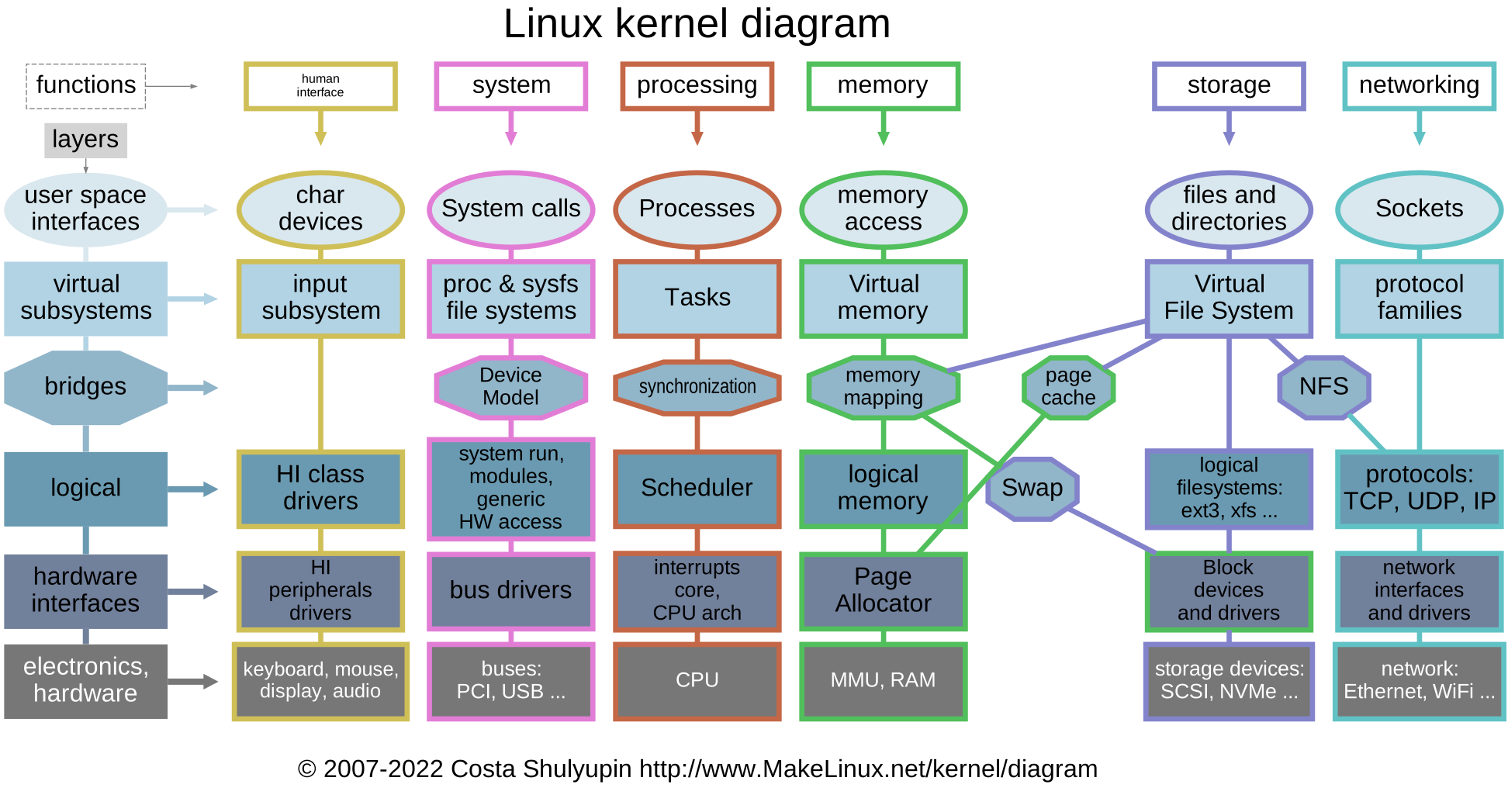
The full subsystem graph above is honest about scale in a way a curated diagram never is: everything depends on something, most of it is not worth holding in your head at once, and the tree's directory structure is the tool that makes that manageable — you consult the graph for scope, not for navigation. For day-to-day orientation, six boxes are enough:
The six boxes to actually hold in your head.
References
MAINTAINERS— the authoritative map from any path in the tree to the people and mailing lists that own it, and a surprisingly good index of what subsystems exist at all.- Development process documentation — how the tree is organised socially (subsystem maintainers, mailing lists, trees), which explains a lot of how it ended up organised physically.
- Elixir cross-referencer, v6.18 — the fastest way to answer a one-off "where is this actually defined" question without a local clone, and the same version this section is pinned to.