Ensembles and Stacking
Bagging and boosting are both ensembles of the same base learner. This page covers combining genuinely different models — a linear model, a tree ensemble, and a neural network, say — which only helps to the extent those models fail in different ways.
An ensemble helps in proportion to how uncorrelated its members' errors are — identical models averaged give you nothing.
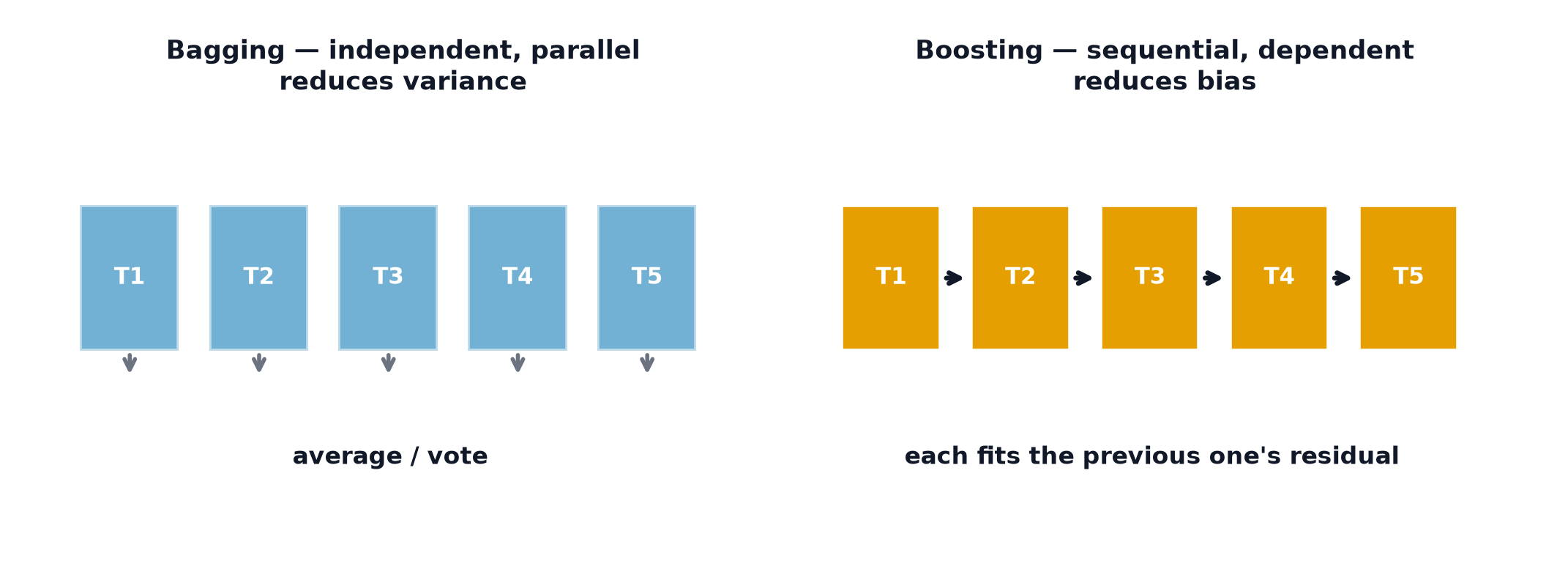
The three families
Bagging (Random Forests and Bagging): parallel, same base learner, reduces variance. Boosting (Gradient Boosting): sequential, same base learner, reduces bias. Stacking: combines predictions from different model types via a learned combination rule.
Voting: hard vs. soft
Hard voting: each model casts a discrete vote for a class, majority wins. Soft voting: average the predicted probabilities across models, then take the argmax — generally performs better because it uses the models' confidence, not just their final decision.
Weighted averaging
A simple extension: instead of equal weights, weight each model's contribution by its individual validation performance — a stronger model counts for more.
Stacking: base learners plus a meta-learner
Train several diverse base learners on the training data; then train a meta-learner whose inputs are the base learners' predictions and whose target is the original label. The meta-learner learns how to combine the base models' opinions, rather than combining them with a fixed rule like averaging.
Why the meta-learner must be trained on out-of-fold predictions
This is the entire trick, and getting it wrong silently ruins the ensemble. If the meta-learner is trained on the base learners' predictions on the same data those base learners were trained on, the base learners' predictions will be overly accurate (they've already seen the answers) — the meta-learner will then learn to trust base learners' training-set overconfidence, which does not transfer to new data. The fix: generate each base learner's predictions on data it did not see during its own training, using cross-validation — each base learner predicts on the fold it was held out from, and only those honest, out-of-fold predictions feed the meta-learner.
Blending vs. stacking
Blending is a simplified variant: hold out a single validation set (instead of full k-fold), train base learners on the remainder, and train the meta-learner on the base learners' predictions for that one held-out set — simpler to implement, uses less data for the meta-learner's training signal.
Diversity as the actual currency
A stacked ensemble of five near-identical gradient boosting models tuned slightly differently gains almost nothing over a single one, because their errors are highly correlated (same Random Forests and Bagging's variance floor applies here too). A stack combining a linear model, a tree ensemble, and a neural network — each with a different inductive bias, therefore different error patterns — gains meaningfully more, even if each individual model is slightly weaker on its own.
Cost: latency, memory, debuggability
An ensemble multiplies serving cost by however many models it contains, multiplies memory footprint the same way, and makes debugging a bad prediction harder (which of models is responsible?) — real costs that must be weighed against the (often modest) accuracy gain.
When a single well-tuned model is the right call
If latency or interpretability matter, or if the accuracy gain from stacking is only a fraction of a percentage point, a single well-tuned model is usually the better production choice — ensembling is most worth its cost in offline settings (competitions, batch scoring) where the marginal accuracy is the only thing that matters.
Code: VotingClassifier and StackingClassifier over diverse base models
import numpy as np
from sklearn.datasets import make_classification
from sklearn.linear_model import LogisticRegression
from sklearn.ensemble import RandomForestClassifier, VotingClassifier, StackingClassifier, GradientBoostingClassifier
from sklearn.svm import SVC
from sklearn.model_selection import cross_val_score, KFold

X, y = make_classification(n_samples=1000, n_features=20, random_state=0)

base_models = [
    ("logreg", LogisticRegression(max_iter=500)),
    ("forest", RandomForestClassifier(n_estimators=100, random_state=0)),
    ("svm", SVC(probability=True, random_state=0)),
]

voting = VotingClassifier(estimators=base_models, voting="soft")
stacking = StackingClassifier(estimators=base_models, final_estimator=LogisticRegression(),
                               cv=5)  # cv=5 ensures out-of-fold predictions feed the meta-learner

for name, model in [("voting", voting), ("stacking", stacking)] + base_models:
    scores = cross_val_score(model, X, y, cv=5)
    print(f"{name:10s}: {scores.mean():.4f} +/- {scores.std():.4f}")

# --- Correlation of base-model errors: why the diverse trio helps ---
preds = {}
for name, model in base_models:
    fold_preds = np.zeros(len(y))
    for train_idx, val_idx in KFold(5, shuffle=True, random_state=0).split(X):
        model.fit(X[train_idx], y[train_idx])
        fold_preds[val_idx] = model.predict(X[val_idx])
    preds[name] = (fold_preds != y).astype(int)  # 1 = error

error_matrix = np.array(list(preds.values()))
print("\nerror correlation matrix (lower off-diagonal = more diverse, more useful to stack):")
print(np.round(np.corrcoef(error_matrix), 3))
When to reach for this
| Data size | any, but the meta-learner needs enough data to train reliably |
| Feature count | inherited from base learners |
| Interpretability | low — a black box on top of black boxes |
| Training cost | sum of all base learners, plus cross-validation overhead for stacking |
| Inference cost | sum of all base learners' inference cost |
See also
- Random Forests and Bagging — ensembling identical learners, for contrast.
- Train/Validation/Test Splits — the cross-validation discipline stacking depends on.