Imbalanced Data
99% of your rows are one class, and accuracy just became a lie. Imbalance is best understood as a metric-and-threshold problem before it's a sampling problem — fixing evaluation costs nothing and should always come first, and often it turns out to be the only fix actually needed.
Imbalance is a metric-and-threshold problem before it is a sampling problem — fix the evaluation first, then decide whether to touch the data.
Where imbalance comes from
Rare-event prediction (fraud, disease, equipment failure), where the rare class is inherently uncommon in the real world — not a data-collection mistake to be "fixed" by resampling, but a genuine property of the problem the model must be evaluated against honestly.
Why accuracy and even ROC-AUC mislead at extreme ratios
Accuracy on a 99:1 dataset is trivially high for a model that predicts the majority class always — covered in Evaluation Metrics for Classification. ROC-AUC is more robust but still misleading at extreme ratios: its false-positive rate is normalised by the (huge) number of true negatives, so even a poor classifier with many false positives relative to the tiny number of true positives can still show a deceptively high AUC. PR-AUC does not have this problem — precision is computed relative to predicted positives, which stays sensitive to false positives regardless of how many true negatives exist.
Threshold moving as the cheapest fix
Most classifiers default to a 0.5 decision threshold, which is simply the wrong choice when classes are imbalanced and error costs differ. Moving the threshold based on the actual cost of false positives versus false negatives (Evaluation Metrics for Classification) costs nothing computationally and is often the single most effective imbalance fix — it requires no retraining.
Class weights in the loss
Multiply each class's loss contribution by a weight inversely proportional to its frequency (the formula from Loss Functions), forcing the optimiser to treat minority-class mistakes as costing more — available as a simple parameter (class_weight="balanced") in most sklearn models.
Random undersampling and what it discards
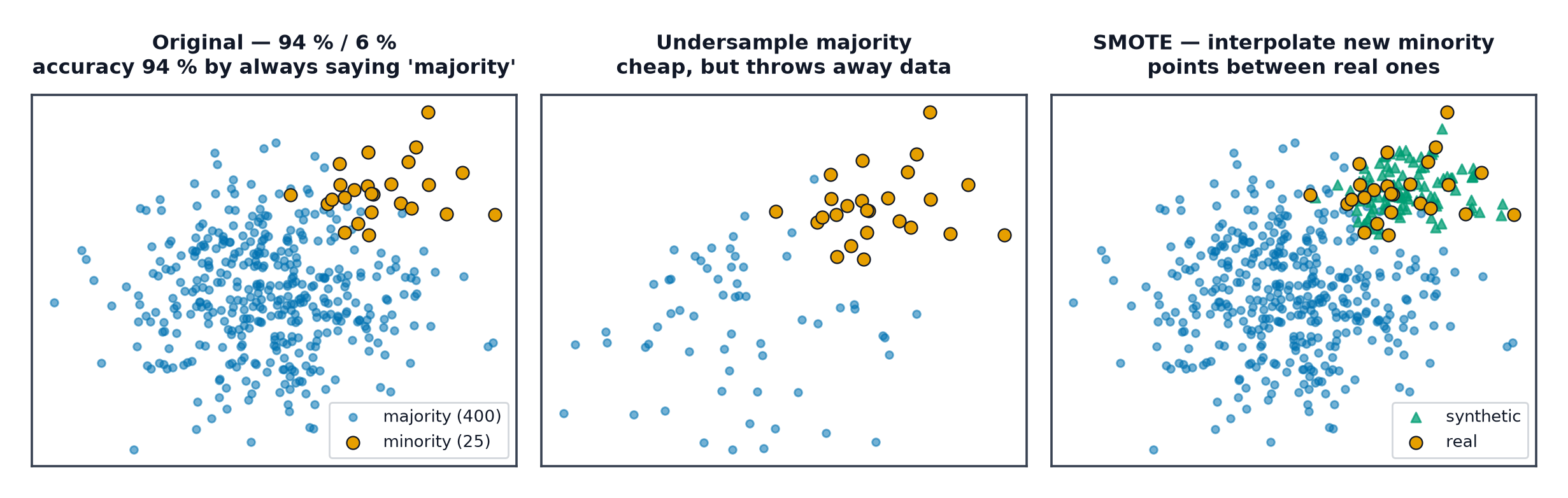
Randomly remove majority-class examples until classes are balanced — cheap, but discards potentially useful information, and with severe imbalance can throw away the vast majority of the dataset.
Random oversampling and the overfitting it invites
Randomly duplicate minority-class examples until classes are balanced — preserves all data, but duplicated points give the model exact repeats to memorise, increasing overfitting risk on the minority class specifically.
SMOTE and the honest evidence
The code example below uses imbalanced-learn (imblearn), not in the default library set. Install with pip install imbalanced-learn.
SMOTE (Synthetic Minority Oversampling Technique) generates synthetic minority examples by interpolating between existing minority points and their nearest minority neighbours, rather than exact duplicates — a more sophisticated alternative to naive oversampling. The honest caveat, backed by several published benchmarking studies: SMOTE often does not outperform simple class weighting or threshold tuning in practice, despite being the most commonly reached-for imbalance technique — try the cheaper fixes first and measure whether SMOTE actually helps on your specific data before assuming it will.
Resampling belongs inside the cross-validation fold
Applying SMOTE (or any resampling) to the full dataset before splitting leaks synthetic points derived from what will become validation data back into training — the same leakage class covered in Train/Validation/Test Splits. Resampling must happen only on the training portion of each fold, never before the split.
Ensemble approaches
Balanced bagging: each bootstrap sample in a bagging ensemble is drawn to be class-balanced, rather than reflecting the original imbalanced proportions — combines Random Forests and Bagging's variance reduction with a built-in resampling step.
Anomaly detection as the alternative framing
At extreme imbalance ratios (far fewer than 1% positive), there may be too few positive examples for a classifier to learn stable patterns at all — Anomaly Detection's "model normal, flag deviation" framing can work better than trying to force a supervised classifier to learn from a handful of positive examples.
Decision table by imbalance ratio
| Ratio | Reach for |
|---|---|
| Mild (up to ~9:1) | class weights, threshold tuning — often sufficient alone |
| Moderate (10:1 to 100:1) | class weights + threshold tuning; consider SMOTE if those aren't enough |
| Severe (100:1 to 1000:1) | balanced bagging, careful threshold tuning, PR-AUC as the primary metric |
| Extreme (beyond 1000:1, very few positives) | anomaly detection framing instead of supervised classification |
Code: accuracy vs. ROC-AUC vs. PR-AUC divergence, and the SMOTE leak
import numpy as np
from sklearn.datasets import make_classification
from sklearn.model_selection import train_test_split, cross_val_score, StratifiedKFold
from sklearn.linear_model import LogisticRegression
from sklearn.metrics import accuracy_score, roc_auc_score, average_precision_score

X, y = make_classification(n_samples=2000, weights=[0.99, 0.01], random_state=0)
X_train, X_test, y_train, y_test = train_test_split(X, y, test_size=0.3, stratify=y, random_state=0)

# --- Baseline: predict majority class always ---
majority_preds = np.zeros(len(y_test))
print(f"majority-class accuracy: {accuracy_score(y_test, majority_preds):.4f}  <- looks great, catches zero positives")

model = LogisticRegression(class_weight="balanced", max_iter=500).fit(X_train, y_train)
probs = model.predict_proba(X_test)[:, 1]
preds = (probs >= 0.5).astype(int)

print(f"model accuracy:  {accuracy_score(y_test, preds):.4f}")
print(f"model ROC-AUC:    {roc_auc_score(y_test, probs):.4f}")
print(f"model PR-AUC:     {average_precision_score(y_test, probs):.4f}  <- the honest number here")

# --- SMOTE inside vs. outside the CV fold ---
from imblearn.over_sampling import SMOTE
from imblearn.pipeline import Pipeline as ImbPipeline

skf = StratifiedKFold(n_splits=5, shuffle=True, random_state=0)

correct_pipeline = ImbPipeline([("smote", SMOTE(random_state=0)), ("clf", LogisticRegression(max_iter=500))])
correct_scores = cross_val_score(correct_pipeline, X, y, cv=skf, scoring="average_precision")
print(f"\ncorrect (SMOTE inside CV): {correct_scores.mean():.4f}")

X_smote_leaked, y_smote_leaked = SMOTE(random_state=0).fit_resample(X, y)  # sees all data first
leaky_scores = cross_val_score(LogisticRegression(max_iter=500), X_smote_leaked, y_smote_leaked, cv=5, scoring="average_precision")
print(f"leaky (SMOTE before split):  {leaky_scores.mean():.4f}")
See also
- Evaluation Metrics for Classification — the metric and threshold discipline this page depends on.
- Anomaly Detection — the alternative framing at extreme imbalance ratios.