Transfer Learning for Vision
Almost nobody trains a vision model from scratch anymore, and there's a good structural reason: the early layers of any CNN trained on natural images learn something close to universal — edges, colours, simple textures — regardless of what specific objects the model was ultimately trained to recognise. That generic foundation is exactly what transfer learning reuses.
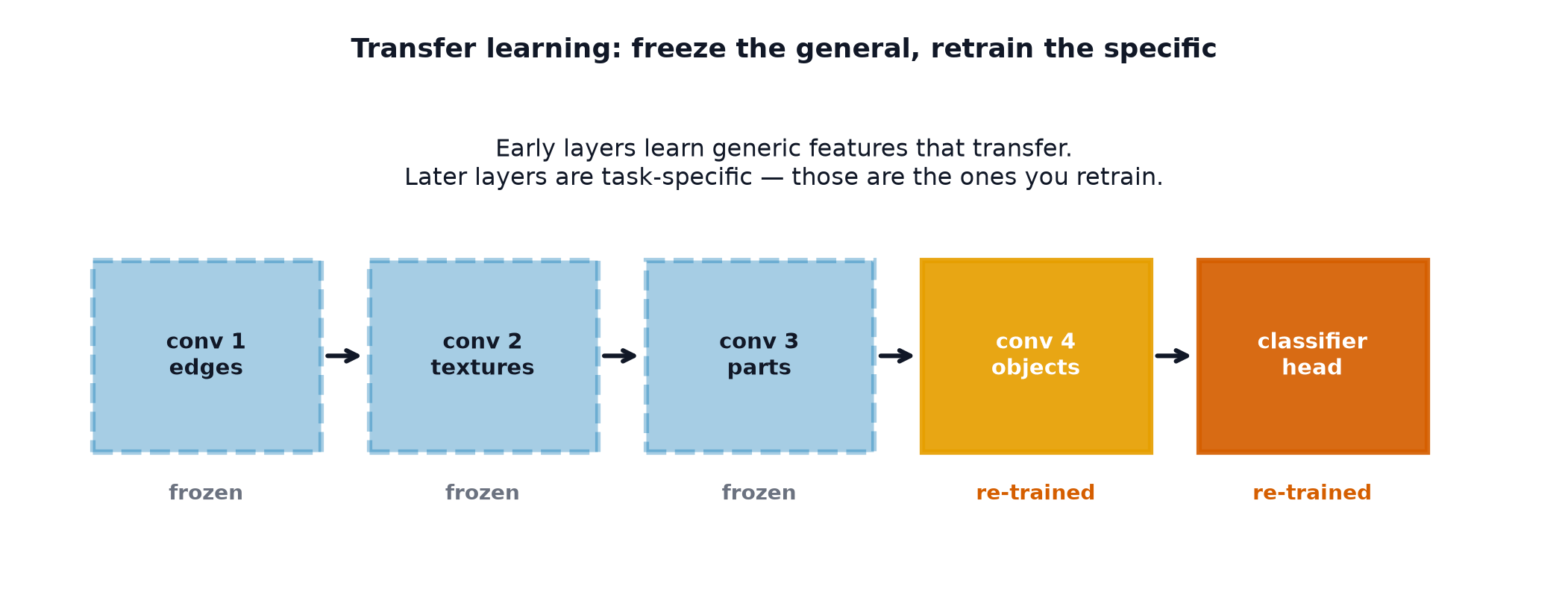
Early layers learn generic edges and textures that transfer across almost any image task — only the later layers are task-specific.
What pretrained features actually contain, layer by layer
Early layers: edge detectors, colour blobs, simple textures — visibly similar across almost any CNN trained on natural images, regardless of the final task. Middle layers: more complex textures, simple parts (eyes, wheels, wood grain). Late layers: increasingly abstract, task-specific combinations closely tied to the original training objective (e.g. "this pattern predicts golden retriever"). Transfer learning works because the early and middle layers' generic features are useful for a very wide range of downstream tasks, even ones the original model never saw.
Feature extraction: freeze, train a new head
Freeze every pretrained layer's weights entirely; replace the final classification layer with a new one sized for the target task's number of classes; train only that new layer. Cheap, fast, and works reasonably well when the target task is visually similar to the original pretraining data.
Fine-tuning: unfreeze progressively
Rather than keeping the entire backbone frozen, unfreeze some or all of it and continue training at a low learning rate — lets the pretrained features adapt somewhat to the target task's specifics, generally outperforming pure feature extraction when enough target-task data is available to support it without overfitting.
Which layers to unfreeze, and in what order
A common practice: start by fine-tuning only the last few layers (closest to the task-specific end), and progressively unfreeze earlier layers if more adaptation is needed and enough data supports it — unfreezing the earliest layers first risks destroying the generic, broadly-useful features those layers hold before the later layers have had a chance to adapt around them.
Learning rates: small for the backbone, larger for the head
The new task head starts from random initialisation and needs to learn quickly; the pretrained backbone already encodes useful information and should only be nudged gently — using the same learning rate for both risks either training the head too slowly or destroying the backbone's pretrained knowledge too quickly, the same discriminative-learning-rate principle from Finetuning and Instruction Tuning.
BatchNorm statistics during fine-tuning, and the classic bug
Normalization Layers's BatchNorm behaves differently in train vs. eval mode. A classic transfer-learning bug: leaving BatchNorm layers in train mode while otherwise freezing the backbone means their running statistics keep updating based on the new (possibly small, possibly differently-distributed) target-task batches — this can silently corrupt the very statistics that made the pretrained features good in the first place, even though the weights were correctly frozen.
How much data justifies full fine-tuning
Feature extraction alone is often sufficient (and safer against overfitting) with only a few hundred target-task examples; full fine-tuning of most or all layers generally needs at least low thousands of examples to avoid quickly overfitting the far larger number of unfrozen parameters — a rough rule of thumb, not a hard boundary, and worth verifying empirically per task.
Domain gap: when ImageNet features do not transfer well
Pretrained-on-natural-photos features transfer well to other natural-photo tasks, but transfer considerably less well to domains with fundamentally different visual statistics — medical imaging (X-rays, MRIs), satellite imagery, or microscopy, where the textures, structures, and relevant visual cues differ substantially from anything in typical pretraining data. In these cases, domain-specific pretrained backbones (where available) or a greater reliance on full fine-tuning (rather than feature extraction) tend to perform meaningfully better.
Self-supervised pretrained backbones as an alternative
Self-Supervised Vision-pretrained backbones (trained without any labels at all, on potentially domain-relevant unlabelled images) can be a stronger starting point than a supervised ImageNet backbone specifically when the target domain diverges substantially from natural photos and some in-domain unlabelled data is available.
Decision table
| Dataset size | Domain similarity to pretraining | Reach for |
|---|---|---|
| Small (hundreds) | similar | feature extraction |
| Small (hundreds) | different | feature extraction, or domain-specific pretrained weights if available |
| Large (thousands+) | similar | fine-tuning, most or all layers |
| Large (thousands+) | different | full fine-tuning, or self-supervised pretraining on in-domain data first |
Code: frozen vs. fine-tuned, early-layer filters visualised
import torch
import torch.nn as nn
from torchvision import models
import matplotlib.pyplot as plt
import time

def make_model(num_classes, freeze_backbone):
    model = models.resnet18(weights=models.ResNet18_Weights.DEFAULT)
    if freeze_backbone:
        for param in model.parameters():
            param.requires_grad = False
    model.fc = nn.Linear(model.fc.in_features, num_classes)  # new head, always trainable
    return model

torch.manual_seed(0)
X = torch.randn(64, 3, 64, 64)
y = torch.randint(0, 5, (64,))

results = {}
for label, freeze in [("frozen backbone", True), ("fine-tuned backbone", False)]:
    model = make_model(num_classes=5, freeze_backbone=freeze)
    trainable = sum(p.numel() for p in model.parameters() if p.requires_grad)
    total = sum(p.numel() for p in model.parameters())
    optimizer = torch.optim.Adam([p for p in model.parameters() if p.requires_grad], lr=0.001)
    start = time.perf_counter()
    for _ in range(5):
        optimizer.zero_grad()
        loss = nn.functional.cross_entropy(model(X), y)
        loss.backward(); optimizer.step()
    elapsed = time.perf_counter() - start
    print(f"{label:22s}: {trainable:,}/{total:,} trainable params, {elapsed:.3f}s for 5 steps")

# --- Visualise early-layer filters ---
model = models.resnet18(weights=models.ResNet18_Weights.DEFAULT)
first_conv_weights = model.conv1.weight.data  # shape (64, 3, 7, 7)
fig, axes = plt.subplots(4, 8, figsize=(12, 6))
for i, ax in enumerate(axes.flat):
    filt = first_conv_weights[i].permute(1, 2, 0)
    filt = (filt - filt.min()) / (filt.max() - filt.min())
    ax.imshow(filt); ax.axis("off")
plt.savefig("pretrained_filters.png")
See also
- CNN Architectures — the pretrained backbones this page reuses.
- Data Augmentation — commonly combined with fine-tuning to further reduce overfitting risk on small target datasets.