Training Loop Anatomy
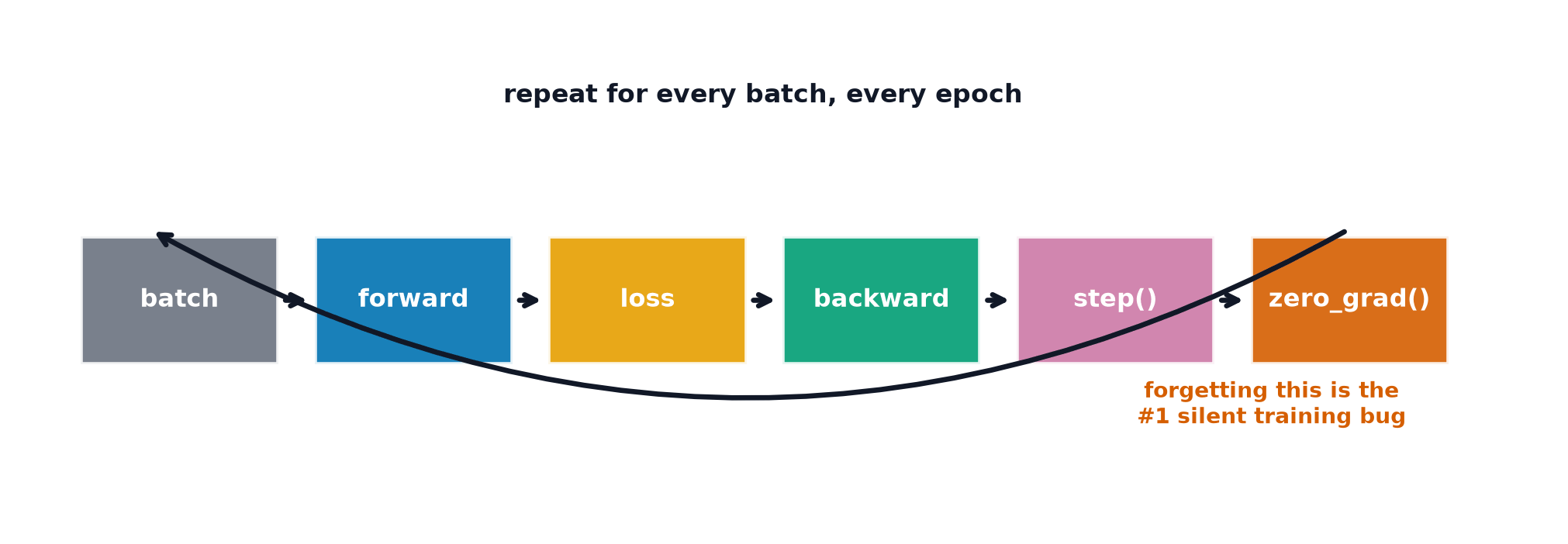
Every deep learning project, regardless of architecture or task, runs the same twenty-odd lines at its core: forward, compute loss, zero the gradients, backward, step. That order is not negotiable — get it wrong and training either does nothing or does something subtly incorrect, and both failure modes tend to fail quietly rather than crash loudly.
Forward, loss, zero_grad, backward, step — in that order, every time, and the order is not negotiable.
The canonical loop
for epoch in range(num_epochs):
    model.train()
    for x, y in train_loader:
        optimizer.zero_grad()
        pred = model(x)
        loss = loss_fn(pred, y)
        loss.backward()
        optimizer.step()
Zero the gradients before the backward pass (not after) — because PyTorch Tensors and Autograd's .backward() accumulates into whatever .grad currently holds.
model.train() vs. model.eval()
These calls don't run any computation themselves — they set a flag that changes the behaviour of specific layers. Normalization Layers's BatchNorm switches between batch statistics (train) and running statistics (eval); Regularization in Deep Nets's dropout switches between masking activations (train) and passing them through unmodified (eval). Forgetting to call .eval() before validation silently leaves both of these in training-mode behaviour during evaluation.
The validation loop and torch.no_grad()
model.eval()
with torch.no_grad():
    for x, y in val_loader:
        pred = model(x)
        val_loss += loss_fn(pred, y).item()
torch.no_grad() disables graph tracking for the whole block, saving memory and computation that would otherwise be wasted building a graph nothing will ever call .backward() on.
Metric accumulation done right
Averaging per-batch metrics naively (sum(batch_metrics) / len(batches)) is subtly wrong when the final batch has fewer examples than the rest (a common consequence of drop_last=False) — the correct accumulation weights each batch's contribution by its actual example count: sum(batch_metric * batch_size) / total_examples.
Checkpointing: what to save
A checkpoint that saves only model.state_dict() cannot correctly resume training — resuming also needs the optimizer state (momentum buffers, Adam's moment estimates), the scheduler state (where in the learning-rate schedule training was), the epoch number, and ideally the RNG state (for exact reproducibility, see Reproducibility).
Resuming correctly
Load all of the above back in, and resume the epoch counter from where it left off — resuming from epoch 0 with a restored model but a fresh optimizer effectively discards the optimizer's accumulated momentum, causing a discontinuity in training dynamics right at the resume point.
Early stopping
Track validation loss across epochs; if it hasn't improved for a set number of epochs (patience), stop training and restore the checkpoint from the best epoch, not the most recent one.
Gradient accumulation for large effective batch sizes
When a desired batch size doesn't fit in GPU memory, split it into smaller "micro-batches," accumulate their gradients (call .backward() on each without an intervening zero_grad() or step()), and only call optimizer.step() once every micro-batches — mathematically equivalent to training with a larger batch, at the cost of more forward/backward passes per effective step.
Gradient clipping placement
Clip gradients (torch.nn.utils.clip_grad_norm_) after .backward() but before optimizer.step() — clipping before the backward pass would have nothing to clip yet, and clipping after the step would be too late to affect that step's update.
Logging what matters
At minimum: training loss per step or epoch, validation loss/metric per epoch, learning rate (to catch scheduler bugs), and gradient norms (to catch the vanishing/exploding symptoms from Vanishing and Exploding Gradients) — logging only the loss hides most of the useful diagnostic signal.
The six classic bugs
| Bug | Symptom |
|---|---|
Missing zero_grad() | loss decreases erratically, or the effective learning rate seems to grow over time |
Forgetting model.eval() before validation | validation metrics fluctuate oddly, especially with BatchNorm/dropout |
| Loss computed on the wrong axis/dimension | loss is a suspicious constant, or shapes silently broadcast incorrectly |
| Shuffling validation data every epoch | can't directly compare validation metrics across epochs when doing error analysis |
Evaluating under torch.no_grad()-less code paths meant for training | unnecessary memory use, occasionally a crash on large validation sets |
Saving only model.state_dict() | resumed training discards optimizer momentum, causing a training discontinuity |
Code: a complete training script with checkpointing and early stopping
import torch
import torch.nn as nn
from torch.utils.data import TensorDataset, DataLoader

torch.manual_seed(0)
X = torch.randn(1000, 10)
y = (X.sum(dim=1) > 0).float().unsqueeze(1)
train_ds, val_ds = TensorDataset(X[:800], y[:800]), TensorDataset(X[800:], y[800:])
train_loader = DataLoader(train_ds, batch_size=32, shuffle=True)
val_loader = DataLoader(val_ds, batch_size=32, shuffle=False)  # never shuffle validation

model = nn.Sequential(nn.Linear(10, 32), nn.ReLU(), nn.Linear(32, 1), nn.Sigmoid())
optimizer = torch.optim.Adam(model.parameters(), lr=1e-3)
loss_fn = nn.BCELoss()

best_val_loss, patience, patience_counter = float("inf"), 5, 0

for epoch in range(50):
    model.train()
    train_loss_sum, train_n = 0.0, 0
    for x, y_batch in train_loader:
        optimizer.zero_grad()
        pred = model(x)
        loss = loss_fn(pred, y_batch)
        loss.backward()
        torch.nn.utils.clip_grad_norm_(model.parameters(), max_norm=5.0)  # after backward, before step
        optimizer.step()
        train_loss_sum += loss.item() * len(x)  # weighted by batch size
        train_n += len(x)

    model.eval()
    val_loss_sum, val_n = 0.0, 0
    with torch.no_grad():
        for x, y_batch in val_loader:
            pred = model(x)
            val_loss_sum += loss_fn(pred, y_batch).item() * len(x)
            val_n += len(x)
    val_loss = val_loss_sum / val_n

    if val_loss < best_val_loss:
        best_val_loss, patience_counter = val_loss, 0
        torch.save({
            "epoch": epoch, "model_state": model.state_dict(),
            "optimizer_state": optimizer.state_dict(), "val_loss": val_loss,
        }, "best_checkpoint.pt")
    else:
        patience_counter += 1
        if patience_counter >= patience:
            print(f"early stopping at epoch {epoch}, best val_loss={best_val_loss:.4f}")
            break

    if epoch % 10 == 0:
        print(f"epoch {epoch}: train_loss={train_loss_sum/train_n:.4f}  val_loss={val_loss:.4f}")
See also
- PyTorch Tensors and Autograd — the
.backward()/.gradmechanics this loop relies on. - Debugging Neural Networks — the systematic process for when this loop doesn't produce a decreasing loss.