Learning Paradigms
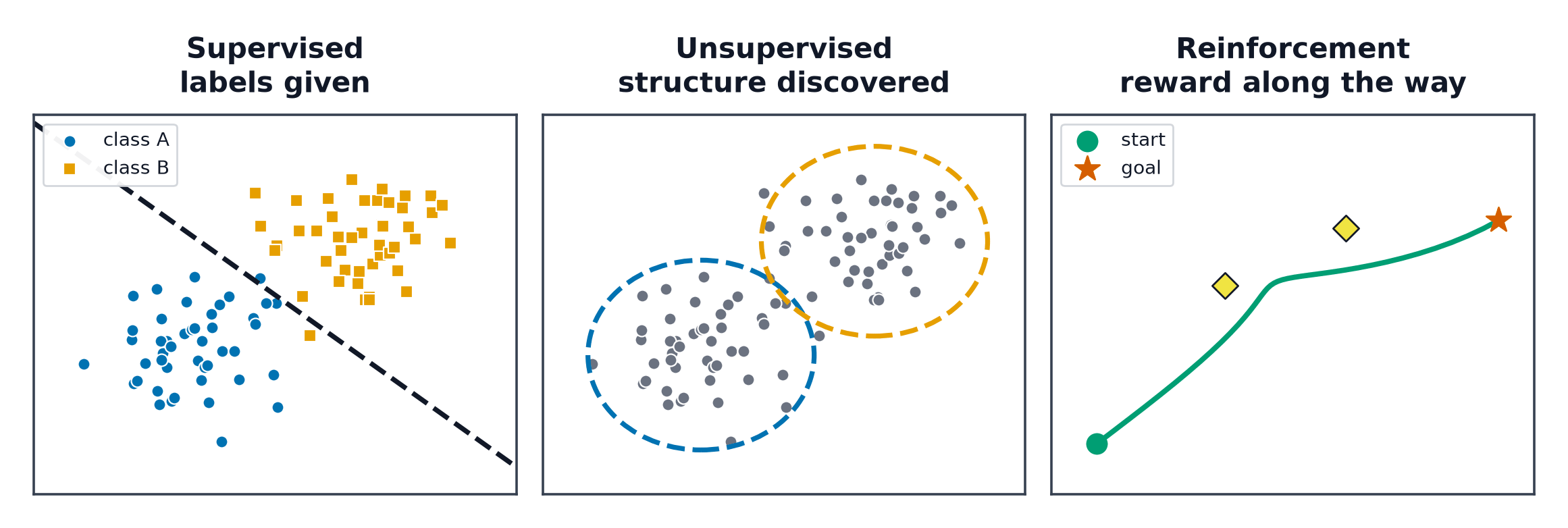
Before picking an algorithm, answer one question: what does the training signal look like? A dataset of (input, correct-output) pairs calls for a different family of methods than a pile of unlabelled data, which in turn differs from a system that only gets a delayed reward for a sequence of actions. The paradigm is chosen by the data you have, not by which algorithm sounds most impressive.
Paradigms are classified by what supervision is available, not by what model is used — a neural network can be trained under any of them.
Supervised learning
Every training example comes with the "correct answer." The model learns a function from labelled pairs .
- Regression — is continuous (predict a house price, a temperature).
- Classification — is categorical (predict spam/not-spam, a digit 0–9).
Formally, supervised learning searches for the minimising expected loss over the true (unknown) data distribution:
| Symbol | Meaning |
|---|---|
| input space and output space | |
| the function being learned, mapping | |
| the loss function penalising a wrong prediction | |
| the true, unknown distribution generating pairs | |
| expectation — the average loss if you could see every possible |
You never see directly — you only get a finite sample from it, which is why generalisation (covered in Bias-Variance Tradeoff) is the central concern of the whole field.
Unsupervised learning
No labels at all — only , no . The goal shifts from "predict the output" to "describe the structure":
- Clustering — group similar points (customer segments, document topics).
- Density estimation — model , the probability of observing a given input.
- Dimensionality reduction — find a lower-dimensional representation that preserves what matters.
Self-supervised learning
A middle path: manufacture labels from the unlabelled data itself. Mask a word and predict it from context; predict the next frame of a video; rotate an image and predict the rotation. No human ever labelled anything, but the training loop looks exactly like supervised learning because the "label" is a piece of the same data held out. This is the mechanism behind every modern large language model — see Pretraining Objectives.
Semi-supervised learning
A small labelled set plus a large unlabelled set. Common when labelling is expensive (medical images) but raw data is cheap. Techniques typically use the unlabelled data to shape the model's notion of "plausible input" and the labelled data to pin down the actual task.
Reinforcement learning
No fixed dataset at all — an agent takes actions in an environment and receives a reward signal, often delayed and sparse. The training data is generated by the agent's own behaviour, which makes this qualitatively different from every paradigm above. Covered in full in Reinforcement Learning.
Decision table
| You have... | Reach for |
|---|---|
| Labelled examples, continuous target | Supervised regression |
| Labelled examples, categorical target | Supervised classification |
| Only unlabelled data, want groups | Clustering |
| Only unlabelled data, want a smaller representation | Dimensionality reduction |
| Huge unlabelled corpus, want a general-purpose model | Self-supervised pretraining |
| A little labelled data, a lot of unlabelled data | Semi-supervised learning |
| An environment, a reward signal, no fixed dataset | Reinforcement learning |
Where each is covered
- Supervised learning: Classical ML and Deep Learning.
- Unsupervised learning: k-Means Clustering, PCA and SVD.
- Self-supervised learning: Pretraining Objectives, Self-Supervised Vision.
- Reinforcement learning: the entire Reinforcement Learning section.
Code: one example per paradigm
import numpy as np
from sklearn.datasets import load_iris
from sklearn.linear_model import LogisticRegression
from sklearn.cluster import KMeans

X, y = load_iris(return_X_y=True)

# --- Supervised: a classifier trained on (X, y) pairs ---
clf = LogisticRegression(max_iter=200).fit(X, y)
print("supervised accuracy:", clf.score(X, y))

# --- Unsupervised: k-means sees only X, no labels ---
km = KMeans(n_clusters=3, n_init=10, random_state=0).fit(X)
print("unsupervised cluster sizes:", np.bincount(km.labels_))

# --- Toy self-supervised objective: predict a masked feature from the rest ---
masked_col = 0
X_context = np.delete(X, masked_col, axis=1)
X_target = X[:, masked_col]
from sklearn.linear_model import LinearRegression
ssl_model = LinearRegression().fit(X_context, X_target)
print("self-supervised R^2 predicting masked feature:", ssl_model.score(X_context, X_target))
The self-supervised block is the important one: X_target was never a human-provided label, it is a column of X we deliberately hid and asked the model to reconstruct from the rest — the exact trick behind masked language modelling.
See also
- What Is Machine Learning — the three ingredients every paradigm shares.
- The ML Workflow — how paradigm choice fits into a full project.