Why Interpretability Matters
A model that is accurate on your test set can still be unusable — because it is illegal to deploy without an explanation, because it is right for a reason that will not survive next quarter, or because nobody will act on a number they cannot interrogate.
"Why did the model say that?" is a different question from "is the model accurate?", and a good answer to the second does not supply the first. Interpretability is how you check that a model is right for the right reasons — which is the only kind of correctness that generalises.
Four distinct reasons, with different requirements
| Reason | Who asks | What satisfies them |
|---|---|---|
| Debugging | You | Any method that reveals what the model keyed on |
| Trust and adoption | Domain experts, users | Explanations in their vocabulary, not features |
| Regulation | Legal, compliance | Documented, reproducible, often model-specific |
| Fairness auditing | Everyone | Behaviour sliced by protected group |
These pull in different directions. A SHAP plot is excellent for debugging and useless for a customer told their loan was declined. Under the GDPR and the US Equal Credit Opportunity Act, "adverse action" notices must give specific principal reasons — a requirement that post-hoc attribution satisfies awkwardly at best.
The famous failure modes
Every one of these was a model with excellent test-set metrics.
- The husky and the wolf. A classifier separating huskies from wolves turned out to be detecting snow in the background. It scored well because wolf photos happened to be taken in snow. This is the canonical demonstration of a right answer for a wrong reason.
- Pneumonia and asthma. A model predicting pneumonia mortality learned that asthmatic patients had lower risk — true in the data, because asthmatics were routed straight to intensive care. Deployed as a triage tool it would have sent exactly the highest-risk patients home.
- Rulers in dermatology images. Skin-lesion classifiers picked up on the surgical rulers that clinicians place beside lesions they already suspect are malignant.
- Hospital tokens in chest X-rays. Models learned to identify which hospital took the scan from metadata burned into the image, and used base rates rather than pathology.
The pattern is identical each time: a shortcut correlated with the label in training, absent or reversed in deployment. No accuracy metric can detect this. Only looking at what the model used can.
Interpretable by design, or explained afterwards
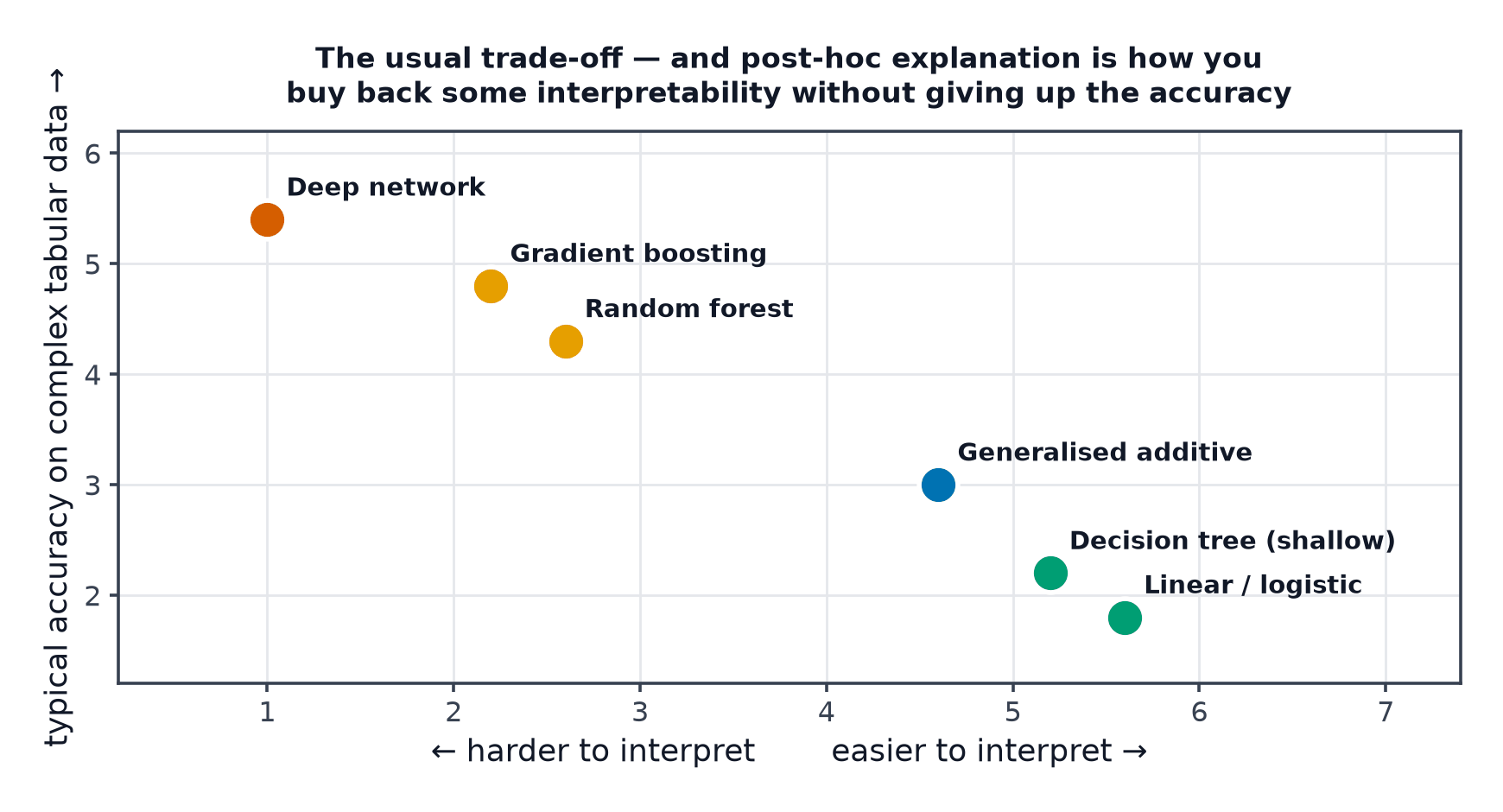
| Intrinsically interpretable | Post-hoc explained | |
|---|---|---|
| Examples | Linear/logistic, shallow trees, GAMs, rule lists | Any model + SHAP, LIME, PDP |
| Explanation is | The model itself | An approximation of the model |
| Faithfulness | Exact by construction | Approximate, sometimes badly |
| Accuracy ceiling | Lower on complex data | Whatever the model achieves |
The reflex to fit gradient boosting and explain it afterwards is often the wrong move. On many tabular problems a well-specified logistic regression or a small GAM loses very little accuracy and gives an explanation that is exact rather than approximate.
Rudin's argument is worth taking seriously: for high-stakes decisions, explaining a black box is a worse answer than not using a black box. The burden should be on demonstrating that the extra accuracy is real, material, and worth the loss of a faithful explanation.
The axes to keep straight
Global vs. local. Global explanations describe the model's overall behaviour ("income is the most important feature"). Local explanations describe one prediction ("this applicant was declined mainly because of their debt ratio"). They answer different questions and can genuinely disagree — a feature can be globally unimportant but decisive for a particular case.
Model-specific vs. model-agnostic. Model-specific methods exploit internal structure (tree split gains, linear coefficients, attention weights) and are usually faster and more faithful. Model-agnostic methods (permutation importance, LIME, KernelSHAP) treat the model as a black box and work on anything, at higher cost.
What an explanation is not
- It is not causal. A SHAP value says the model's output moves with this feature, not that changing the feature in the world changes the outcome. Confusing the two leads directly to bad interventions.
- It is not necessarily faithful. A surrogate model can approximate a black box well on average and badly exactly where you are looking.
- It is not unique. Different methods routinely produce different — occasionally contradictory — attributions for the same prediction, and there is no ground truth to arbitrate.
- It is not a fairness guarantee. A model can produce reasonable-looking explanations and still be discriminatory through proxy variables.
See also
- Global Methods — feature importance, PDP and ICE.
- Local Methods — SHAP, LIME and counterfactuals.
- Pitfalls and Honest Practice — how these methods mislead.
- Responsible AI and Failure Modes — the broader governance picture.