CI/CD for ML
Automating the path from a commit to a deployed model, with gates that can actually stop a bad one — not automation for its own sake, but a system where "commit" doesn't mean "deployed," and a real evaluation gate stands between the two.
ML CI/CD has three pipelines, not one - code, training, and deployment - and each needs its own trigger and its own gate.
What differs from software CI/CD
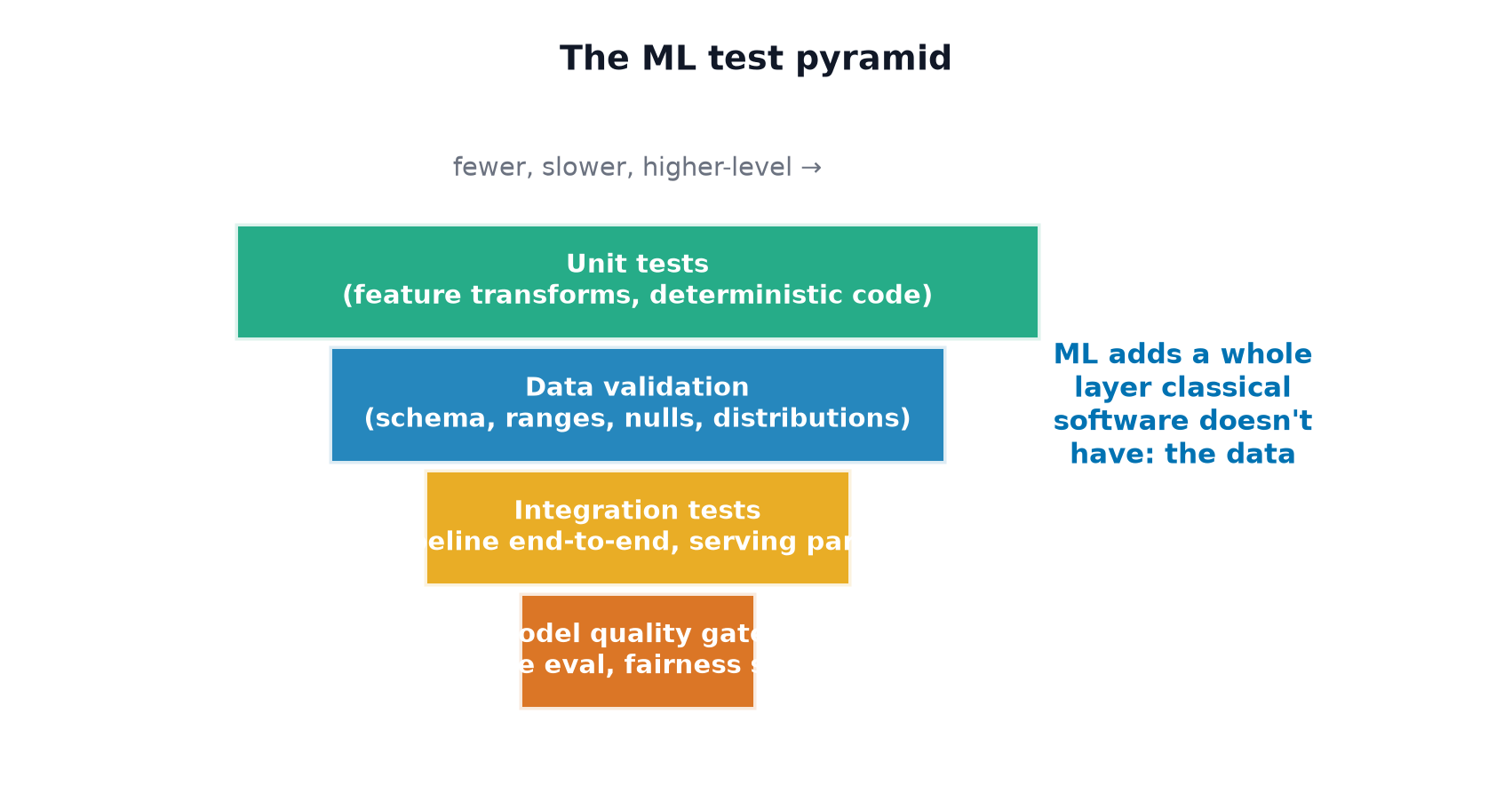
Standard software CI/CD tests code against a fixed, deterministic expectation — the same input should always produce the same output, and a test either passes or fails unambiguously. ML systems add: data as an input (correctness depends on data the CI system doesn't fully control), non-deterministic outputs (Reproducibility's natural run-to-run variance, even when seeded imperfectly), and statistical quality gates (pass/fail decided by a metric threshold with sampling noise, not a binary assertion) — all requiring CI/CD practices beyond what standard software testing assumes.
The code pipeline: lint, type check, unit tests, data validation tests
The most standard-software-like of the three pipelines: lint and type-check on every commit, unit tests for individual functions, and — the ML-specific addition — tests for the Data Pipelines and Contracts's validation logic itself (does the contract checker correctly catch a known-bad input).
Testing ML code specifically
Preprocessing functions: unit-testable like any pure function — given a known input, does it produce the known correct output. Shape contracts: assert tensor shapes at key points in the model, catching a broken reshape or a mismatched dimension immediately rather than deep inside a cryptic runtime error. The overfit-one-batch smoke test: can the model overfit a single small batch to near-zero loss — if it can't, something in the training loop is broken, and this is far faster to run than a full training job. A tiny end-to-end training run: a few steps on a tiny synthetic dataset, checking the full pipeline runs without crashing — not evaluating quality, just confirming the mechanics work.
The training pipeline: triggered by code, data, or schedule
Distinct from the code pipeline, the training pipeline actually runs training, triggered by a code change (new model logic), a new dataset version (Data Versioning and Lineage), or a schedule (routine retraining, or Data and Concept Drift's triggered retraining).
The evaluation gate, and promotion only on passing it
Every training pipeline run feeds directly into Offline Evaluation's automated evaluation suite — a model that fails the gate simply does not get promoted to the registry, regardless of how the training run otherwise looked. This gate is what makes automated retraining (Data and Concept Drift's Level 2 maturity) safe to run unattended.
The deployment pipeline: canary, monitor, promote or roll back
A separate pipeline handles taking an evaluation-gate-passed, registered model and actually deploying it: Online Evaluation and A/B Testing's canary release, automated monitoring during the canary window, and either promotion to full rollout or automatic rollback based on the observed guardrail metrics.
Artefact promotion rather than rebuilding per environment
The exact artefact that passed staging evaluation should be the exact artefact promoted to production — rebuilding or retraining separately for each environment risks a subtle difference between what was tested and what actually gets deployed, defeating the purpose of the gate entirely.
Secrets and data access in CI
Training pipelines often need access to sensitive data and credentials — CI systems need the same secrets-management discipline as any production system (scoped, rotated credentials, never hardcoded or logged), a genuine security surface that's easy to underestimate for "just a training job."
Keeping the pipeline fast enough that people use it
A CI/CD pipeline that takes hours to give feedback gets bypassed under pressure ("I'll just deploy manually this once") — keeping the fast-feedback code pipeline genuinely fast (seconds to low minutes) is what keeps it actually used, even if the full training pipeline necessarily takes longer.
A minimal setup worth having on day one
- Lint and unit tests on every commit (the code pipeline, fast).
- An overfit-one-batch smoke test and a tiny end-to-end training run in CI.
- An automated evaluation gate any training run must pass before promotion.
- A one-command rollback, tested and known to work before it's needed under pressure.
| Symbol | Meaning |
|---|---|
| evaluation gate | the automated pass/fail check between training and promotion |
| smoke test | a fast, minimal check that the pipeline mechanics work at all |
Code: a CI workflow with lint, tests, data validation, and a training smoke test
name: ML CI
on: [push, pull_request]

jobs:
  code-pipeline:
    runs-on: ubuntu-latest
    steps:
      - uses: actions/checkout@v4
      - name: Install dependencies
        run: pip install -r requirements.txt
      - name: Lint
        run: ruff check .
      - name: Unit tests
        run: pytest tests/unit --maxfail=1
      - name: Data validation tests
        run: pytest tests/data_validation --maxfail=1
      - name: Training smoke test
        run: python scripts/smoke_test_training.py
import numpy as np
import torch
import torch.nn as nn

def overfit_one_batch_test(model, X, y, n_steps=200, loss_threshold=0.01):
    """If the model can't overfit one small batch, the training loop is broken somewhere."""
    optimizer = torch.optim.Adam(model.parameters(), lr=0.01)
    for _ in range(n_steps):
        optimizer.zero_grad()
        loss = nn.functional.mse_loss(model(X), y)
        loss.backward()
        optimizer.step()
    assert loss.item() < loss_threshold, f"failed to overfit one batch: final loss={loss.item():.4f}"
    print(f"overfit-one-batch smoke test PASSED: final loss={loss.item():.5f}")

def tiny_end_to_end_test(train_fn, n_synthetic_samples=50):
    """A few steps on tiny synthetic data, checking the FULL pipeline runs without crashing."""
    X_synthetic = np.random.default_rng(0).normal(0, 1, (n_synthetic_samples, 4))
    y_synthetic = np.random.default_rng(0).integers(0, 2, n_synthetic_samples)
    result = train_fn(X_synthetic, y_synthetic, n_steps=5)  # tiny, mechanics-only run
    assert result is not None, "training pipeline returned no result"
    print("tiny end-to-end pipeline test PASSED")

if __name__ == "__main__":
    model = nn.Sequential(nn.Linear(4, 8), nn.ReLU(), nn.Linear(8, 1))
    X = torch.randn(8, 4)
    y = torch.randn(8, 1)
    overfit_one_batch_test(model, X, y)

    def fake_train_fn(X, y, n_steps):
        return {"final_loss": 0.5, "n_steps": n_steps}
    tiny_end_to_end_test(fake_train_fn)
See also
- Offline Evaluation — the evaluation gate this page's training pipeline is built around.
- Model Registry and Packaging — where a gate-passing artefact gets promoted for deployment.