Online Evaluation and A/B Testing
The offline metric improved, and the business metric did not. This gap is common enough to expect it as the default outcome, not a surprising exception — offline metrics are proxies, and only a genuine online experiment measures the thing actually being optimised for.
Offline metrics are proxies; only an online experiment measures the thing you actually care about.
Why offline and online results diverge
Feedback loops: a deployed model's predictions can change future user behaviour, which then changes the data the model sees next — an effect no static offline evaluation set can capture. Distribution shift: live traffic drifts from the offline evaluation set over time (Data and Concept Drift). Proxy mismatch: the offline metric (accuracy, F1) is rarely the actual business goal (revenue, retention, satisfaction) — it's a proxy chosen because it's measurable offline, and proxies can diverge from what they're meant to approximate.
Shadow deployment: run the new model, serve the old one
Run the new model on live traffic in parallel with the currently-serving model, logging its predictions without ever actually serving them to users — a zero-risk way to observe how the new model would behave on genuinely live data before it affects anyone, catching gross problems before any real exposure.
Canary releases and progressive rollout
Serve the new model to a small percentage of real traffic (a canary), monitor closely, and progressively increase that percentage if metrics hold — limiting the blast radius of an undetected problem to a small fraction of users at each stage, rather than exposing everyone at once.
A/B tests: the randomisation unit, and the trap of randomising by request instead of by user
An A/B test randomly assigns traffic to the current model (control) or the new model (treatment), comparing outcomes. The randomisation unit matters critically: randomising by request rather than by user means the same user can see both variants across different requests — contaminating the comparison, since a user's later behaviour may be influenced by an earlier request that landed in the other arm. Randomising consistently by user (or account) avoids this specific, common trap.
Primary metric, guardrail metrics, and pre-registration
Choose one primary metric the test is actually judging success by, plus guardrail metrics that must not regress even if the primary metric improves (latency, error rate, an unrelated business metric) — and pre-register both before launching the test. Deciding the success metric after seeing results invites unconsciously picking whichever metric happened to look favourable.
Sample size and test duration, computed before launching
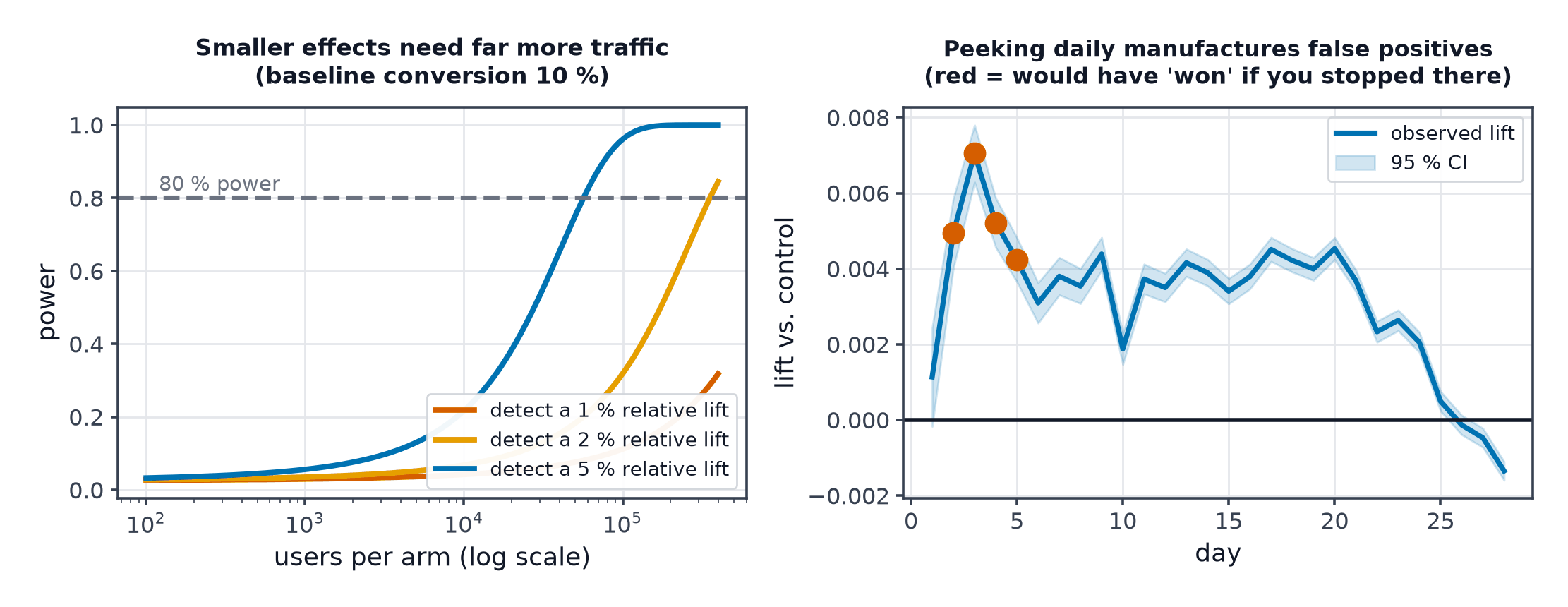
The required sample size (per arm) for a two-proportion test, given a target minimum detectable effect , baseline rate , and desired significance/power — computed before launching, so the test runs for a pre-determined duration rather than an ad-hoc "until it looks done."
Novelty and primacy effects
Novelty effect: users react differently to something new simply because it's new, independent of its actual merit — inflating early results in a way that fades. Primacy effect: users initially resist a change out of habit, understating a genuinely better variant's true effect until they adjust. Both distort short-duration test results in opposite directions, and are a reason to run tests long enough to let the initial reaction settle.
Peeking, and why it inflates false positives
Checking a test's results repeatedly and stopping as soon as significance is reached ("peeking") inflates the false-positive rate substantially above the nominal significance level — each additional look is another chance for noise to cross the significance threshold by pure luck. Fixed test duration, decided in advance, or a properly-designed sequential testing method (not ad-hoc peeking) are the two valid alternatives.
Interference between arms
If treatment and control users interact with each other (a marketplace, a social network), one arm's behaviour can leak into and contaminate the other — violating the independence assumption underlying standard A/B test statistics, and requiring specialised experimental designs (cluster randomisation, for instance) to address correctly.
Interleaving for ranking systems
For ranking or recommendation systems specifically, interleaving — mixing results from both the control and treatment ranker into a single list shown to the same user, then attributing engagement to whichever ranker each clicked result came from — is often far more statistically sensitive than a standard between-user A/B test, detecting smaller true differences with much less traffic.
Multi-armed bandits as the alternative to a fixed split
Rather than a fixed 50/50 (or other static) split for the whole test duration, a Exploration Strategies-style multi-armed bandit dynamically shifts traffic toward the better-performing arm as evidence accumulates — trading some statistical rigour (a fixed-split test's interpretation is cleaner) for reduced regret (less traffic wasted on the losing arm during the test itself).
Reading a result honestly, including the null one
A test that finds no significant difference is not a failed test — it's informative evidence that the new model didn't help (at least on the metric and effect size tested), and reporting it honestly (rather than searching post-hoc for a subgroup where it "worked") is what keeps the whole experimentation process trustworthy over time.
| Symbol | Meaning |
|---|---|
| the minimum detectable effect | |
| required sample size per arm |
Code: a sample-size calculator, and simulating false-positive inflation from peeking
import numpy as np
from scipy.stats import norm

def sample_size_two_proportion(baseline_rate: float, min_detectable_effect: float,
                                 alpha: float = 0.05, power: float = 0.8) -> int:
    z_alpha = norm.ppf(1 - alpha / 2)
    z_beta = norm.ppf(power)
    p = baseline_rate
    n = 2 * (z_alpha + z_beta) ** 2 * p * (1 - p) / (min_detectable_effect ** 2)
    return int(np.ceil(n))

n_required = sample_size_two_proportion(baseline_rate=0.10, min_detectable_effect=0.02)
print(f"required sample size per arm: {n_required}")

# --- Simulate the false-positive inflation caused by repeated peeking ---
rng = np.random.default_rng(0)

def run_ab_test_with_peeking(n_peeks, true_rate=0.10, n_per_peek=100):
    """Both arms have the SAME true rate (no real effect) — any 'significant' result is a false positive."""
    control, treatment = [], []
    for _ in range(n_peeks):
        control.extend(rng.binomial(1, true_rate, n_per_peek))
        treatment.extend(rng.binomial(1, true_rate, n_per_peek))
        p_control, p_treatment = np.mean(control), np.mean(treatment)
        n = len(control)
        pooled = (p_control + p_treatment) / 2
        se = np.sqrt(2 * pooled * (1 - pooled) / n)
        z = (p_treatment - p_control) / se if se > 0 else 0
        if abs(z) > 1.96:  # "significant" at alpha=0.05
            return True  # stopped early on a false positive
    return False

n_trials = 500
false_positive_rate_no_peeking = np.mean([run_ab_test_with_peeking(n_peeks=1, n_per_peek=1000) for _ in range(n_trials)])
false_positive_rate_with_peeking = np.mean([run_ab_test_with_peeking(n_peeks=10, n_per_peek=100) for _ in range(n_trials)])

print(f"\nfalse-positive rate, single fixed-duration look: {false_positive_rate_no_peeking:.3f}  (should be near 0.05)")
print(f"false-positive rate, 10 peeks with early stopping: {false_positive_rate_with_peeking:.3f}  (inflated)")
See also
- Offline Evaluation — the gate an online test only runs after already passing.
- Monitoring and Observability — the always-on measurement an A/B test's guardrail metrics feed into.