Seq2Seq and Encoder-Decoder
Translation, summarisation, and question answering all share a structural challenge: the input and output are both sequences, but rarely the same length, and the alignment between them isn't fixed. The encoder-decoder architecture solved this by splitting the problem into two halves — compress the input, then generate the output — and it framed the field's central problem for the next several years, including the one it couldn't quite solve on its own.
Compress the input into a state, then generate the output from it — and the compression step is exactly where the architecture fails.
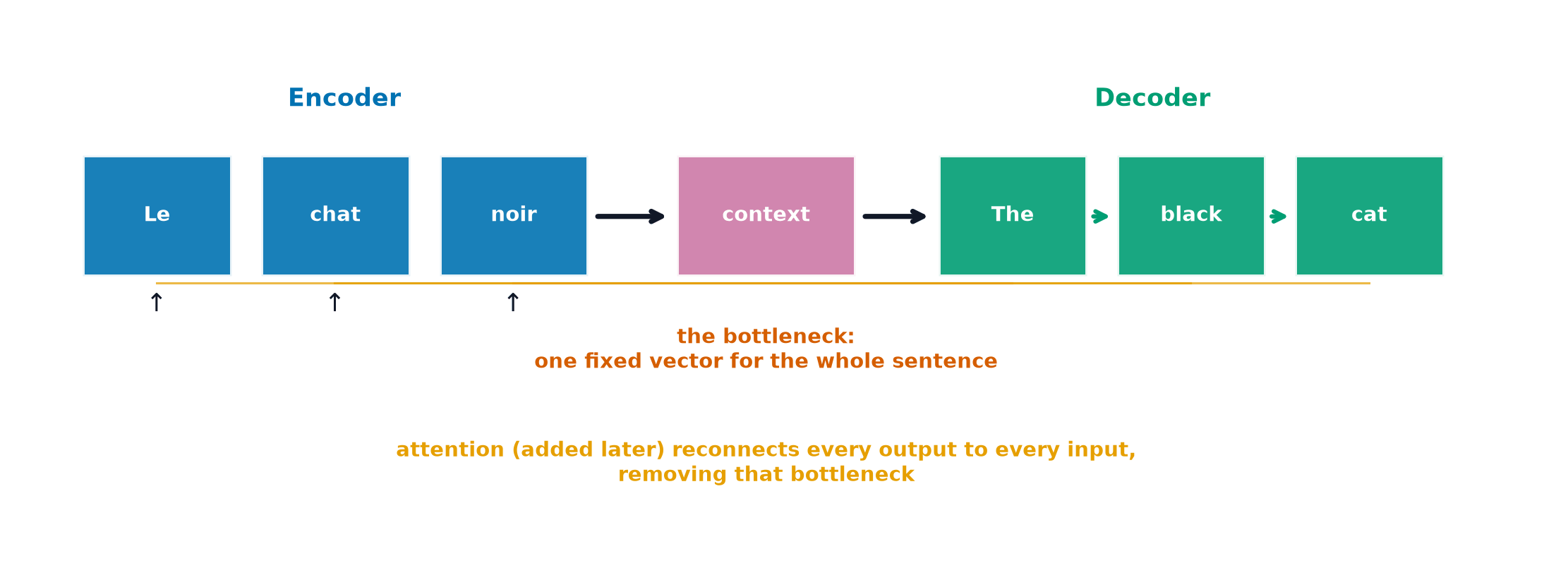
The task shape
Unlike Recurrent Neural Networks's sequence-to-one or one-to-sequence cases, translation genuinely needs sequence-to-sequence: variable input length, variable (and generally different) output length, with no assumed one-to-one alignment between input and output positions.
The encoder
An RNN (typically LSTM/GRU — see LSTM and GRU) processes the entire input sequence, producing a final hidden state meant to summarise the whole input.
The context vector
The encoder's final hidden state, handed off as the sole initial state for the decoder — every piece of information the decoder will ever have about the input is compressed into this single fixed-size vector.
The decoder
Another RNN, initialised from the context vector, generating the output sequence one token at a time — at each step, it takes its own previous output as input for the next step (the autoregressive generation pattern from Language Modeling Basics).
Teacher forcing in this setting
During training, the decoder is fed the true previous output token (from the training target sequence) rather than its own prediction — the same teacher-forcing pattern and the same exposure-bias gap described in Language Modeling Basics, here applying specifically to the decoder half of the architecture.
The fixed-size bottleneck, and the evidence for it
Every piece of information about a 50-word input sentence must be squeezed into the same fixed-size vector as a 5-word one — and empirically, translation quality (measured by BLEU and similar metrics) degrades measurably as input sentence length grows, exactly the symptom you'd expect if the fixed-size context vector is losing information proportional to how much it's being asked to compress.
Why this bottleneck motivated attention
If the decoder could instead look back at all of the encoder's intermediate hidden states — not just the single final one — it could pull exactly the information relevant to generating each output token, rather than relying on everything having survived compression into one vector. That's precisely the fix Attention Mechanism introduces on the next page.
| Symbol | Meaning |
|---|---|
| context vector | the encoder's final hidden state, the decoder's only view of the input |
| the conditional generation objective, factorised over output positions |
Beam search, introduced
Rather than greedily picking the single most probable token at each decoder step (which can lock in an early mistake that a full sequence-level view would have avoided), beam search keeps the top- partial sequences at each step, expanding all of them and keeping only the overall top- continuations — a search strategy that trades compute for a better approximation of the highest-probability complete sequence. Full treatment, including why beam search's benefits are more nuanced than they first appear, in Decoding Strategies.
Encoder-decoder vs. decoder-only
This page's architecture has two separate stacks (encoder, decoder) with the context vector as the sole bridge between them. Transformer Variants covers the modern landscape, including decoder-only architectures that dispense with a separate encoder entirely, processing input and generating output within a single stack — the architecture behind most current large language models.
Tasks that still suit encoder-decoder
Despite decoder-only models' dominance for open-ended generation, encoder-decoder architectures (T5-style) remain a strong, sometimes preferred choice for tasks with a clear, bounded input-to-output transformation — translation, summarisation, and similar tasks where the "input" and "output" roles are genuinely distinct rather than a continuous conversational stream.
Code: an LSTM encoder-decoder on a synthetic transduction task, quality vs. length
import torch
import torch.nn as nn

class Encoder(nn.Module):
    def __init__(self, vocab_size, embed_dim, hidden_dim):
        super().__init__()
        self.embed = nn.Embedding(vocab_size, embed_dim)
        self.lstm = nn.LSTM(embed_dim, hidden_dim, batch_first=True)
    def forward(self, x):
        _, (h, c) = self.lstm(self.embed(x))
        return h, c  # the context vector (both LSTM states)

class Decoder(nn.Module):
    def __init__(self, vocab_size, embed_dim, hidden_dim):
        super().__init__()
        self.embed = nn.Embedding(vocab_size, embed_dim)
        self.lstm = nn.LSTM(embed_dim, hidden_dim, batch_first=True)
        self.out = nn.Linear(hidden_dim, vocab_size)
    def forward(self, x, h, c):
        output, (h, c) = self.lstm(self.embed(x), (h, c))
        return self.out(output), h, c

# --- Toy task: reverse a sequence of digit-tokens ---
vocab_size, embed_dim, hidden_dim = 12, 16, 32  # 10 digits + <bos> + <eos>
BOS, EOS = 10, 11
encoder = Encoder(vocab_size, embed_dim, hidden_dim)
decoder = Decoder(vocab_size, embed_dim, hidden_dim)
optimizer = torch.optim.Adam(list(encoder.parameters()) + list(decoder.parameters()), lr=0.01)

def make_batch(seq_len, batch_size=32):
    src = torch.randint(0, 10, (batch_size, seq_len))
    tgt = src.flip(dims=[1])  # the "translation" task: reverse the sequence
    tgt_in = torch.cat([torch.full((batch_size, 1), BOS), tgt[:, :-1]], dim=1)  # teacher forcing input
    return src, tgt_in, tgt

for step in range(500):
    src, tgt_in, tgt = make_batch(seq_len=6)
    optimizer.zero_grad()
    h, c = encoder(src)
    logits, _, _ = decoder(tgt_in, h, c)
    loss = nn.functional.cross_entropy(logits.reshape(-1, vocab_size), tgt.reshape(-1))
    loss.backward()
    optimizer.step()

# --- Quality vs. input length: reproducing the bottleneck symptom ---
print("seq_len | accuracy")
for seq_len in [4, 6, 10, 15, 20]:
    src, tgt_in, tgt = make_batch(seq_len, batch_size=64)
    with torch.no_grad():
        h, c = encoder(src)
        logits, _, _ = decoder(tgt_in, h, c)
    preds = logits.argmax(dim=-1)
    acc = (preds == tgt).float().mean().item()
    print(f"{seq_len:7d} | {acc:.3f}")
Accuracy should visibly decline as seq_len grows well beyond what the model was trained on — the fixed-size context vector's information bottleneck, reproduced directly.
See also
- LSTM and GRU — the recurrent cell typically used inside both the encoder and decoder.
- Attention Mechanism — the fix for exactly the bottleneck this page identifies.