Text Preprocessing and Tokenization
Models don't see text — they see a sequence of integers, and every choice about how those integers are assigned decides what the model can and can never learn. A tokeniser that splits "unbelievable" into three pieces lets the model reuse what it learned about "un-" and "-able" elsewhere; a tokeniser that treats it as one opaque unit has no such option.
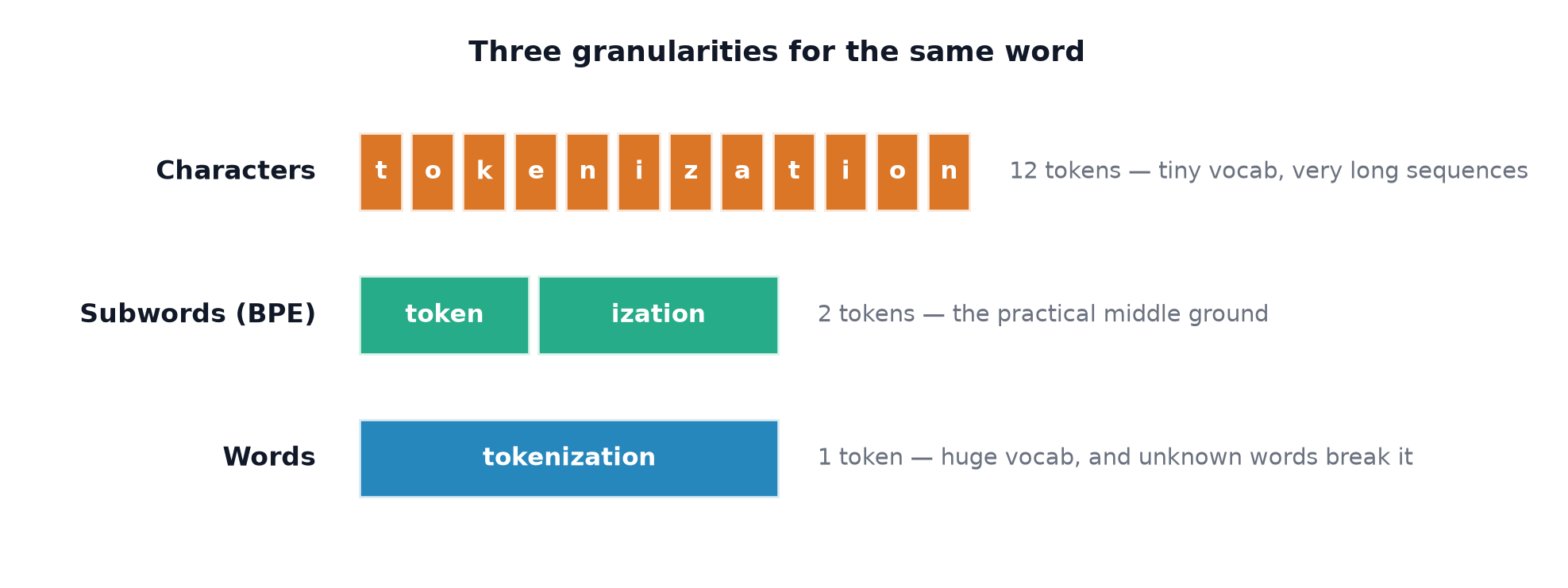
Subword tokenisation is the compromise between an unbounded word vocabulary and a character sequence too long to model.
The classic pipeline, and why most of it is obsolete
Older NLP pipelines lowercased text, stripped punctuation, applied stemming (crudely chopping suffixes) or lemmatisation (reducing to a dictionary root), and removed "stop words" (common function words like "the," "is"). Modern subword tokenisers and large pretrained models learn to handle case, morphology, and function words directly from data — most of this classic pipeline is now unnecessary, and can actively hurt performance by discarding information (case can be meaningful; "not" is a stop word that changes meaning entirely if removed).
Word-level vocabularies and the out-of-vocabulary problem
The simplest tokeniser: one token per whitespace-separated word, with a fixed vocabulary built from training data. Any word not seen during vocabulary construction becomes an unknown-token, <UNK> — a hard ceiling that no amount of model capacity can fix, since the information in that word is simply discarded.
Character-level and its sequence-length cost
Tokenising by individual character eliminates the out-of-vocabulary problem entirely (every possible string is representable), but produces sequences many times longer than word-level tokenisation for the same text — and since Self-Attention in Depth's cost scales quadratically with sequence length, this is a serious practical cost, not just an inconvenience.
Subword tokenisation
The compromise: split rare/unknown words into smaller, reusable pieces, while keeping common words as single tokens. "unbelievable" might become ["un", "believ", "able"] — three tokens the model has seen many times in other contexts, rather than one token it has never seen at all.
BPE (Byte-Pair Encoding), walked through
Start with a vocabulary of individual characters. Repeatedly find the most frequent adjacent pair of tokens in the training corpus and merge it into a single new token, adding it to the vocabulary. Repeat for a fixed number of merges (the target vocabulary size).
Worked example on a toy corpus "low low lower lowest": start with characters l o w e r s t; the pair (l, o) is most frequent, merge into lo; then (lo, w) merges into low; then (e, r) merges into er, and so on — each merge is chosen purely by frequency, with no linguistic rules involved.
WordPiece and its likelihood criterion
Similar iterative merging, but instead of choosing the most frequent pair, WordPiece chooses the pair that most increases the training corpus's likelihood under a simple language model built from the current vocabulary — a subtly different objective from BPE's pure frequency count, used by BERT-family models.
SentencePiece
Treats the input as a raw stream of Unicode characters (including spaces, encoded as a special symbol) rather than assuming whitespace-delimited words — this makes it language-agnostic, correctly handling languages like Japanese or Chinese that don't use whitespace to separate words, unlike BPE/WordPiece implementations that assume a pre-tokenisation step splits on whitespace first.
| Symbol | Meaning |
|---|---|
| vocabulary size | total number of distinct tokens the tokeniser can produce |
| merge | one BPE/WordPiece step, combining two existing tokens into a new one |
Special tokens
[CLS] (a token whose final representation is used as a whole-sequence summary, common in BERT-style models), [SEP] (marks a boundary between two segments, e.g. question and context), [PAD] (fills sequences to a common length for batching), [BOS]/[EOS] (beginning/end of sequence, common in generative models).
Vocabulary size as a design trade
A larger vocabulary means shorter sequences (more meaning packed per token) but a larger, more expensive embedding table and output layer (whose size scales with vocabulary). A smaller vocabulary means longer sequences but a smaller model. Typical modern vocabularies range from roughly 30,000 to 250,000 tokens depending on the target languages and model scale.
Tokenisation artefacts that bite
Leading-space handling differs subtly between tokenisers (some treat "cat" and " cat" as entirely different tokens); numbers are frequently split in inconsistent, non-obvious ways ("1234" might become ["12", "34"] or four separate digit tokens depending on the tokeniser); non-Latin scripts often require more tokens per character than Latin script under the same tokeniser, meaning the same sentence meaning costs more tokens (and therefore more compute, and more money against a per-token API price) in some languages than others; and a trailing-whitespace mismatch between a prompt's end and a generation's expected start is a classic, hard-to-spot generation bug.
Counting tokens for cost
Because API pricing and context-window limits are denominated in tokens, not characters or words, knowing the tokeniser-specific token count of a piece of text (not just its length) is directly relevant to both cost estimation and fitting within context limits.
Code: BPE from scratch, then a real tokenizer, then the script-cost demo
from collections import Counter, defaultdict

def get_pair_counts(corpus):
    counts = Counter()
    for word_tuple, freq in corpus.items():
        for i in range(len(word_tuple) - 1):
            counts[(word_tuple[i], word_tuple[i+1])] += freq
    return counts

def merge_pair(pair, corpus):
    new_corpus = {}
    for word_tuple, freq in corpus.items():
        merged, i = [], 0
        while i < len(word_tuple):
            if i < len(word_tuple)-1 and (word_tuple[i], word_tuple[i+1]) == pair:
                merged.append(word_tuple[i] + word_tuple[i+1]); i += 2
            else:
                merged.append(word_tuple[i]); i += 1
        new_corpus[tuple(merged)] = freq
    return new_corpus

text = "low low lower lowest lowest"
corpus = Counter(tuple(w) + ("</w>",) for w in text.split())

print("initial:", dict(corpus))
for step in range(6):
    pairs = get_pair_counts(corpus)
    if not pairs: break
    best_pair = max(pairs, key=pairs.get)
    corpus = merge_pair(best_pair, corpus)
    print(f"merge {step+1}: {best_pair} -> vocabulary now includes {''.join(best_pair)}")

# --- A real tokenizer, for comparison ---
from transformers import AutoTokenizer
tokenizer = AutoTokenizer.from_pretrained("distilgpt2")
tokens = tokenizer.tokenize("unbelievable subword tokenization")
print("\nreal tokenizer output:", tokens)
print("token ids:", tokenizer.encode("unbelievable subword tokenization"))

# --- Same meaning, different token cost across scripts ---
for text, label in [("Hello, how are you?", "English"), ("こんにちは、元気ですか?", "Japanese")]:
    n_tokens = len(tokenizer.encode(text))
    print(f"{label}: {n_tokens} tokens for {len(text)} characters")
See also
- Word Embeddings — turning these token ids into continuous vectors.
- Language Modeling Basics — what the model actually predicts, one token at a time.